
To get your product in stores, prove four things to a buyer: margin, supply, compliance and demand. Then start with independent shops or a regional chain, get found through supplier portals, RangeMe or a broker, pitch with numbers, and sell through fast enough to stay. Target’s accelerator team says it can take six to nine months from a yes to the shelf.
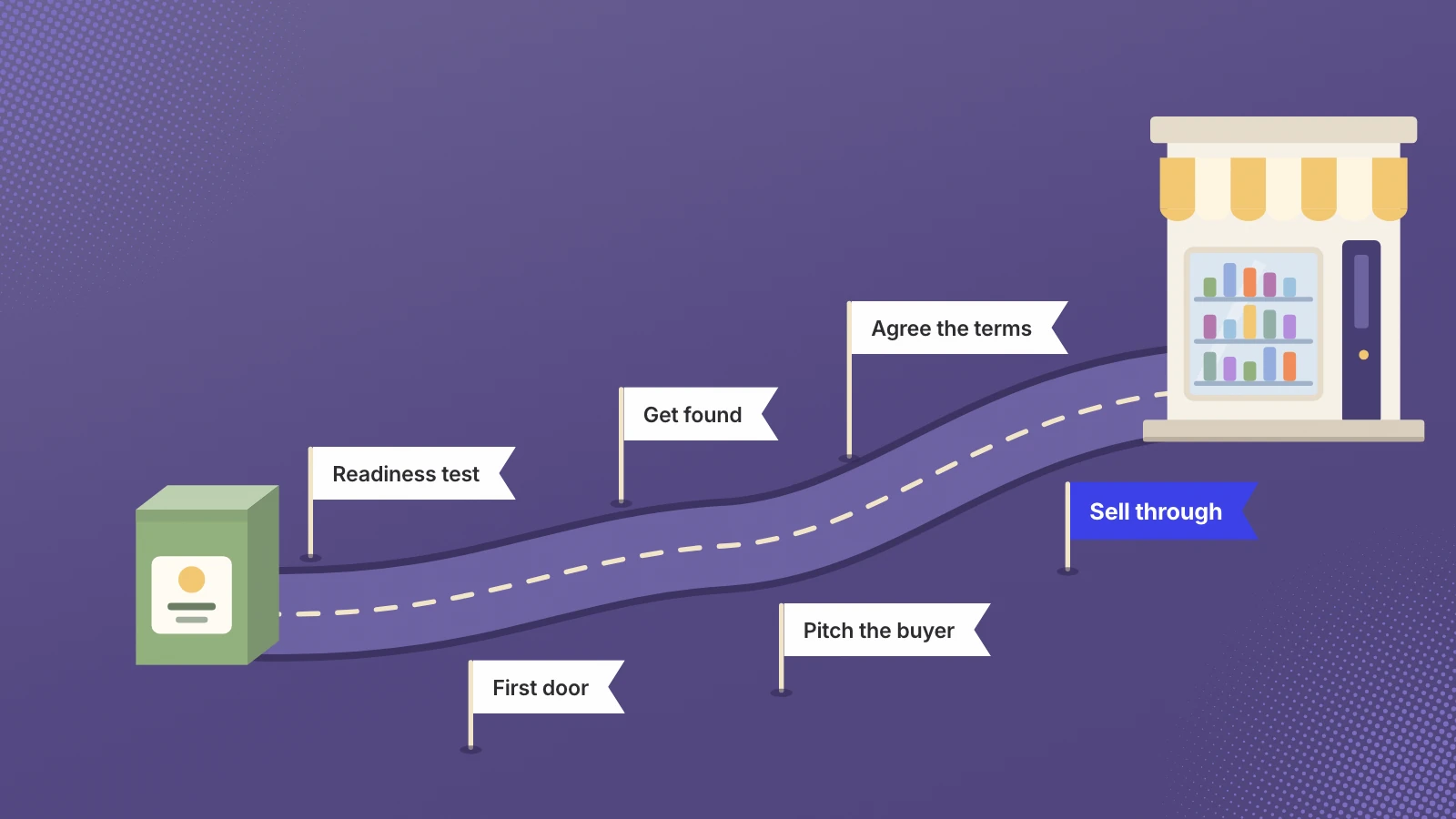
To get your product in stores, you have to show a buyer that it earns the space: the margin works, you can supply it, it meets the retailer’s rules, and shoppers already want it. Then you pick a first door you can actually serve, get found, pitch, agree the terms, and sell fast enough to keep the spot. These are the six stages, each with its own detailed guide below:
- Pass the readiness test. Margin, supply, compliance and demand.
- Choose your first door. Independent shops, a regional chain or a national retailer.
- Get found. Supplier portals, RangeMe, trade shows, brokers and accelerators.
- Pitch the buyer. A sell sheet, samples and numbers the buyer can check.
- Agree the terms. Price, slotting, compliance and who takes which margin.
- Launch and sell through. Marketing near the stores, and the velocity that keeps you there.
A note on where this comes from. I have not sold a product into a retailer myself. This guide is built from retailers’ own supplier pages, the companies that sit between brands and stores, and named trade reporting, each linked where it is used.
Is your product ready for retail?
Buyers are short of shelf space, not products. Target’s accelerator team says buyers are approached by hundreds of brands every day, while a category may have only a handful of open spots a year (Target Accelerators). Before you take one of those meetings, pass four tests:
- Margin. The store has to make money on you. Faire tells brands new to wholesale that shops typically need a 50% margin, twice your wholesale price, and a chain that buys through a distributor adds the distributor’s cut on top. Work it back from the shelf price with our wholesale pricing guide.
- Supply. Can you fill every reorder on time, at volume, from a facility the retailer accepts? UNFI, for one, asks new suppliers for a third-party food safety audit certificate (SPS Commerce).
- Compliance. GS1 barcodes, product liability insurance, EDI and labels that meet the rules. Our compliance guide covers UPCs, EDI and chargebacks.
- Demand. Evidence that shoppers already buy: sales, reorders, reviews and posts by real customers. KeHE scores the brands at its discovery events on criteria including early traction and velocity indicators (KeHE). What buyers look for on your social media covers what counts as proof.
Can you get a homemade product into stores?
Rarely straight from a home kitchen. FDA says a private residence is not a “facility” and does not register with it, but any facility that makes, processes, packs or holds food for sale must register before it starts, and state and local rules apply on top. Home producers sell under state cottage food laws, and the Harvard Law School Food Law and Policy Clinic’s 50-state survey, updated in December 2021, found that most states only allow “direct” sales of food made at home, read differently state by state. The Association of Food and Drug Officials keeps a section of rules for each state.
Retailers ask for more again. Whole Foods lists liability insurance and production in a certified commercial facility among the requirements for brands in its LEAP accelerator. So plan the move to a licensed commercial kitchen or a co-packer before you pitch a store, and check what your state allows first. This is not legal advice.
Which stores should you approach first?
Start smaller than feels ambitious. Warren Wilson, Target Accelerators’ founder in residence, suggests approaching smaller, local and regional retailers before national ones. There are three first doors, plus two side doors:
- Independent shops. Sell to them direct, deliver yourself, or list on Faire, which takes 15% plus a $10 first-order fee when a shop finds you on its marketplace and 0% when you bring the shop (Faire). Brokers, distributors and marketplaces compares the routes.
- A regional chain. UNFI says it supplies independent, regional and national grocers (UNFI), so a regional buyer may want you through a distributor. Win the buyer, then bring the order to the distributor.
- A national retailer. Each has its own front door, set out in the retailer guides below. Most are a second step, not a first.
- Side doors. Retailer accelerator programs, such as Whole Foods’ LEAP, and pitch events like Walmart Open Call, which is only for items made, grown or assembled in the U.S. (Walmart).
A broker I spoke with this spring told me founders new to packaged goods tend to chase more doors and more retailers early, which feels right but is expensive and hard to sustain (more from that conversation). There is a data reason to go slowly too: SPINS notes that a brand’s first stores usually sell best when it built local recognition before launch. Prove the product in a few stores, then expand.
How do you get your product into grocery stores?
Grocery buys category by category, often on a calendar. Sprouts’ new item page shows the mechanics: most categories take submissions year-round, but some follow a submission calendar with one window for every new item; accepted items must be at the distributor or warehouse two weeks before the test set date; and a grocery item needs two retail-ready samples, an ingredient statement, a nutrition facts panel and an allergen statement. RangeMe emails Premium suppliers about upcoming category reviews at participating retailers on the first Tuesday of each month, a sign that other grocers run on calendars too.
A sensible order for a food or drink brand: independent grocers near you, then natural and specialty stores, often through a distributor such as KeHE or UNFI, then a regional chain, then national. Time each pitch to the category’s window, because a missed window can mean waiting for the next one.
How do retail buyers find new products?
Through five channels, and a small brand should be findable in most of them:
- Supplier portals and RangeMe. Of the eight retailers in the guides below, five take submissions through their own form or portal, two send you to RangeMe, and Costco asks you to contact a buying office. A RangeMe profile with up to 3 products is free, and paid plans run $99 to $2,499 a year (RangeMe). KeHE takes every new product submission through it.
- Trade shows and matched buyer meetings. Our pitching guide lists the main shows, their 2027 dates and how pre-booked buyer meetings work.
- Brokers. Paid on commission to put you in front of buyers they know; see what a food broker charges.
- Accelerators and open calls. Competitive, but they put you in a room with buyers who asked to be there.
- Scouting. KeHE wrote in 2022 that its team visits around 30 farmers markets a year looking for early-stage brands (KeHE). The stores and markets you sell at now are part of your pitch.
How do you pitch a retail buyer?
With a sell sheet, samples and numbers a buyer can check, in less time than you expect: KeHE’s Trend Finder pitches run 20 minutes. Lead with who buys the product and how fast it sells where it is already stocked, then the margin the store makes and how you will drive shoppers to the shelf. How to pitch a retail buyer has the sell sheet and line sheet templates, the questions buyers ask and a follow-up schedule.
What terms will a retailer ask you to accept?
More than a price. Read each of these against your margin before you sign:
- Your wholesale price and the margin chain. How to price for wholesale and retail works from shelf price back to cost.
- Slotting fees and free fill. What some retailers charge to stock a new item, and how small brands negotiate them: our slotting fees guide.
- Barcodes, EDI, routing guides and chargebacks. The paperwork that decides whether you get paid in full: UPC, EDI and chargebacks.
- Broker commission and distributor margin. Oklahoma State University Extension puts broker commissions at 5% to 8% and Farm Credit Canada at 3% to 5%; distributor margins come on top.
Have a lawyer read the supplier agreement. Nothing here is legal, tax or accounting advice.
What happens after you get the order?
The job changes from selling the buyer to selling the shopper. Target’s accelerator team says it could be six to nine months from the award of business to the shelf, and is blunt about what comes next: velocity doesn’t just happen when you appear at a retailer, so you have to invest in marketing to build awareness. SPINS says some retailers set velocity targets for each category, and items that keep missing them risk discontinuation.
- Your first 90 days on shelf: a week-by-week launch marketing plan from the purchase order to day 90.
- Sell-through rate and velocity: the formulas, a worked example, and what happens to slow sellers at a line review.
Retailer guides
Each retailer has its own front door. Here is where each one starts, from its own pages, and the guide that covers the rest:
| Retailer | Where you start | Our guide |
|---|---|---|
| Target | The Supplier Intake Form; Target Plus, its online marketplace, is invite-only | Getting into Target |
| Walmart | Self-registration, which Walmart says does not guarantee an agreement | Getting into Walmart |
| Costco | Food and sundries: one of 8 US division offices; non-food: the corporate office in Issaquah, Washington | Getting into Costco |
| Whole Foods Market | The Supplier Portal and Potential Supplier Form; it warns it cannot guarantee a reply | Getting into Whole Foods |
| Sephora | A RangeMe profile, shared with Sephora’s merchandising team | Getting into Sephora |
| Ulta Beauty | A RangeMe profile matched to the right category buyer | Getting into Ulta Beauty |
| Trader Joe’s | The Potential Vendor form; it contacts you only if the product fits | Getting into Trader Joe’s |
| Erewhon | The Submit a Product form linked from its site; its portal declines disallowed ingredients automatically, and reviews run monthly (Beauty Independent) | Getting into Erewhon |
Where does marketing fit?
At both ends of the path: before the pitch, as proof that shoppers want the product, and after launch, as the reason they look for it on the shelf. That demand side is the only part of this guide Leo works on. Leo for consumer brands turns footage you already own into daily posts, and runs creator campaigns that look for creators whose followers match your buyers; FitCommit’s campaign found 124 creators, and 17 said yes. For the launch itself, Leo’s launch video studio cuts a 30 to 45 second launch video from your footage, from $500 in 5 working days.
None of that gets a product into a store: Leo does not broker, distribute or pitch products, and has no relationship with any retailer named here. It makes the demand you already have easier for a buyer to see. If you are working through these stages now, start that part early, because it takes longest to build: see how Leo works for consumer brands.
Prove it small, sell it through, then ask for more doors.
Sources
- Target Accelerators, Navigating wholesale partnerships as a small business
- Target, Suppliers
- Walmart, Apply to be a supplier
- Walmart, Open Call FAQs
- Costco, Vendor inquiries
- Whole Foods Market, Information for potential suppliers
- Sephora, Finding products: potential Sephora vendors
- Ulta Beauty, Merchandising product submissions
- Trader Joe’s, Potential vendor form
- Erewhon, Submit a product
- Beauty Independent, How beauty brands make the cut at, and get cut from, Erewhon
- Faire, Pricing policy for US and Canada based brands
- Faire, How much does it cost to sell on Faire if I’m based in North America?
- UNFI, Press release with company overview, 9 July 2026
- SPS Commerce, How to become a supplier for UNFI
- KeHE, Trend Finder product discovery events
- KeHE, 3 ways distributors discover products
- RangeMe, Plans and pricing for suppliers
- Sprouts Farmers Market, New item submission process
- RangeMe, What is RangeMe Premium?
- FDA, How to start a food business
- Harvard Law School Food Law and Policy Clinic, Cottage foods and home cooking: fifty-state survey
- Association of Food and Drug Officials, Cottage food regulatory guidance
- SPINS, CPG glossary: velocity
- SPINS, Mastering sales velocity
- Oklahoma State University Extension, Are food brokers right for you? (FAPC-130)
- Farm Credit Canada, Broker or distributor? How to choose the best option for your product
Written by Lera Leonteva. Leo AI makes social video and runs creator campaigns for consumer brands, so we have a commercial interest in the marketing part of this guide. Retailer facts are from each retailer’s own pages, read November 2026.