
Retail buyers look on your social media for proof that people already want your product: sales and repeat buyers, reviews, customers posting about you unprompted, creators who fit, and content good enough to sell from. No retailer publishes a follower minimum. Target’s readiness checklist asks whether you have “an engaged online audience,” not how big it is.
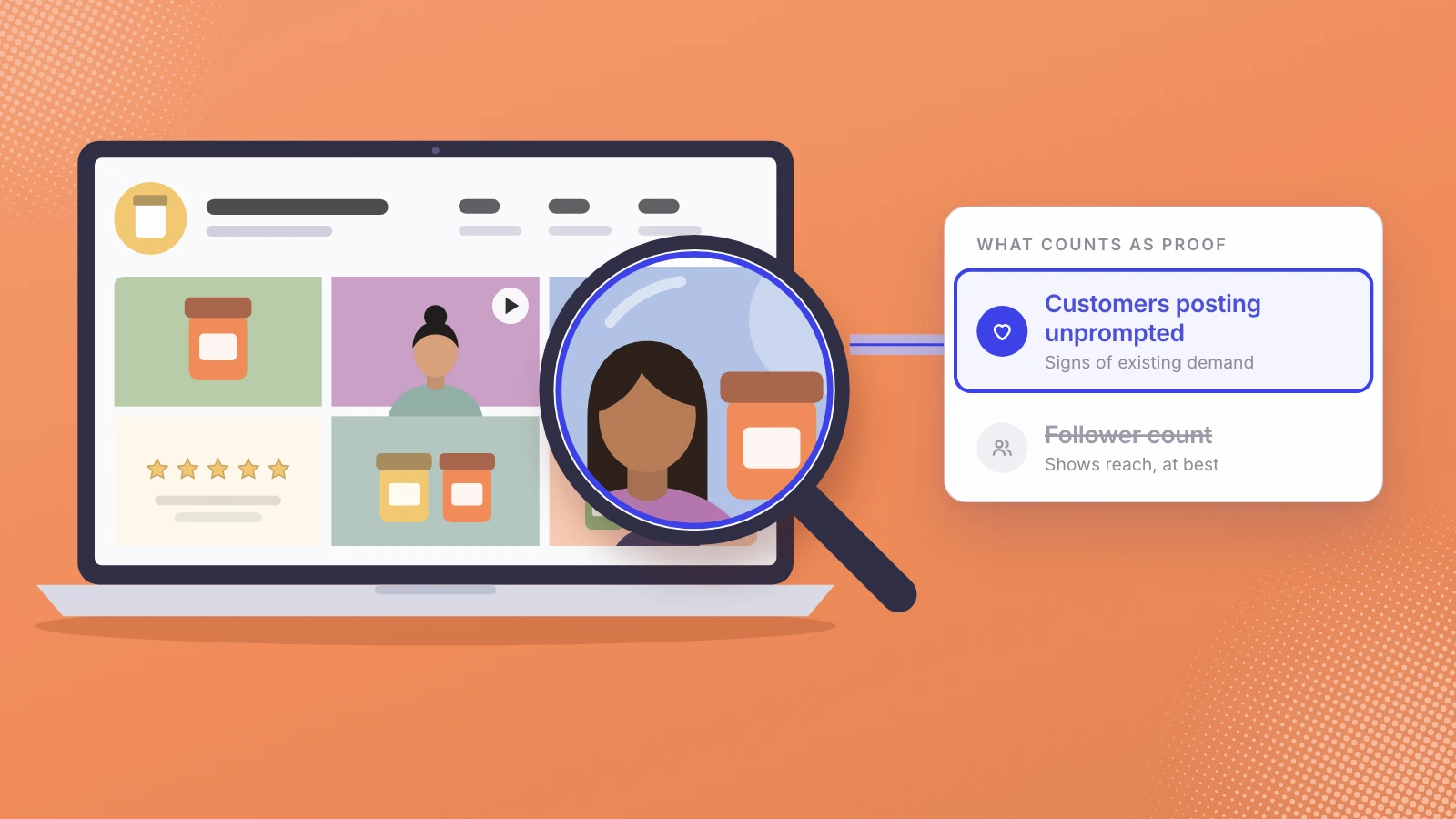
What retail buyers look for on your social media is evidence: signs that people already want what you sell, and that you can keep them wanting it after launch. I have never sold a product into a retailer myself, so this post sets out what retailers and their accelerator programs say in public, next to one conversation I had this spring with someone who does it for a living.
Followers are not the test. Visible, repeatable demand is.
What do buyers check when they look you up?
This spring I spoke with a sales broker who sells small food and beverage brands into retailers and helps those brands with revenue plans and trade-spend budgets. Their view was that buyers look through a brand’s social channels, and through posts by its customers, for signs of existing demand before they take the brand on. In their experience, a brand that already has a large following and a strong direct-to-consumer business is more likely to get shelf space, and buyers look at the quality of the content too.
The broker added two warnings. Founders who are new to consumer packaged goods tend to chase more doors and more retailers early, which feels right but is expensive and hard to sustain. And a lot of creator buzz comes down to luck: a viral moment fades within about a week.
That is one broker’s view, from food and beverage, not any retailer’s policy. But most of it lines up with what retailers publish themselves.
Do retailers care about social media followers?
They care about what followers prove. Target Accelerators’ readiness checklist says: “Retailers want to see proof that your product can succeed.” It asks founders to show proven sales, a strong digital presence and brand buzz. Under digital presence it asks whether you have “an engaged online audience on social media platforms” and “a strong community around your brand that subscribes to your brand’s dedicated emails.”
Beauty retailers say similar things. Sephora Accelerate’s criteria ask: “Do you have a polished prototype or real buzz from customers and fans?” Ulta gives its extra MUSE award on sales growth, whitespace opportunity and community impact. And George Tsoukalas, general manager of Sephora in Australia and New Zealand, told Inside Retail in November 2026: “Our decisions are informed by customer behaviour, search trends, social conversations and Beauty Advisor feedback.”
Notice the caveat that comes with it. Tsoukalas also said: “We look beyond social hype to assess product differentiation, local relevance and long-term potential.” Leigh Quilhot, who runs merchandising for several categories at Bluemercury, told Fashionista it is “important not to conflate a brand with a really robust digital media budget with a brand that is actually really resonating with the customer and going to actually convert.”
Buyers also want the marketing to continue once you are on shelf. Target’s April 2026 guide to retail readiness puts it in one line: “Retail buyers want to see brands investing in velocity drivers beyond launch.”
How many followers do you need to get into Target?
There is no published number. For this series I read Target’s supplier pages and Accelerators guides, Sephora’s and Ulta’s product submission pages and both beauty accelerators’ criteria, and none names a follower count. Target’s supplier platform lists its decision criteria as category fit, industry experience, scalable capabilities, capacity, safety and compliance, category requirements, cost and insurance.
Your accounts do get looked at. SPS Commerce’s walkthrough of Target’s Supplier Intake Form lists “Social media accounts/URLs” among the company details it asks for. What a buyer finds there matters more than the count. Target’s checklist is also blunt about timing: “Mass retail should not be a first step.” How to get your product into Target covers the rest of Target’s process.
What counts as proof, and what is a vanity number?
A useful test is whether the signal would survive if you stopped paying for it. Here is how the usual signals compare:
| Signal | Why it counts | The weak version |
|---|---|---|
| Sales and repeat purchase | Target Accelerators asks for proven sales, and says buyers ask about velocity and repeat purchase in every line review | Launch-week revenue with no reorders |
| Reviews | Target’s guide lists customer reviews as social proof that builds confidence at shelf | A few five-star reviews from friends |
| Customers posting unprompted | It is the existing demand the broker said buyers look for | Reposts of your own ads |
| Creator posts | Creators whose followers match your shoppers put you in front of the right people | One big creator with the wrong audience |
| Content quality | Target’s guide suggests short-form video that explains the benefits and shows the product in use | Polished posts nobody comments on |
| Follower count | Shows reach, at best | Followers bought with ad spend, the trap Quilhot describes |
Independent stores read the same signals. Faire, the wholesale marketplace for independent shops, says its 2025 survey of retailers found that researching via social media and among peers drives a majority of their purchasing decisions, and that social proof such as “user-generated content, customer reviews, and store photos of your product on shelves” can influence them.
Why isn’t one viral video proof?
Because it fades, and a buyer is committing shelf space for months. The broker put a viral moment’s life at about a week. Unilever’s chief executive, Fernando Fernandez, was blunter when he spoke to investors on 4 November 2026: “the lifespan of a video today is 4 days.” He told the same investor event that Unilever now works with 500,000 content creators. It doesn’t rely on one video, and neither should you.
Target’s Accelerators site says the same about launches. In a July 2026 piece on expansion, Jen Hagness, who has advised brands for 20 years, writes that the spike around a launch is real but temporary, and that buyers want brands that keep driving traffic to shelf. She calls chasing doors without building velocity “one of the most common and most expensive mistakes emerging brands make,” which is close to what the broker told me. What keeps you on the shelf is sell-through and velocity, and steady demand feeds both.
A six-month plan to build proof before you pitch
Six months is my estimate, not a retailer rule. It is long enough to show a trend instead of a spike.
- Month 1: choose the retailer and audit your feed. Pick one retailer; the founder’s guide to retail helps you choose. Then look at your profile as a stranger would: bio, last 12 posts, tagged posts and reviews. Add tracked links so you can see which posts send people to your site.
- Month 2: post every day from footage you already have. Product demos, how-tos, founder talks, packing orders, behind the scenes. Steady posting keeps the feed alive past the short life of any one video.
- Month 3: make it easy for customers to vouch for you. Ask for reviews in the order email, reshare customer posts with permission, and keep a dated proof log of reviews, tags and messages.
- Month 4: run a small creator campaign. Choose creators whose followers look like your shoppers, not the biggest accounts. The FTC’s guidance says creators should disclose any financial, employment, personal or family relationship with a brand, and free products count. This is not legal advice.
- Month 5: sell somewhere a buyer can see. A local shop, a regional chain or independent stores. Target’s checklist calls regional stores a way to test and scale before national retail. Post the shelf photos.
- Month 6: put the proof on one page. Sales trend, repeat rate, review count and average, three customer posts, creator results and your best clip. It goes behind your sell sheet.
Where Leo fits
I run Leo, so weigh this section accordingly. Leo doesn’t sell to retailers and can’t make a buyer say yes. It does two parts of the plan. Leo for consumer brands indexes the footage you already own, finds the moments worth posting, cuts captioned vertical clips and schedules them, so month 2 doesn’t depend on finding time to edit. On the Pro plan, each post can carry a tracked link in its first comment.
It also runs creator campaigns, and its creator portal checks every submission before you see it: a hook in the first seconds, clear voice, a call to action, the brand named, and video that is vertical, in focus and well lit. For FitCommit, a fitness app, the campaign found 124 creators and 17 said yes, a 13.7% yes rate, with 1.43 million combined followers; 22% of creators reached by email said yes, against 18% by X DM and 4% by Instagram DM. FitCommit sells an app, not a product on a shelf, so read that as one campaign, not a retail benchmark. The full results are on the creator campaigns page.
If you plan to pitch a retailer next year, the six months before the meeting are the part you control. Tell us who buys from you and we’ll show you the creators your shoppers follow, and how many posts are already sitting in your footage. When the order comes, the first 90 days on shelf picks up from there.
A buyer can only judge the demand they can see. Start showing it before you need it.
Sources
- Target Accelerators, Mass retail readiness: what every startup founder should consider
- Target Accelerators, From scrappy to scalable: building a CPG brand ready for retail
- Target Accelerators, The right shelf at the wrong time: why retail expansion isn’t a race
- Target, Supplier discovery and relationship management platform
- SPS Commerce, How to become a Target supplier
- Sephora Accelerate, FAQs
- Ulta Beauty, Ulta Beauty announces 2026 MUSE Accelerator cohort
- Inside Retail, How Sephora is making global beauty feel local in Australia
- Fashionista, Inside beauty retailers’ strategies for discovering emerging brands
- Faire, Webinar recap: level up your social strategy to grow wholesale sales
- Unilever, Investor Event 2026 transcript
- Federal Trade Commission, Disclosures 101 for social media influencers
- The Business of Fashion, Why beauty brands can’t afford to ignore TikTok Shop
Written by Lera Leonteva. Leo AI makes social video and runs creator campaigns for consumer brands, so we have a commercial interest in this subject. Retailer statements are from each retailer’s own pages and named reporting, read November 2026.