
Start with the shelf price and work back. Take off the retailer’s margin (a Massachusetts state guide puts it at 20 to 60%), the distributor’s (20 to 30%), any broker commission (5 to 15%), trade spend and freight. What is left must cover your cost of goods with room to spare. Margin is profit over price; markup is profit over cost.
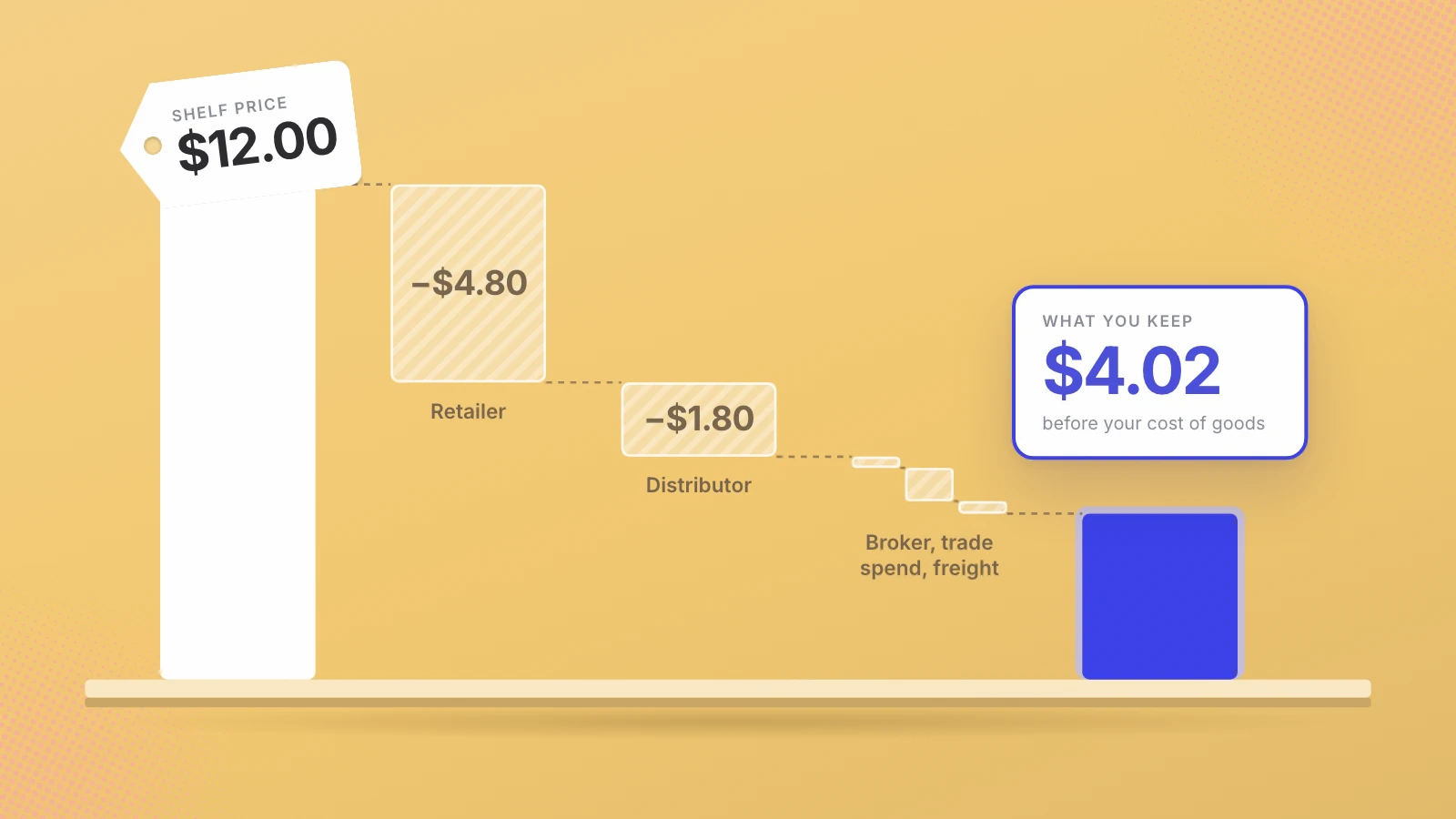
How to price your product for wholesale comes down to the order you do the sums in. Start with the price a shopper will pay on the shelf, take off what each business between you and that shopper keeps, and see what is left for you. If what is left doesn’t cover your cost of goods with room to spare, the product isn’t priced for retail yet. Pricing is one stage of the bigger job in our founder’s guide to getting into retail stores.
Start at the shelf price and subtract. Never start at your cost and add.
How do you price a product for wholesale?
Walk the aisle where your product would sit and note what comparable items sell for. Pick a shelf price inside that range, then subtract in order: the retailer’s margin, the distributor’s margin if you use one, any broker commission, the promotions you will fund (trade spend) and freight.
Manitoba’s agriculture department lays the sequence out in its pricing worksheet: a $5.00 shelf price, less a 40% retailer margin, leaves $3.00; less a 25% distributor margin, $2.25; less 5 cents of freight the manufacturer pays, $2.20. Each margin comes off the price that business sells at, not what it pays.
Margin vs markup: what is the difference?
Margin is profit as a share of the selling price; markup is profit as a share of cost. Buyers talk in margin, and mixing the two up is the quickest way to underprice. The formulas:
- Margin = (price − cost) ÷ price
- Markup = (price − cost) ÷ cost
- Price for a target margin = cost ÷ (1 − margin)
- Price for a target markup = cost × (1 + markup)
- Converting: margin = markup ÷ (1 + markup), and markup = margin ÷ (1 − margin)
Say a store buys your jar for $6.00 and sells it for $10.00. Its margin is $4.00 ÷ $10.00, or 40%. Its markup is $4.00 ÷ $6.00, or 66.7%. A founder who wants a 40% margin on a $6.00 cost and adds 40% gets $8.40, which is a 28.6% margin. The right price is $6.00 ÷ 0.6, or $10.00.
| Margin | Equals a markup of |
|---|---|
| 25% | 33.3% |
| 30% | 42.9% |
| 35% | 53.8% |
| 40% | 66.7% |
| 50% | 100% (keystone) |
What margins do retailers, distributors and brokers take?
The best public ranges come from the state food-business guides of Massachusetts and Montana. Read them as ranges, not quotes:
| Who | Massachusetts guide | Montana guide |
|---|---|---|
| Retailer | 20 to 60% (grocery 20 to 30%, specialty 40 to 60%) | 33 to 50% for the grocer |
| Distributor | 20 to 30% | 20 to 30% |
| Broker | 5 to 15% | 5 to 15% |
The Massachusetts guide adds category detail: about 50% for dry goods, 25 to 30% for produce and dairy, and 40 to 50% for frozen. Montana’s guide notes that major food retailers usually net 2 to 3.5% after all expenses, which is why a grocery buyer defends every point. Brokers and distributors do different jobs for those percentages; our broker and distributor guide compares them.
A worked example: from shelf price back to cost
Here is one product sold through a distributor with a broker. Every rate is an illustrative input inside the ranges above, chosen so the arithmetic is easy to follow:
| Step | Input (illustrative) | Per unit |
|---|---|---|
| Suggested shelf price | $12.00 | |
| Retailer margin | 40% of shelf price | −$4.80 |
| Retailer pays the distributor | $7.20 | |
| Distributor margin | 25% of its selling price | −$1.80 |
| Distributor pays you (your invoice) | $5.40 | |
| Broker commission | 5% of your invoice | −$0.27 |
| Trade spend: promotions, demos, free fill | 15% of your invoice | −$0.81 |
| Freight to the distributor | Flat, per unit | −$0.30 |
| What you keep | $4.02 | |
| Cost of goods | −$2.40 | |
| Your gross profit | 40.3% of what you keep | $1.62 |
The $1.62 is exactly 30% of your invoice, and the shelf price is five times the cost of goods. Montana’s guide quotes one industry expert putting retail at about four times cost of goods on average; this chain needs more because it pays a broker and funds promotions. Sold straight to an independent shop at keystone, the same product would invoice at $6.00.
- Retailer’s cost. Shelf price × (1 − retailer margin): $12.00 × 0.60 = $7.20.
- Your invoice price. Retailer’s cost × (1 − distributor margin): $7.20 × 0.75 = $5.40. Selling direct to the store? Skip this step.
- What you keep. Invoice × (1 − broker % − trade spend %) − freight: $5.40 × 0.80 − $0.30 = $4.02.
- Your margin. (What you keep − cost of goods) ÷ what you keep: ($4.02 − $2.40) ÷ $4.02 = 40.3%.
Trade spend is the line founders leave out most often. Retailers expect the brand to fund promotions: Sprouts’ new item page says “ads, new item features, Extravaganza discounts, trainings, demos and TPR’s would be expected” as part of a vendor’s support. The Promotion Optimization Institute says CPG companies have historically spent 11 to 27% of revenue on trade promotions, and McKinsey, citing Nielsen, put it at about 20% and reported that 59% of promotions lost money (72% in the United States). In the example, one extra 10% promotion off your invoice costs $0.54 a unit, a third of your gross profit. Slotting and free fill come on top for many launches (how to estimate slotting fees).
Is keystone pricing still the rule?
Keystone means the store doubles what it paid: wholesale is half the retail price, a 50% margin or a 100% markup. Faire, the wholesale marketplace for independent shops, calls it the most standard way to set wholesale prices, and its help center says retailers typically need a 50% margin, or 2x the wholesale price.
Supermarkets usually work on less, and a distributor takes its share from the same gap. Treat keystone as the default for independent shops and as a ceiling in grocery, and confirm any target margin a buyer names in writing, as a margin, not a markup.
What are retail margins by industry?
For a sense of what retailers earn across everything they sell, NYU’s Aswath Damodaran publishes gross margins by industry for US companies. His January 2026 data:
| Industry | Gross margin |
|---|---|
| Retail (grocery and food) | 26.31% |
| Retail (general) | 33.18% |
| Retail (special lines) | 35.30% |
| Food wholesalers | 15.44% |
| Food processing | 23.23% |
| Household products | 51.04% |
| Soft beverages | 54.74% |
| Apparel | 56.88% |
These are company-wide averages, not what a buyer will ask on your item, and grocery’s net margin in the same data is 1.32%. On the brand side, Montana’s guide says specialty food makers should aim for a gross margin between 40 and 60%.
How do you keep DTC and shelf prices consistent?
Sell direct at the price you ask stores to charge. The Manitoba worksheet is blunt: if you sell direct to consumers, “you must charge them the full retail price to prevent undermining your retailers,” and every retailer pays the same wholesale price, broker or not. Faire writes a version of this into its pricing policy: a brand’s wholesale and MSRP prices on Faire must be the same or lower than anywhere else it sells.
- Publish one suggested retail price per item on your line sheet. The Massachusetts guide says it keeps your product priced similarly across retailers, except on sale.
- It is only a suggestion: Faire’s retail pricing guide reminds stores they can set their own prices.
- Time site-wide discounts around your retail promotions, so your site isn’t the cheapest place to buy while a store pays full price.
Where does marketing fit in the price?
Nowhere in the chain above, and that is the trap. Every line assumes the product sells, and what decides that after launch is velocity, the units each store sells each week (how sell-through and velocity work). Trade spend buys a lower price for a few weeks; it doesn’t give shoppers a reason to look for you.
That reason is the part we work on, so weigh this accordingly. Leo for consumer brands turns footage you already own into daily posts and runs creator campaigns that find creators your buyers follow. In FitCommit’s campaign, one creator video cost 1/24 to 1/40 of an agency Reel at the same scale. A launch video from our studio is $500 for a 30 to 45 second cut from your footage, in 5 working days. Give demand its own line in the P&L, next to trade spend.
If you are setting wholesale prices for a buyer meeting this season, put the marketing number in the same sheet. Tell us who buys from you and we’ll show you the creators they follow, so that line is a real figure rather than a guess.
A price that works on paper still needs shoppers who know to look for it.
Sources
- Mass.gov, Massachusetts Food Processors Resource Guide, chapter 4
- Montana Department of Agriculture, Selling to grocery stores: pricing
- Manitoba Agriculture, Pricing worksheet
- Faire, Pricing policy for US and Canada based brands
- Faire, Wholesale pricing, order minimums, and case sizes explained
- Faire, Retail price: everything you need to know to set yours
- Aswath Damodaran, NYU Stern, Margins by sector (US), January 2026
- Sprouts Farmers Market, New item submission process
- Promotion Optimization Institute, 2023 State of the Industry report
- McKinsey & Company, How analytics can drive growth in consumer-packaged-goods trade promotions
Written by Lera Leonteva. Leo AI makes social video and runs creator campaigns for consumer brands, so we have a commercial interest in the marketing line of this guide. Margin ranges come from named state guides and data sets, read November 2026, and the worked example uses illustrative inputs.