
Send a one-page sell sheet with the product, suggested retail price and proof it sells; have a line sheet ready with every SKU’s UPC, case, pallet and cost details; and pitch in under five minutes, as Michigan State University Extension advises. Expect questions on velocity, margin, launch support and shipping, and time follow-ups to the buyer’s category review calendar.
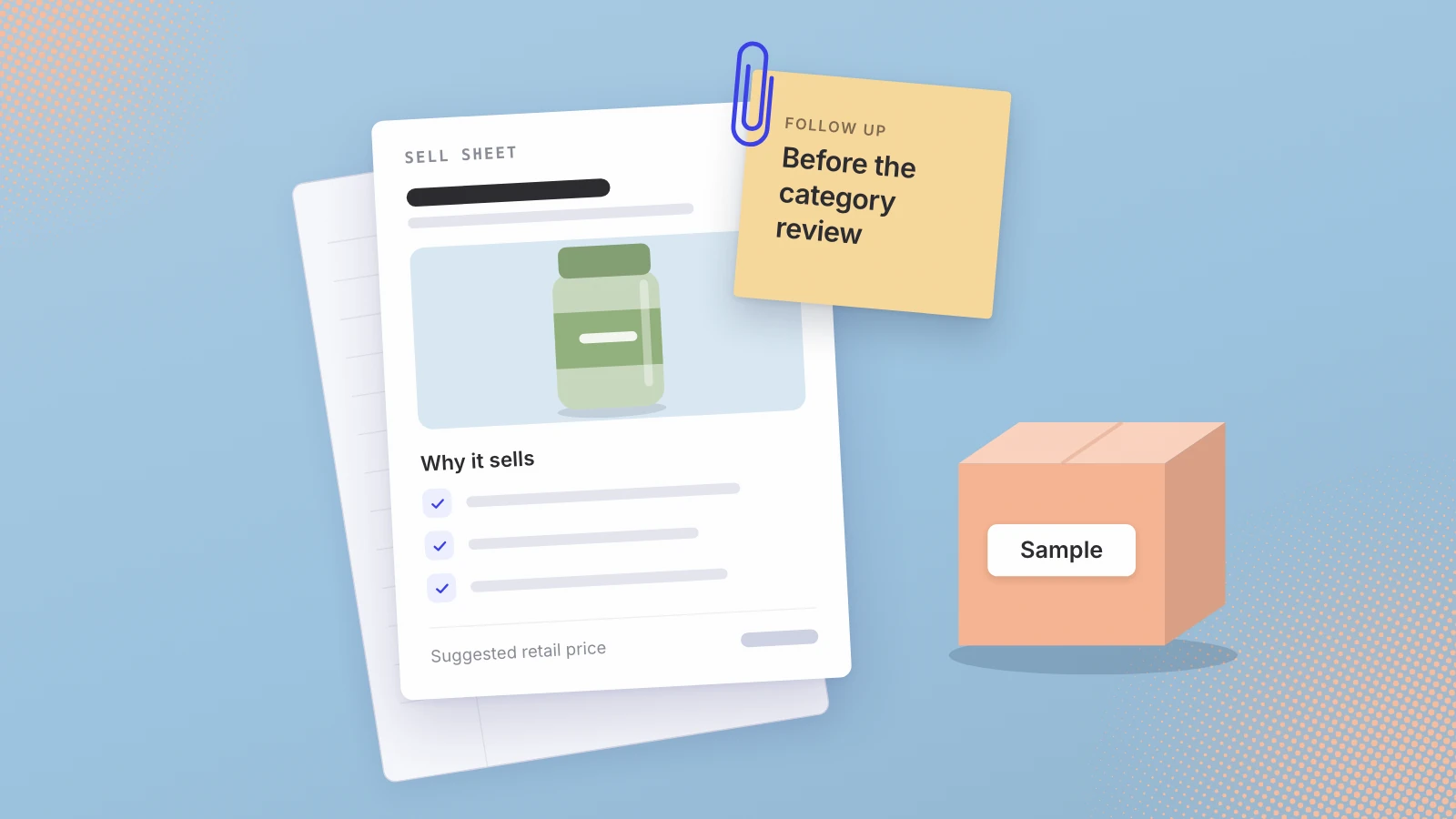
How to pitch to retail buyers comes down to three documents and a short meeting. A sell sheet earns the buyer’s attention, a line sheet gives them what they need to set you up, and a deck carries the conversation. Below are templates for each, the questions buyers ask, where to meet them, and how to follow up.
Make it easy for a busy buyer to say yes, and easy to set you up when they do.
Sell sheet vs line sheet vs deck: what goes on each?
| Document | Its job | What’s on it |
|---|---|---|
| Sell sheet | Gets a buyer interested | One page: photo, story, key facts, suggested retail price, proof it sells |
| Line sheet | Lets a buyer order and set you up | One row per SKU: codes, case and pallet details, costs, terms |
| Deck | Carries the meeting | Six slides: why it exists, the shopper, proof, price, supply, the ask |
Michigan State University Extension calls its version of the line sheet a pricing sheet and keeps it separate from the sell sheet, which is worth copying: you can update costs without reprinting your best page.
Sell sheet template
MSU Extension’s checklist is the base: a clear photo of the product in its package, the company story, the shelf form (shelf stable, refrigerated or frozen), shelf life, ingredients and Nutrition Facts. Add what a buyer scans for, and copy this:
| Section | What to put |
|---|---|
| Header | Brand, product name, and one line on what it is and who it is for |
| Photo | The product in its retail package, front on, on a plain background |
| Why it sells | Three short points: what it does better, who buys it, your proof (sales, reorders, reviews) |
| Product facts | Size, shelf form, shelf life, ingredients, allergens, certifications |
| Price | Suggested retail price per unit; costs stay on the line sheet |
| Codes | The UPC for each item (how to get GS1 barcodes) |
| Launch support | What you will fund at launch: demos, promotions, ads, social and creators |
| Contact | Name, email, phone, and your broker or distributor if you have one |
Line sheet template
A line sheet answers the questions a buyer would otherwise email you. Sprouts’ new item form shows what one grocery chain asks for, with some fields required only in certain departments. Build one row per SKU with these columns:
| Column | What to enter |
|---|---|
| Item number and UPC | Your SKU code and the 12-digit UPC |
| Description and size | Name, variant, unit size and unit of measure |
| Unit dimensions | Height, width and depth of one unit |
| Case pack | Units per case |
| Case specs | Gross and net weight; length, width and height |
| Pallet | TI (cases per layer) and HI (layers), and total cases per pallet |
| Costs | Regular wholesale, FOB (collected from you) and delivered (you pay freight), per case and per unit |
| MSRP | Suggested retail price per unit |
| Deals | Ongoing discount % and everyday low price (EDLP) %, if any |
| Certifications | Organic, non-GMO, gluten-free and similar |
Put the terms once, at the top: payment terms, minimum order, lead time, and whether to order direct or through a distributor. The prices must agree with your wholesale pricing everywhere you sell.
What should a retail pitch deck include?
Six slides, built around what a Target merchant, Adam Gregory, lists as the signals buyers look for:
- Why it exists. The problem it solves and what it does better, in a shopper’s words. He calls a clear reason to exist the first signal of retail readiness.
- Who buys it, and where it sits. The shopper, the category and the products beside it. He looks for a product that fits naturally into the category.
- Proof of demand. Sales to date, reorders, reviews and repeat rate. He names “proven demand or early velocity”.
- Price and margin. Shelf price, their cost and their margin, with the working. Buyers weigh margin structure and cost justification.
- Supply. Units per week, lead time and how you ship. Say “we produce X units per week”, not “we’ll scale as needed”.
- Launch plan and the ask. What you will fund in the first 90 days, and the test you propose: which stores, how many SKUs, for how long.
What questions do retail buyers ask?
- Velocity. How fast it sells where you are now, in units per store per week, not only total sales.
- Margin. What they make at your suggested price, after the promotions you plan.
- Launch support. Sprouts’ submission page says ads, new item features, discounts, trainings, demos and TPRs “would be expected as part of a vendor’s support of the line.”
- Shopper. Who buys it, and why they would buy it from this store.
- Operations. Gregory’s list for line reviews: can you fulfill orders reliably, how fast can you ship, do you understand compliance requirements, can you operate within retail systems.
Ask questions back. MSU suggests finding out the liability insurance the store requires, replenishment timelines, how demos work, and how many cases of similar products sell each month.
Where do you find retail buyers?
- Retailer portals. Some chains take submissions online. Sprouts uses a web form and a calendar of reset dates by category, and accepted items must be at the distributor two weeks before the test set.
- RangeMe. A discovery platform that puts your products in front of buyers who manage your categories. The free plan lists 3 products; paid plans add direct submissions (costs and brokers compared).
- Trade shows. Natural Products Expo West runs 2 to 5 March 2027 in Anaheim, with exhibits 3 to 5 March. The Summer Fancy Food Show is set for 25 to 27 July 2027 in New York; the 2026 show drew more than 9,100 registered buyers, and its pavilion for first-time exhibitors sold out.
- Matched meetings. ECRM pre-schedules one-to-one meetings between brands and buyers by category, typically 15 to 20 a day. Cost varies by session.
- Brokers and side doors. A broker takes your sell sheet to buyers they already call on, and accelerators and open calls are covered in our guide to getting into retail stores.
What happens in the meeting, and should you send samples?
Keep the pitch short. MSU advises pitching the product in less than five minutes, then handing over samples, the sell sheet and the pricing sheet; ECRM’s meetings run 10 or 20 minutes. Know your ingredients, allergens, certifications, UPCs and how your case fits their shelf.
Send samples the way each retailer asks. Sprouts wants two retail-ready samples of each new grocery item, or two empty packages of your top 2 or 3 SKUs for dairy and frozen, labeled with the brand and category and sent to its New Items team rather than to category managers. ECRM recommends samples buyers can see, touch and taste in the meeting.
How should you follow up with a retail buyer?
Buyers work on a calendar. MSU notes that some retailers choose new products only once a year. Sprouts says the category manager will contact you if an item is selected for further review, and that you will hear by email if it isn’t. RangeMe’s Premium plan emails alerts for upcoming category reviews on the first Tuesday of each month. Time follow-ups to the next review, not to the week. If I were pitching this season, my rhythm would be:
- Within a day. A short thank-you with the sell sheet, line sheet and answers to anything you couldn’t answer in the room.
- Before the category review. One update with something new: a store added, a reorder, a sales number, press.
- After a no. Ask what would change the answer and when the category is next reviewed, then come back with exactly that.
How do you show demand in a pitch?
With things a buyer can check. A broker I spoke with this spring told me buyers look through a brand’s social channels, and posts by its customers, for signs of existing demand before they take it on (what buyers look for on social media). That makes your own channels part of the pitch, and your launch support slide a plan with dates, not adjectives.
This is the part Leo works on, so weigh it accordingly. Leo for consumer brands turns footage you already own into daily posts and runs creator campaigns that find creators your shoppers follow; FitCommit’s campaign found 124 creators, and 17 said yes. For the “now available” moment, our launch cut is $500 for a 30 to 45 second video from your footage, in 5 working days.
If you have a buyer meeting on the calendar, build the launch support slide before the deck. Tell us who buys from you and we’ll show you the creators they follow, so the slide names real people and real dates.
A buyer can’t see your future sales. Show them the demand you already have.
Sources
- Michigan State University Extension, Food processors: preparing for selling in stores, part 2
- Sprouts Farmers Market, Things to know
- Sprouts Farmers Market, New item submission process
- Target Accelerators, Signals buyers look for when they say yes
- RangeMe, How it works
- RangeMe, Subscription plan comparison
- RangeMe, What is RangeMe Premium?
- Natural Products Expo West, General information
- Specialty Food Association, Summer Fancy Food Show
- Specialty Food Association, The 70th Summer Fancy Food Show (press release)
- ECRM, Frequently asked questions
Written by Lera Leonteva. Leo AI makes social video and runs creator campaigns for consumer brands, so we have a commercial interest in the launch support part of a pitch. Retailer and trade show facts are from their own pages, read November 2026.