
To get your product into Costco, call or write to the buying office that covers your item: Costco’s vendor page sends food suppliers to one of eight US regional offices and non-food suppliers to its corporate office in Issaquah, Washington. Expect to prove the item in one region first, through a roadshow or a rotation of about six to eight weeks.
To get your product into Costco, you usually start by calling or writing to a buying office. Costco’s vendor inquiries page has no submission form: it lists a corporate office in Issaquah, Washington, eight US regional offices and eleven international ones. If you are still choosing a first retailer, the founder’s guide to retail stores compares the options.
The short version: one buyer, one region, one item, and a test that has to sell.
Who do you contact to sell to Costco?
It depends on what you make. Food suppliers go to “the appropriate division office”; non-food suppliers go to the corporate office. The eight US divisions:
| Costco region | Office |
|---|---|
| Northwest | Issaquah, Washington |
| Northern California | Livermore, California |
| Los Angeles | Garden Grove, California |
| San Diego | San Diego, California |
| Texas | Plano, Texas |
| Midwest | Addison, Illinois |
| Northeast | Sterling, Virginia |
| Southeast | Duluth, Georgia |
Costco says in its annual report for fiscal 2026 that it buys most merchandise directly from suppliers, so the conversation that matters is with a Costco buyer, whether you make the call or a broker does.
Small companies have a second door: the intake form on Costco’s Supplier Inclusion page, where Costco says its buyers “often seek to work with small businesses and diverse suppliers to bring unique items” into warehouses and onto Costco.com. It asks first whether your company is US owned and operated, and Costco notes it “does not guarantee a business partnership.”
Why is Costco so hard to get into?
Because the shelf is small on purpose. The annual report says Costco carries fewer than 4,000 active items per warehouse, “significantly less than other broadline retailers,” and limits most items “to fast-selling models, sizes, and colors.”
Each slot faces a huge audience: 84.1 million paid members at the end of fiscal 2026 and, per Costco’s 4 November 2026 sales release, 943 warehouses, 651 of them in the United States and Puerto Rico. RetailWire described the assortment in April 2025 as one or two brands per category. With that few slots, I’d assume a new item has to beat something already on the floor.
What does Costco expect on price and pack size?
Thin margins and big packs. The annual report says the model lets Costco “operate profitably at significantly lower gross margins” than most retailers, and that “many consumable products are offered for sale in case, carton, or multiple-pack quantities only,” displayed on pallets.
The filing states no markup cap. Co-founder Jim Sinegal confirmed to The Seattle Times in 2009 that Costco’s margins never go above 14 percent, and RetailWire reported caps of 14% for outside brands and 15% for Costco’s own. Price your club pack backward from a shelf price that fits; wholesale pricing for retail has the math.
Costco has also said it doesn’t ask for slotting fees. The FTC’s February 2001 workshop report quotes a Costco representative: “[W]e really don’t require any fees. We just want the best price that they can give us.” That was 2000, so confirm with your buyer; slotting fees covers other retailers.
What is a Costco roadshow?
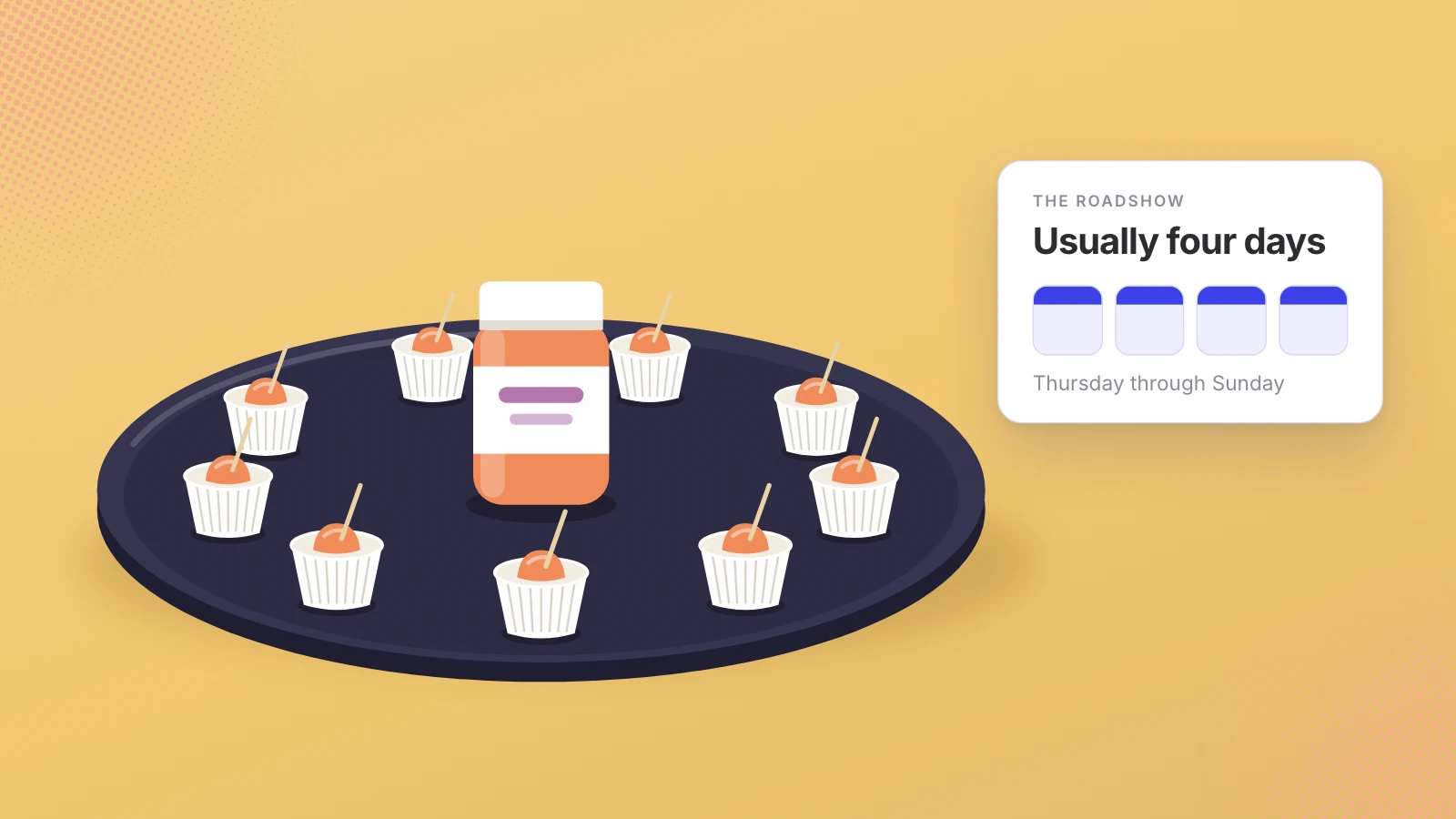
A short, staffed selling event in one warehouse, and for many new food brands it is the audition. Club Demonstration Services (CDS), the preferred in-house product demonstration service provider to Costco, offers roadshows for “a food or beverage item not carried in Costco as a stocked item.” Each runs “usually four days” before moving to another warehouse, and its vendor policies say food roadshows generally run Thursday through Sunday.
New Hope Network reported in October 2026 that most startups must commit to roadshows before winning shelf space: product on consignment in a Costco warehouse, and founders, family and friends handing out samples for days at a time.
Demos of stocked items also go through CDS: book at least two weeks ahead, and its supervisor can buy your samples in the warehouse at the member price. Prices aren’t published.
Do you start in one region or nationwide?
Almost always one region. In New Hope’s report, the candy brand Better Sour skipped the roadshow: a Pacific Northwest buyer ordered a rotation that put it in up to 120 warehouses across the region for six weeks. Four more rotations in other regions followed, and its co-founder said it beat Costco’s weekly minimums everywhere.
A rotation ends on purpose. Love+Chew founder Lauren Chew told FoodNavigator-USA in July 2024 that her Northern California rotation would last “about six to eight weeks and then will disappear,” and that the brand always sees a spike in Amazon and online sales afterward. Read sell-through rate and velocity first; those weekly minimums are the bar.
How do you get a food product into Costco?
Pass Costco’s food safety audit, at your plant or your co-packer’s. Costco’s Global Food Safety Audit Expectations (version 3.0, effective 1 September 2025) require every operation to be audited each year “to a Costco-approved standard by a Costco-approved certification body,” from the final processing facility onward, whether or not it sells to Costco directly. Costco says its buying staff “will use audit information to guide purchasing decisions.”
- Which audit. A GFSI certification such as SQF, BRCGS, FSSC 22000 or IFS with a Costco Addendum, or Costco’s own Food Safety/GMP audit, which needs 85% overall and in each category. Ask your co-packer which one it holds.
- First-time sites. A facility with no previous third-party food safety audit can ask for an Introductory Costco Food Safety/GMP audit: pre-approved by Costco, announced in advance, and passed at 75% in the first year.
- Cost. The supplier pays. Costco caps each audit day, expenses plus 10% included, at $2,300, and says most audits take 1 to 2 days on site.
- Dates and claims. Every product needs a use-by or best-before date, Julian codes are not accepted, and claims such as organic, gluten free or non-GMO must be backed by testing, certification or audit.
Can you sell on Costco.com instead?
Sometimes, but not through a separate door. The annual report says Costco.com ships through Costco’s depots and through “drop-ship and other delivery arrangements with our suppliers,” and the vendor page lists no separate online route.
Costco Next, which sent members to brands’ own storefronts and which some guides still recommend, is closed. Costconext.com now redirects to a Costco help page, published 29 October 2026, saying “Access to Costco Next store fronts is no longer available.”
Is Kirkland Signature a way in?
It is a different business. Costco says it buys and makes private-label goods “where quality and member demand are high,” that Kirkland Signature products “generally earn higher margins,” and that it expects their share of sales to grow. RetailWire put that share at about a third of revenue.
Making Kirkland Signature means manufacturing to Costco’s specification under Costco’s name. It can be a good factory business, but it builds Costco’s brand, not yours: the same trade-off as making a store label for Trader Joe’s.
Where does your own marketing fit?
In the weeks you are on the floor and after. Love+Chew’s founder described members going online to find the brand once the rotation ends; that only pays off if they find something alive.
A roadshow also produces footage you own: founders sampling, members tasting, the pallet going down. Leo indexes footage like that, finds the moments worth posting, reframes them vertical with captions and schedules daily posts, and posts nothing when no clip fits. Each post can carry a tracked link in its first comment, so you see which clips send people to your site during and after the rotation. A creator campaign adds creators whose followers match your buyers. Leo for consumer brands runs both.
One caution on pace: a broker I spoke with this spring told me founders new to packaged goods tend to chase more doors early, which feels right but is expensive and hard to sustain. More in what retail buyers look for on your social media.
If a roadshow or rotation is on your calendar, tell us who buys from you and we’ll show you the creators they follow, and how your warehouse footage can keep posting after the pallets are gone.
Costco buys items that sell. Everything here is a way to prove yours will, one region at a time.
Sources
- Costco, Vendor inquiries
- Costco, Supplier Inclusion
- Costco Wholesale, Form 10-K for the fiscal year ended August 30, 2026
- Costco Wholesale, Costco Wholesale Corporation reports October sales results
- Costco, hosted by Azzule, Global Food Safety Audit Expectations for Costco Suppliers, version 3.0
- Costco, Costco Next member services
- Club Demonstration Services, About CDS
- Club Demonstration Services, Roadshows
- Club Demonstration Services, Vendor policies and procedures
- New Hope Network, Better Sour’s retail-first strategy for better-for-you candy
- FoodNavigator-USA, From bootstrapping to big-box store shelves: Love+Chew CEO shares tips for growth
- RetailWire, Why haven’t other retailers replicated Kirkland’s success?
- The Seattle Times, Complete Q&A with Costco founder, CEO Jim Sinegal
- Federal Trade Commission, Workshop report on slotting allowances in the grocery industry
Written by Lera Leonteva. Leo AI makes social video and runs creator campaigns for consumer brands, so we have a commercial interest in the marketing part of this guide. Costco facts are from Costco’s own pages and filings, read 11 November 2026; demo and roadshow details are from Club Demonstration Services and named trade reporting.