
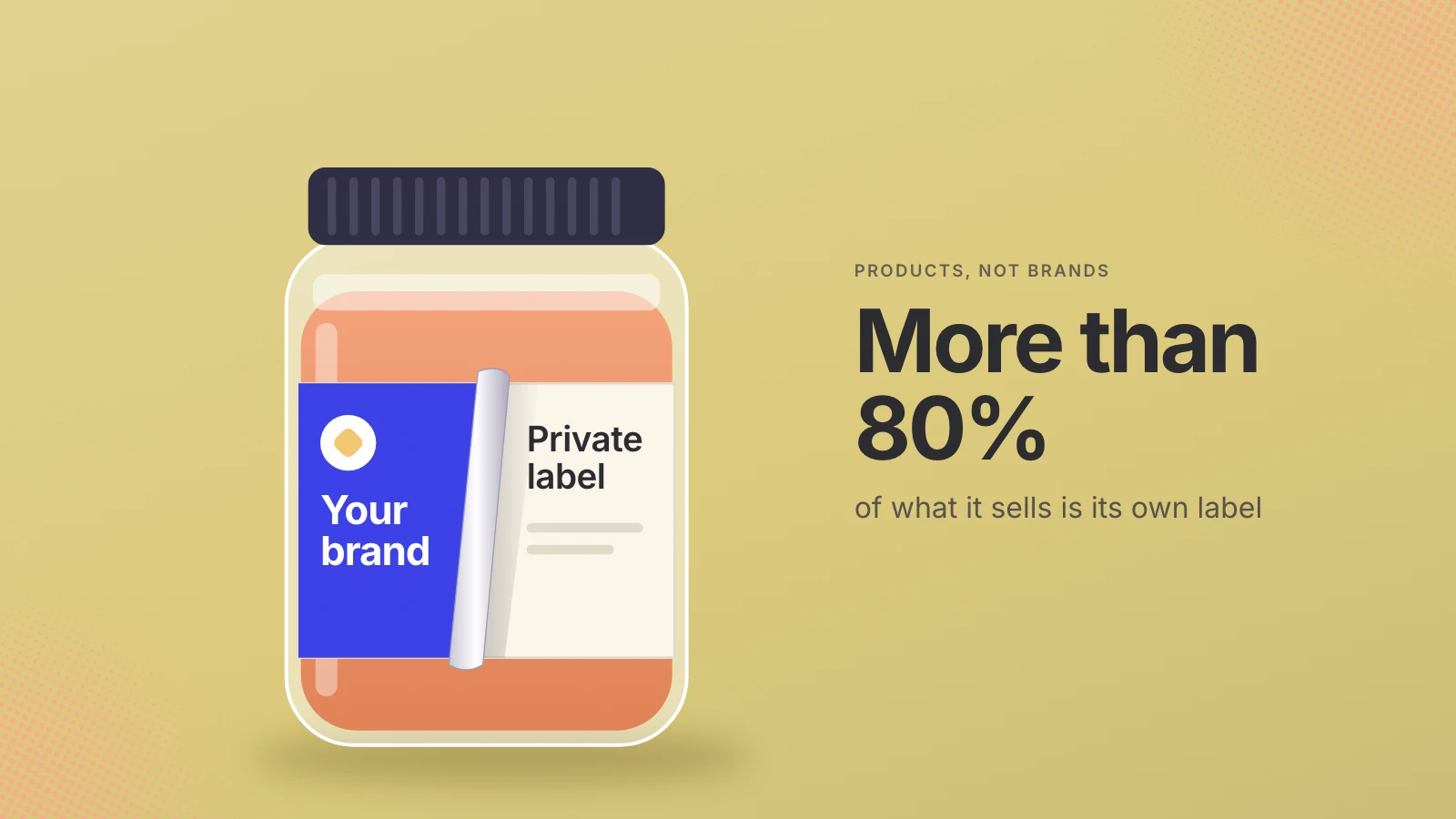
To get your product into Trader Joe’s, submit the Potential Vendor form on traderjoes.com; it says it will contact you if the product is a fit. Know the model first. More than 80% of what it sells is its own label, every product must win the votes of at least 70% of its tasting panel, and it charges no slotting fees.
To get your product into Trader Joe’s, you fill in a form, and the company is candid about what follows: review takes “some time,” and “if it is a fit, we will contact you.” Most of this guide comes from Trader Joe’s own site and the transcripts of its podcast, Inside Trader Joe’s, which say a good deal about how it buys.
Before you fill in the form, decide what you want from Trader Joe’s: a customer for your factory, or a shelf for your brand.
How do you submit a product to Trader Joe’s?
Through the Potential Vendor form on traderjoes.com. After your company details, it asks for the product’s name and category and why it is “a good fit for Trader Joe’s.” The rest is a checklist you can prepare in advance:
- Where the product is grown or produced, and whether the facility is GFSI certified (and with which certification).
- Whether you make it in your own facility or at a co-packer.
- Whether it is already sold at other US retailers.
- Whether it is MSG-free and GMO-free, free of artificial flavors and added trans fats, and colored only with naturally derived colors.
- Whether the facility is FDA or USDA licensed and holds safety certifications including GMP and HACCP.
The form names no timeline and asks for no fee. If you hear nothing, its own wording suggests the product was not a fit.
Where does Trader Joe’s get their products?
From manufacturers it finds and works with directly, often on products it designed. The About Us page says its buyers “travel the world searching for products” and buy direct from suppliers whenever possible. On episode 15 of its podcast, Mitch Heeger, who introduced himself as executive vice president for marketing and merchandising, said it works both ways: developers with an idea “go track down a vendor,” and “in many cases, it’s not being made already.” Jon Basalone added that it is rare for Trader Joe’s to put its label on something a supplier already makes.
Suppliers deliver to Trader Joe’s warehouses, and stores order from there. On episode 101, its deli category manager said a new product starts with two weeks of supply. For its Protein Pancakes, Trader Joe’s expected stores to order about 2,000 cases a week; in week one they ordered 5,200, and the supplier has been adding equipment since.
Who makes what is kept quiet. Fortune reported in 2015 that a standard vendor agreement it obtained in 2010 says the vendor “shall not publicize its business relationship with TJ’s in any manner.”
Will your product carry your brand or Trader Joe’s?
Most likely Trader Joe’s. On episode 4, the company said more than 80% of the products it sells are private label. On episode 15, Heeger put it at 85 to 95% excluding wine, and said branded products stay where “our customers are looking for that,” about “maybe 10% of our products.” Numerator data cited by Supermarket News in June 2026 put private label at 79% of Trader Joe’s unit sales.
That small branded share is the only place your own name sits on a Trader Joe’s shelf. Everything else is a Trader Joe’s product made by a company shoppers never see. If you make a product for its label, you are building its brand, and if the terms Fortune saw still apply, you can’t say so in public.
Does Trader Joe’s charge slotting fees?
No. The About Us page says most grocers charge suppliers to put an item on the shelf, which “results in higher prices... so we don’t do it.” On episode 41, Trader Joe’s laid out how it buys instead:
- It buys in very large quantities.
- It works as directly as it can with whoever makes the product.
- It pays vendors on quick terms, electronically.
- It owns its inventory, with no consignment, and doesn’t ask vendors to stock its shelves.
What other grocers charge is covered in slotting fees. At Trader Joe’s the negotiation is about price instead: it says it bargains hard for the best one, so check your margin with wholesale pricing for retail before you quote.
How does Trader Joe’s decide what to sell?
A tasting panel votes on every product. Its tasting panel episode says Trader Joe’s doesn’t sell anything that hasn’t passed, and passing means “a super majority, 70% or more” of panelists vote yes. Non-food items get used rather than eaten: candles are burned and lotions tried. On episode 2, Trader Joe’s said none of its vendors “can buy access or be present or help sway those decisions.”
Then the shelf decides. The About Us page says that if an item “doesn’t pull its weight in our stores, it goes away.” And on episode 15 it said each store orders what it thinks it can sell, rather than receiving a plan from headquarters.
Can you keep up with Trader Joe’s volume?
Check before you apply. Supermarket News put Trader Joe’s at about 637 stores across 42 states and Washington, D.C. in June 2026, and a spokesperson told Grocery Dive in March that it planned to open more than 20 stores in 2026, after 43 in 2025. Its fresh sandwich suppliers deliver to every warehouse that ships to stores every day except Christmas, New Year’s Day and the Fourth of July. Ask your co-packer what week-one orders at 2.6 times the plan, as with the pancakes, would do to them.
Is Trader Joe’s the right goal for your brand?
It depends on whether you are building a factory business or a brand. Here is how I’d weigh it:
| If you want | Trader Joe’s fits when | Look elsewhere when |
|---|---|---|
| Volume and steady orders | You can make a product to its spec and price, at its scale | Your margin only works at DTC prices |
| Your name on a shelf | Shoppers already ask for your product by name | You need retail to build awareness |
| Proof for the next buyer | Rarely: a private-label win stays private | You plan to cite retail wins in pitches |
The branded slots go to products customers already look for, and nothing in the process lets you buy that. Customers who look for you are built on channels you own; what retail buyers look for on your social media covers what counts as proof, and the founder’s guide to retail stores compares other first doors.
Leo works on that part. It turns footage you already own into captioned daily posts on a schedule, and its creator campaigns find creators whose followers match your buyers. FitCommit’s campaign found 124 creators and 17 said yes; email worked best, with 22% saying yes against 18% by X DM and 4% by Instagram DM. None of that gets you past a tasting panel. It builds the customers who would ask for you by name. Leo for consumer brands has the details.
If you’re weighing a Trader Joe’s label against your own, show us who buys from you and we’ll show you the creators they follow. That audience is yours either way.
Trader Joe’s buys products, not brands. Decide which one you are selling before you press submit.
Sources
- Trader Joe’s, Potential Vendor form
- Trader Joe’s, About us
- Trader Joe’s, Inside Trader Joe’s, episode 2 transcript
- Trader Joe’s, Inside Trader Joe’s, episode 4 transcript
- Trader Joe’s, Inside Trader Joe’s, episode 15 transcript
- Trader Joe’s, Inside Trader Joe’s, episode 41 transcript
- Trader Joe’s, Inside Trader Joe’s, episode 101 transcript
- Trader Joe’s, Inside Trader Joe’s, what the heck is a tasting panel?
- Fortune, Trader Joe’s fight with Milano maker spotlights its secretive nature
- Supermarket News, SN Super50: and the No. 1 grocer is
- Grocery Dive, Trader Joe’s unveils plans for 8 more stores
Written by Lera Leonteva. We make social video and run creator campaigns for consumer brands at Leo AI, which gives us a commercial interest in the brand-building part of this guide. Trader Joe’s facts are from its own website and podcast transcripts, read 11 November 2026, and from named reporting.