
A food broker is a commission sales agent who pitches retail buyers but never buys your product. Oklahoma State University Extension puts broker commissions at 5% to 8% of invoiced orders, Farm Credit Canada at 3% to 5%. A distributor such as UNFI or KeHE buys, stores and delivers your product. Faire charges 15% plus $10 on a new shop’s first marketplace order.
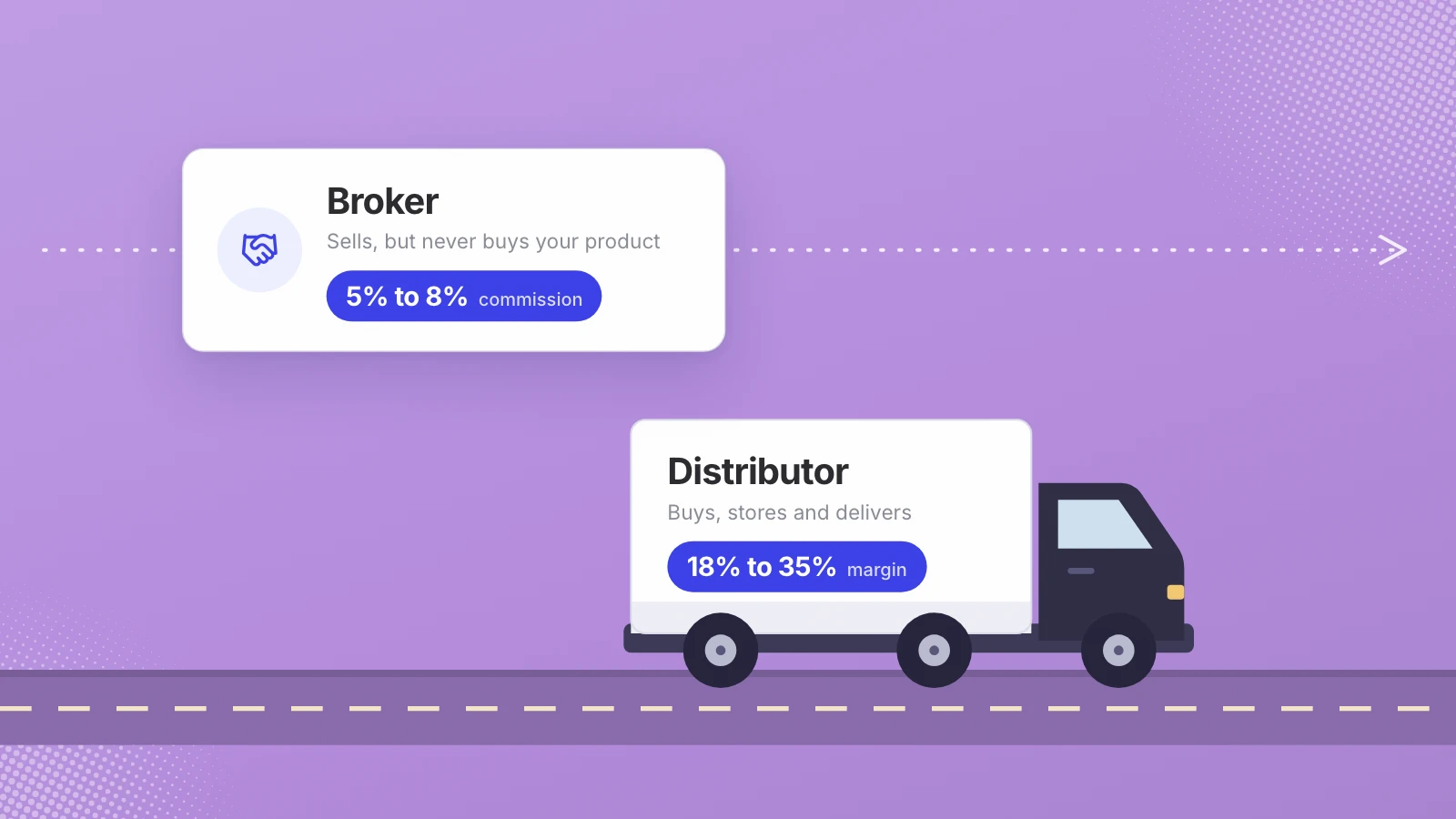
A food broker sells your product to retail buyers for a commission on what ships. A distributor such as UNFI or KeHE buys it, warehouses it and delivers it to stores. A marketplace such as Faire or RangeMe helps buyers find you. They are different jobs, paid differently, and one brand can use all three. This page is one stage of our founder’s guide to getting into retail stores.
A broker sells. A distributor buys and delivers. A marketplace gets you found.
What does a food broker do?
A food broker is an outsourced sales team that calls on buyers it already knows. Brokers don’t buy your product, so you ship to the retailer and bill it yourself, and they carry out the sales programs you develop rather than developing them, as Farm Credit Canada (FCC), a Canadian government lender, puts it. So a broker walks into the buyer’s office with whatever you hand over: the sell sheet, the pricing, the promotion plan and the proof that shoppers want the product.
Brokers juggle many lines. Oklahoma State University Extension says most represent 20 to 30 manufacturers, and that small niche lines often bring in 5% or less of a brokerage’s income, so they may get less steady attention. The field is consolidating too: in June 2025 WholeFoods Magazine listed natural products broker deals including Hanson Faso buying iLevelBrands and PLTFRM buying Presence Marketing.
How much does a food broker charge?
Mostly commission, and the two public guides that publish a range disagree:
| Source | Published commission | What else it says |
|---|---|---|
| Oklahoma State University Extension (2016) | 5% to 8% of the invoice on each order shipped in a calendar month | Nothing is due until orders ship; presenting to every buyer in a market can take 30 to 60 days |
| Farm Credit Canada | 3% to 5% of sales | $100,000 of sales to a chain pays the broker $3,000 to $5,000; some ask for a monthly retainer until volume reaches a minimum |
Then there are retainers. WholeFoods Magazine describes a “draw against commission”, where you pay the retainer or the commission, whichever is greater, or a guarantee for a fixed period, and warns that neither guarantees retail success or the broker’s attention.
What does a distributor like UNFI or KeHE do?
A distributor buys your product and sells it on to stores, so it earns a margin rather than a commission, and FCC notes it only takes items it expects to sell. FCC tells brands to plan on 20% to 25% for shelf-stable products and 25% to 35% for refrigerated or frozen. Oklahoma State gives 18% to 35%, and says some distributors take a startup on consignment, paying monthly for what sold.
On one unit: if a store pays the distributor $4.00 and the distributor keeps 25%, you get $3.00. A broker on 5%, a rate inside both published ranges, takes $0.15, leaving $2.85 before freight, promotions and cost of goods. That 25% margin is about a 33% markup on your price; our wholesale pricing guide works the whole chain.
UNFI
UNFI calls itself a North American grocery wholesaler supplying about 30,000 retail locations (UNFI, July 2026). New suppliers start with its New Supplier Inquiry form. Per SPS Commerce’s April 2026 guide, qualifying submissions join a queue for future contact, and onboarding asks for insurance, item and freight forms, certificates, a price list and spec sheet, and a third-party food safety audit.
KeHE
KeHE says it reaches 31,000+ retail and online stores (its supplier page) and receives all new product submissions through RangeMe. Its Trend Finder events run in spring, fall and winter, with 20-minute virtual pitches to category managers; standouts get a Golden Ticket into onboarding. New suppliers under $500,000 in their first year can opt into a 2% flat rate covering fees such as new item allowances and MCBs. KeHE does not distribute CBD, THC or alcohol.
Direct store delivery
Direct store delivery, or DSD, skips the warehouse: in Oklahoma State’s definition you take each store’s order and deliver from your own truck. Supermarket News described it in 2011 as the route for snacks, soda and bread. A dozen nearby stores served from your own van is DSD at its smallest.
How does Faire wholesale work, and is it worth it?
Faire is a wholesale marketplace where independent shops order from brands. Joining is free, and what you pay depends on who found whom (Faire’s fee page):
- Shops that find you on Faire: 15% commission, plus a one-time $10 fee on the first order.
- Shops you bring with your Faire Direct link: 0% commission.
- Processing, every order: 3.5% + $0.30 for next-day payout, 2.4% + $0.30 for 30 days, 1.9% + $0.30 for 60 days.
So a $200 opening order from a shop that found you, on 30-day payout, pays you $154.90 after $30 commission, the $10 fee and $5.10 processing. Its $200 reorder pays $164.90; a $200 Faire Direct order pays $194.90.
Shops get net 60 terms and free first-order returns, and Faire carries that risk: “Every order we send you is a guaranteed sale” (Faire). The catch: your wholesale and suggested retail prices must be the same or lower on Faire than anywhere else (pricing policy), so you can’t price up to cover the commission, and you agree not to move orders off Faire, reorders included (brand policies). Bring your own shops through Faire Direct and it is cheap; rely on Faire to find them and budget for 15%.
What is RangeMe, and what does it cost?
RangeMe is a discovery platform: brands post profiles and buyers search them. It says over 15,000 retail buyers use it, and KeHE routes every new submission through it. Its supplier plans in November 2026:
| Plan | Price | What it adds |
|---|---|---|
| Free | $0 | A profile with up to 3 products |
| Starter | $99 a year | Unlimited products and buyers’ Immediate Opportunities |
| Premium | $1,399 a year | RangeMe Verified (up to 7x more buyer views, it says), NielsenIQ category data, retailer submissions |
| Pro | $2,499 a year | Three guaranteed buyer meetings, in categories matching upcoming ECRM sessions |
A free profile is worth having for KeHE alone. A listing gets you found; your sell sheet and pitch still have to prove shoppers will buy.
When should you bring in a broker or a distributor?
Bring in a distributor when stores ask to buy you through one. Distributors want demand they can see: KeHE lists early traction and velocity indicators among its Trend Finder criteria, and UNFI’s inquiry asks where your product sells now. Have your velocity ready: how fast you sell in the stores that stock you.
For a broker, here is my judgment. I’d hire one when stores reorder without being chased, you are aiming at chains in a region where you know no one, and your margin can carry a commission, and probably a retainer, for the months before orders ship.
What should you ask before you sign?
Oklahoma State says the manufacturer usually drafts the brokerage agreement, two to three pages, and shows it to at least two or three brokers. Settle these in writing:
- Rate and base. The commission, incentives, and whether it is figured on your invoice to the distributor or the store.
- Payment and deductions. When it is paid, and whether it drops for unauthorized credits or unpaid accounts.
- Accounts and conflicts. The exact chains and regions covered, and which competing lines the broker carries.
- Reporting, exit and references. FCC says to agree on reporting up front and to ask store buyers which brokers serve them best; Oklahoma State cites 30 days as a sample termination term.
This is not legal advice. Have a lawyer read any broker or distribution agreement before you sign.
What a broker shows the buyer is up to you
A broker is a messenger with a good address book; the buyer still decides on evidence. A broker I spoke with this spring told me buyers look through a brand’s social channels, and posts by its customers, for signs of existing demand before they take a brand on; here is what that looks like.
That evidence is what a small brand can build before hiring anyone, and it is the part Leo for consumer brands works on: daily posts cut from footage you already own, and creator campaigns that look for creators whose followers match your buyers. FitCommit’s campaign found 124 creators, and 17 said yes, a 13.7% yes rate, with 1.43 million combined followers. None of that puts a product on a shelf; it gives the broker something real to show.
Meeting a broker this season? See how Leo works for consumer brands, or tell us who buys from you and we’ll show you the creators they already follow.
Hire the broker for the relationships. Bring the proof yourself.
Sources
- Oklahoma State University Extension, Are food brokers right for you? (FAPC-130)
- Farm Credit Canada, Broker or distributor? How to choose the best option for your product
- WholeFoods Magazine, Where have all the brokers gone? And what can I do about it?
- Supermarket News, DSD logistics: PepsiCo
- UNFI, Press release with company overview, 9 July 2026
- SPS Commerce, How to become a supplier for UNFI
- KeHE, Get your brand discovered (suppliers)
- KeHE, Trend Finder product discovery events
- KeHE, 3 ways distributors discover products
- Faire, How much does it cost to sell on Faire if I’m based in North America?
- Faire, How do your retailer terms affect me?
- Faire, Pricing policy for US and Canada based brands
- Faire, Overview of brand policies
- RangeMe, Plans and pricing for suppliers
Written by Lera Leonteva. Leo AI makes social video and runs creator campaigns for consumer brands, so we have a commercial interest in the marketing part of this guide. Other facts are from each company’s own pages, two public guides and named trade press, read November 2026.