
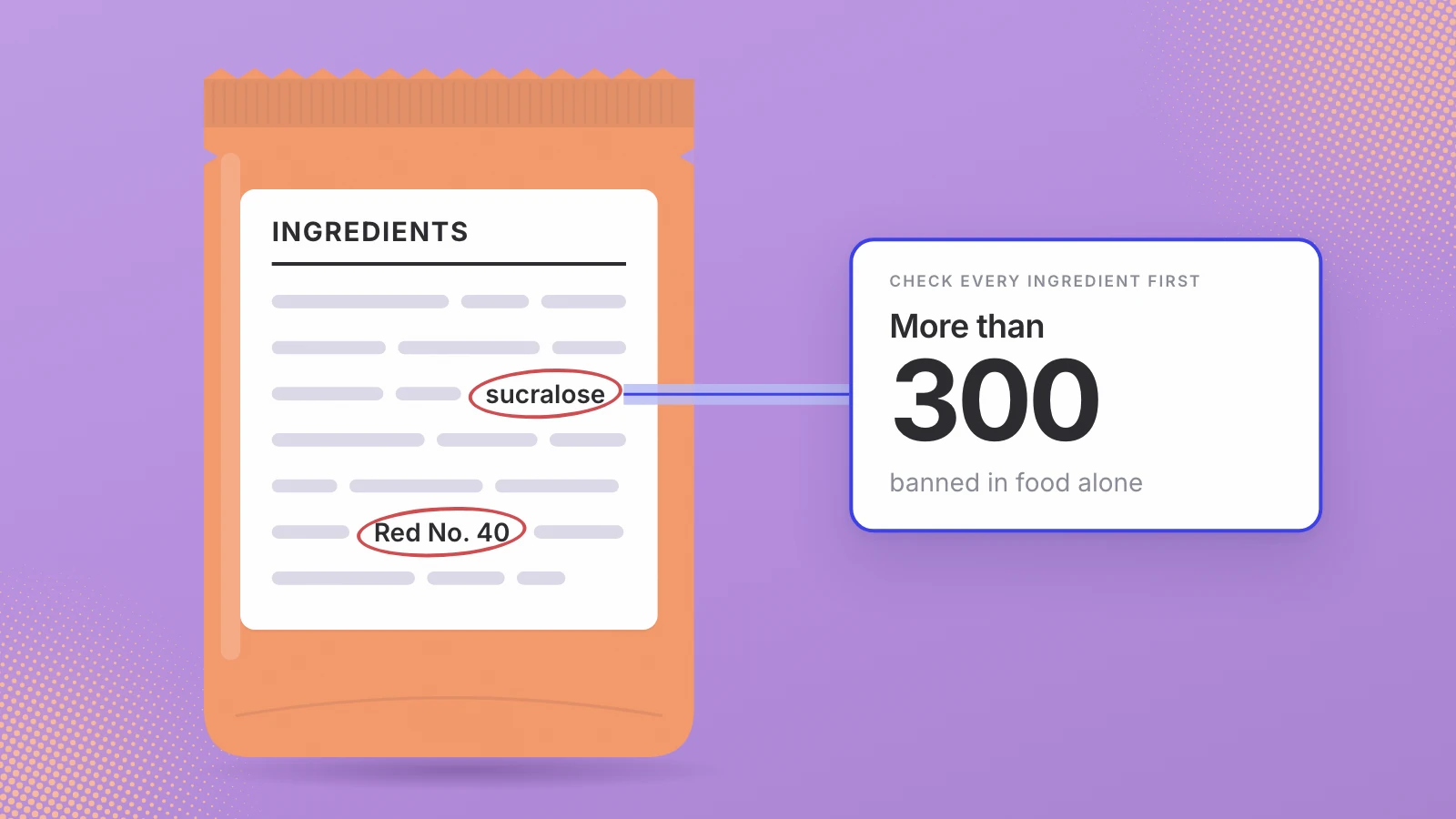
To get your product into Whole Foods Market, register on its Supplier Portal, complete the Potential Supplier Form and submit when your category is up for review. Check every ingredient first: Whole Foods bans more than 300 in food alone. Small brands have two more doors: a regional forager, and LEAP, which picked 10 brands from more than 2,000 applications in 2026.
To get your product into Whole Foods Market, you start online. Its page for potential suppliers sends you to the Supplier Portal and a Potential Supplier Form. What happens next depends on three things the form doesn’t show: the category review calendar, the ingredient lists, and which Whole Foods team your product belongs with. If you are still choosing a first retailer, the founder’s guide to retail stores compares the options.
The portal puts you in the queue. The calendar, the ingredient list and the right buyer get you looked at.
How do you submit a product to Whole Foods?
- Check the quality standards first. Whole Foods says products “must meet our rigorous Quality Standards” and that not all of its standards are posted publicly. Its business requirements include liability insurance, production in a certified commercial facility and transparent sourcing.
- Register on the Supplier Portal. Confirm your email, then complete the Potential Supplier Form about your business and products.
- Submit on your category’s schedule. Casey Gaston, Whole Foods’ executive leader of local and emerging brands, said on BevNET’s CPG Operator podcast in 2024 that it is “critical to follow the category review calendar,” and that off-cycle changes are reserved for business-critical needs.
- Fill in everything. Whole Foods says it “cannot guarantee you will receive a response,” and that complete, accurate submissions help.
How selective is Whole Foods with new products?
Very. Gaston said foragers and merchants get “hundreds, if not thousands, of submissions and inquiries.” The accelerator makes the same point: Whole Foods chose 10 brands for its 2026 LEAP cohort from more than 2,000 applications.
At the Newtopia Now conference, New Hope Network reported in October 2026, emerging brand forager Lisa Tosun said “just being different isn’t enough to be innovation”; it also has to be useful or relevant. Category merchant Gabe Weldin said a product can’t fall outside category parameters such as cost, size and shape. Forager Mindy Hauge added: “Not now doesn’t necessarily mean not ever.”
What ingredients does Whole Foods ban?
More than 575 across its departments, and more than 300 in food. Whole Foods’ quality standards count “575+ ingredients we ban across food, beverages, body care, household cleaning, supplements, catering and more,” and its food ingredient standards list many of the food bans. A few worth checking if you formulated for DTC first:
- Sweeteners: aspartame, sucralose, saccharin, acesulfame-K, neotame, advantame and allulose.
- Fats and syrups: hydrogenated and partially hydrogenated oils, and high-fructose corn syrup.
- Colors: synthetic FD&C colors such as Red No. 40, plus carmine and cochineal.
- Functional add-ins: CBD, melatonin, activated charcoal, kava, 5-HTP and extended-release caffeine.
- Body care: parabens, phthalates and oxybenzone, among “hundreds more.”
New Hope’s report put the baseline plainly: the product must meet the ingredient standards, and every label claim must be legitimate. Check each ingredient against the list before you submit.
Local, regional or national: which Whole Foods team is yours?
It depends on your stage. In New Hope’s account of the panel, Whole Foods has three ways in:
| Team | What it does | Usually fits |
|---|---|---|
| Category merchants | Own a category’s assortment nationwide | Brands ready for national scale |
| Emerging brand foragers | Find and coach young brands, split by category | Something new for a category |
| Regional foragers | Find local suppliers, split by geography | Brands based and made in one state |
Local has a narrow meaning. Gaston said that for Whole Foods to call a product local, it “must be based and manufactured in the same state”; emerging is not tied to place. Weldin noted that Go Macro and Siete, now category leaders at Whole Foods, started as local forager brands.
How do Whole Foods local foragers work?
They are Whole Foods team members who scout for local products. Its local page says its Local Foragers scour “markets, roadside produce stands, mom-and-pop storefronts and more.” You don’t have to wait to be found: Gaston said prospective suppliers should submit through the portal “so our forager team can review it,” and that a product that doesn’t fit one category is easier to place through the forager for your state.
Once you are a supplier, the forager is also the route to Whole Foods’ Local Producer Loan Program. Founded in 2006, it has made over 400 loans worth roughly $42 million, and it tells applicants to ask their Forager or Category Merchant for an introduction.
Is the Whole Foods LEAP accelerator open?
Not for 2026; that round is under way. Whole Foods opened applications for its 2026 Local and Emerging Accelerator Program on 2 June 2026 and named the 10-brand Early Growth cohort on 24 September. Participants get a 12-week curriculum, become eligible for a $25,000 equity investment, and are considered for stores in their home city or region. Whole Foods says 9 of the 10 brands from 2025 are on its shelves, with one more launching in November.
It is for grocery and Whole Body (supplements and body care) brands not yet sold at Whole Foods; alcohol, fresh produce and food service are excluded, and Gaston said in 2024 that it costs nothing. As of 11 November 2026 the supplier page still shows the 2025 timeline and no 2027 dates are published, so check it before you plan around LEAP. Retail accelerator programs compares it with other retailers’ programs.
Do you need a distributor to sell to Whole Foods?
Whole Foods’ supplier page doesn’t say you must have one, but its main distributor shapes how new items reach stores. UNFI extended its deal as Whole Foods’ primary distributor in May 2024 to run until May 2032. In the agreement UNFI filed with the SEC, UNFI stocks a new product Whole Foods requests if a majority of the stores served by the same UNFI distribution center agree to buy it, and new vendors must meet UNFI’s “reasonable requirements for new vendors.” The same clause has the two negotiating a way to introduce items into fewer stores from 2025.
So a one-store or one-region launch may not move through UNFI the way a broad rollout does. Ask your forager or merchant how your item will reach stores before you set prices, and read brokers, distributors and marketplaces for what each layer costs.
What happens after Whole Foods says yes?
You start small and earn each step. Weldin described brands moving up Whole Foods’ tiers “like climbing rungs of a ladder,” showing operational readiness as they go. Hauge called strong promotion and demo plans musts, and said she is impressed by founders who track their own velocity and lift from the data Whole Foods shares.
LEAP graduate GEEM Korean Seaweed Snacks shows the pace: Whole Foods says it launched in the Midwest in May 2025 and earned an expansion across Southern California, Nevada, Arizona and Hawaii from July 2026. Sell-through rate and velocity explains the numbers behind steps like that.
Where does your own marketing help?
In the pitch and in the first months on shelf. New Hope’s summary of what the panel wanted was a great story plus data to back it. Some of that data only you have: who buys from you, where they live, what they say. Some is visible to anyone who opens your Instagram before the meeting.
Leo helps with the visible part. It turns footage you already have, such as product demos, founder talks and your first in-store tastings, into captioned daily posts, and each post can carry a tracked link in its first comment so you can see which clips send people to your site. For a regional launch, a creator campaign finds creators whose followers match your buyers; FitCommit’s found 124 creators, and 17 said yes. Leo for consumer brands runs both.
If your category review is coming up, show us who buys from you now and we’ll show you the creators they follow, so the story in your submission comes with proof anyone can scroll.
Submit on the calendar, clear the ingredient list, find the right team, and bring a story with numbers.
Sources
- Whole Foods Market, Information for potential suppliers
- Whole Foods Market, Our quality standards
- Whole Foods Market, Food ingredient quality standards
- Whole Foods Market, Local brands and makers
- Whole Foods Market, Local Producer Loan Program
- Whole Foods Market, Whole Foods Market opens applications for its 2026 Local and Emerging Accelerator Program
- Whole Foods Market, Whole Foods Market unveils the 2026 Local and Emerging Accelerator Program Early Growth cohort
- New Hope Network, What Whole Foods Market wants to see from emerging brands
- BevNET CPG Media, CPG Operator episode 54: Whole Foods Market, updates for local and emerging brands
- UNFI, United Natural Foods extends distribution partnership with Whole Foods Market to 2032
- UNFI, via SEC EDGAR, Amended and restated agreement for distribution of products (exhibit 10.6)
Written by Lera Leonteva. Leo AI makes social video and runs creator campaigns for consumer brands, so the marketing part of this guide is where we have a commercial interest. Whole Foods facts come from its own supplier, standards and newsroom pages, read 11 November 2026, plus named trade reporting and UNFI’s filings.