
Slotting fees are one-time payments a brand makes to a retailer to get a new product onto its shelves, paid in cash, free product or invoice deductions, usually per item per store. The FTC’s 2003 study found averages of $2,313 to $21,768 per item, per retailer, per metro area; FoodNavigator-USA reported $250 to $1,000 per item per store in 2025.
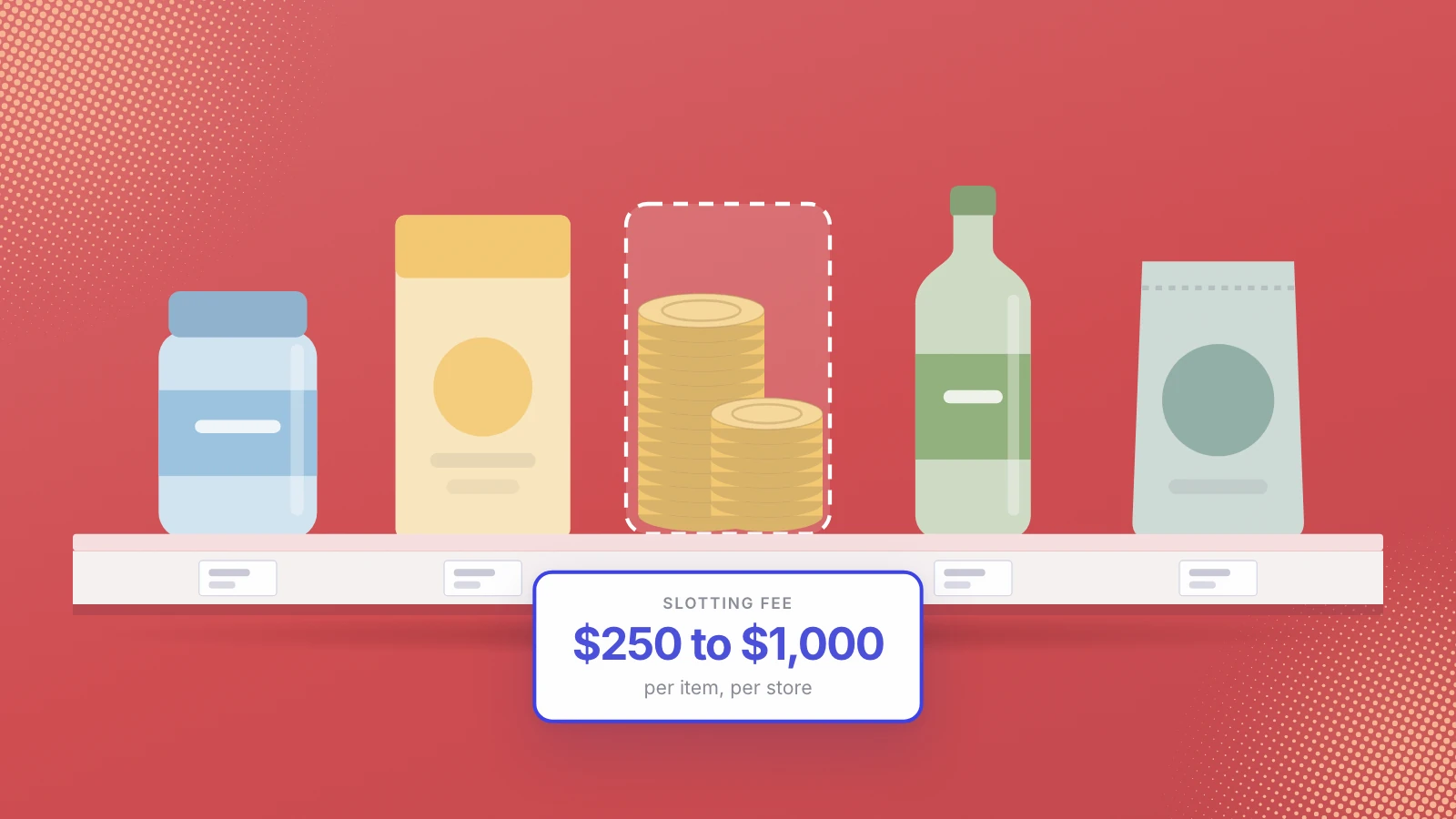
Slotting fees are what a retailer charges a brand to put a new product on its shelves, and for a small food or drink brand they can cost more than the first order is worth. Below is what they are, the forms they take, what the best public data says they cost, and how founders plan around them.
Slotting buys a place on the shelf for a trial period. It doesn’t buy sales.
What are slotting fees?
The FTC’s 2003 staff study defines a slotting allowance as a fee or anything else of value a retailer receives, as a lump sum, in installments or against volume commitments, paid “in cash, in free goods, or in any other thing of value,” as a condition of first putting a product on its shelves or in its warehouse. It applies to new items; fees to keep existing ones are pay-to-stay fees.
Retailers usually price it per item, per store. In the FTC’s 2001 workshop report, retailers expressed slotting as a payment per SKU per store, and each size or flavor counted as a separate SKU with its own fee. Paying doesn’t guarantee a good spot: in the 2003 study, several retailers and suppliers said slotting bought no particular placement, though new items usually stayed on the shelf for at least four to six months.
What forms do slotting fees take?
- Cash up front. The 2001 report says manufacturers usually pay in cash.
- Free fill. Free product instead of cash. UNFI’s New Item Auto Distribution program ships new items to signed-up stores and, for national brands, “includes one FREE case per store”, for items funded by vendors.
- Deductions and bill-backs. In the 2003 study, one retailer took the fee off the first invoice, another lowered the cost per case, and a third credited invoices in a “bill-back” spread across several products.
- Pay-to-stay fees. Payments to keep an existing product on the shelf, commonly for a year. The 2003 study found them rare in the five categories it covered.
- Failure fees. Charged when a product misses its goals, with variants for slow-moving and discontinued items, according to the 2001 report.
The FTC excludes advertising allowances, introductory discounts and other per-unit promotions from its definition. You pay those too, but they belong in your trade spend budget, which the wholesale pricing guide builds into the price.
How much are slotting fees at grocery stores?
The most detailed public data comes from the FTC and is two decades old; the newest figures are from trade press. Here is what has been published, and what each figure measures:
| Source | What it measured | Figure |
|---|---|---|
| FTC workshop report, 2001 | Range a panelist gave, per SKU per store | $75 to $300 |
| FTC staff study, 2003 | Average per item, per retailer, per metro area | $2,313 to $21,768 |
| FTC staff study, 2003 | Average per UPC per store, two retailers’ data | $69.20 |
| FTC staff study, 2003 | National launch of one product, suppliers’ estimate | $1.5 to $2 million |
| FoodNavigator-USA, 2025 | Per item per store, most traditional retailers | $250 to $1,000 |
| FoodNavigator-USA, citing NIQ | Smaller regional launch, per item | About $25,000 |
The 2003 study covered fresh bread, hot dogs, ice cream, shelf-stable pasta and salad dressing, and called its own results “suggestive, not probative.” Frozen and refrigerated items paid the most per item, and five of the seven retailers said slotting was less likely for products delivered direct to store.
Does Walmart charge slotting fees?
Walmart’s public supplier requirements page doesn’t mention slotting fees; it covers registration, barcodes, insurance and packaging. The public record on Walmart and slotting is older: at the FTC’s 2001 workshop, speakers named Wal-Mart and Costco as large retailers that did not charge slotting fees, and the FTC staff wrote that Wal-Mart reportedly insisted instead on “the single best price that a supplier can offer.” A Costco representative said, “we really don’t require any fees. We just want the best price that they can give us.” In the 2003 study, one supplier said it paid slotting to every retailer except Walmart.
Trader Joe’s says something similar about the makers of its own-label products: in its podcast, it says it pulls slotting fees out of those deals (how Trader Joe’s buys). Treat all of this as a starting point. Ask each buyer, in writing, what a new item costs to launch, because a retailer that skips slotting can still ask for its best price, promotions and strict supply terms (selling to Walmart).
How do you estimate slotting for your launch?
Multiply three numbers: SKUs × stores × fee per SKU per store. Then price any free fill at your cost of goods, not your wholesale price. For an illustrative launch of 3 SKUs into a 200-store regional chain:
| Scenario (illustrative) | Sum | Cost |
|---|---|---|
| At the FTC’s 2003 average per UPC per store | 3 × 200 × $69.20 | $41,520 |
| At the low end of FoodNavigator-USA’s range | 3 × 200 × $250 | $150,000 |
| Free fill: one 12-unit case per SKU per store at $2.40 a unit | 600 cases × 12 × $2.40 | $17,280 at cost |
Run the sum before you agree to a store count. Fewer SKUs and fewer stores shrink every line, and that is most of the negotiation.
How can a small brand negotiate or avoid slotting fees?
- Start in a few stores. The 2001 report describes test stores as a way to try a product before a bigger commitment, and one panelist’s product went from a five-store test to the whole chain.
- Offer product instead of cash. With free goods, one panelist said, the manufacturer can “work off a cost of goods basis and it’s less expensive for them.”
- Ask for per-unit or staged terms. The 2001 report lists per-unit introductory allowances and failure fees as alternatives, and in the 2003 study one retailer let smaller vendors pay the fee over time.
- Pick channels that don’t charge. FoodNavigator-USA reported that toddler milk startup Voyager Milk planned to launch in airports, hotel markets and baby stores instead.
- Bring evidence. The same report says retailers sometimes waive slotting if a product is outgrowing its competition or lifts sales of complementary products.
That last point is the one you control before the meeting. Evidence means sales where you already sell, reorders, and shoppers who know your name, and after launch it means velocity, the number that keeps you on the shelf (sell-through and velocity).
How are slotting fees accounted for?
This is a summary of public guidance, not accounting advice. Under US GAAP, a payment to a customer reduces revenue unless you receive a distinct good or service for it. PwC’s revenue guide works through a producer that pays a convenience store for prominent shelf placement and concludes it “should reduce the transaction price” by the slotting fee. So slotting usually reduces net sales rather than counting as marketing expense. PwC treats a retailer you reach through a distributor the same way, as a customer’s customer in the distribution chain, while a payment for a distinct ad service at fair value can be an expense.
On 22 October 2026 the FASB proposed a clarification for payments outside the direct distribution chain, with comments due 23 November 2026; it says the existing test for distinct goods or services would not otherwise change. Ask your accountant about timing and free product.
Where demand fits
Slotting has no marketing fix, and I’d be wary of anyone who says it does. What a brand can build is the evidence a buyer weighs and the pull that sells the product once it lands. Leo for consumer brands works on that side: it turns footage you already own into daily posts and runs creator campaigns that find creators your shoppers follow. In FitCommit’s campaign, 17 of the 124 creators it found said yes, a 13.7% yes rate, with 1.43 million combined followers. None of that changes a retailer’s fee schedule; it gives you something to show when you ask for terms.
If a buyer has just sent you a new-item deal sheet, budget the slotting, then budget the demand that has to follow it. See how Leo builds that demand for consumer brands, or read the founder’s guide to getting into retail for where slotting sits in the whole process.
Know the fee before you agree to the store count, and know how you will sell through it.
Sources
- Federal Trade Commission, Report on the FTC workshop on slotting allowances (February 2001)
- Federal Trade Commission, Slotting allowances in the retail grocery industry (November 2003)
- FoodNavigator-USA, Startup Voyager Milk shares tips to skip slotting fees
- UNFI, New Item Auto Distribution (NIAD)
- Trader Joe’s, Inside Trader Joe’s: what is a private label (transcript)
- Walmart, Supplier requirements
- PwC Viewpoint, Consideration payable to a customer
- FASB, Proposed update: consideration payable to a customer (October 2026)
Written by Lera Leonteva. Leo AI makes social video and runs creator campaigns for consumer brands, so we have a commercial interest in the demand section of this guide. Figures come from FTC reports, trade press and the named companies’ own documents, read November 2026.