
License UPCs from GS1 US: a single GS1 US GTIN costs $30 with no annual fee, and a GS1 Company Prefix for 10 items costs $250 plus $50 a year. Chains such as Walmart ask for the prefix itself. After the first order, expect EDI (850, 856, 810), labeled cases, an insurance certificate, and chargebacks when a shipment breaks the rules.
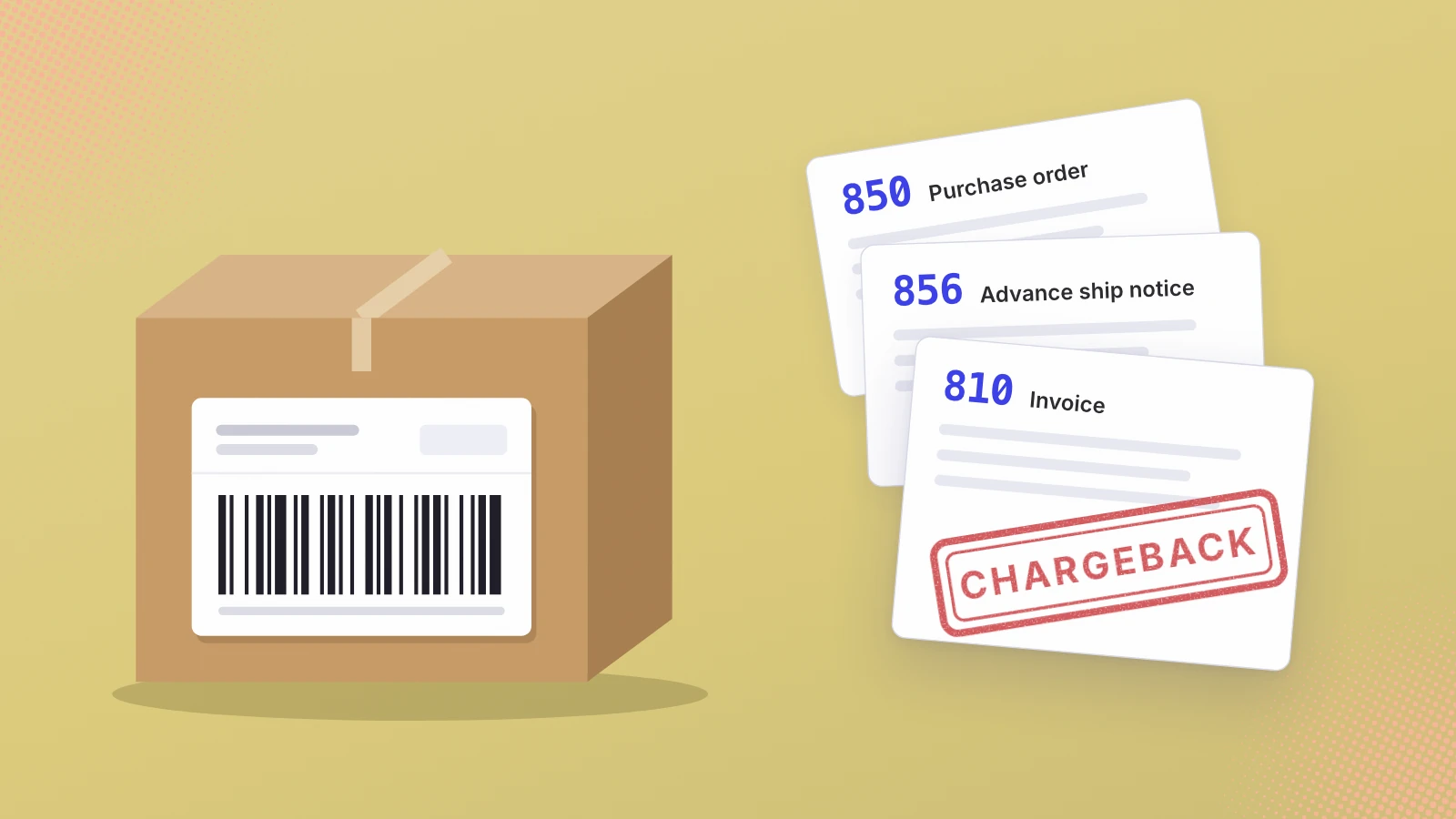
How to get a UPC code for retail is the first compliance question most founders ask, and the cheapest to answer. The costly ones arrive with the first purchase order: EDI, carton labels, routing rules, insurance certificates and the chargebacks that follow a missed requirement. Each is below, with prices and rules from GS1 US, retailers and providers. None of it is legal or insurance advice.
Barcodes are cheap. Missing the rules that come with them is not.
How do you get a UPC code for retail?
License it from GS1 US. You can license single numbers (a GS1 US GTIN) or a GS1 Company Prefix that covers a block of them. GS1 US’s prices in November 2026:
| Barcodes you need | Initial fee | Annual renewal |
|---|---|---|
| 1 (GS1 US GTIN) | $30 | $0 |
| 10 | $250 | $50 |
| 100 | $750 | $150 |
| 1,000 | $2,500 | $500 |
| 10,000 | $6,500 | $1,300 |
| 100,000 | $10,500 | $2,100 |
Count every variant. GS1 US’s FAQ says each variation of a product needs its own GTIN: one style in four colors and four sizes needs 16. Add the new products you expect to launch, and price the prefix that covers them.
Why do retailers want GS1-issued barcodes?
Because the number has to trace back to you. Walmart’s supplier requirements say it “requires a GS1 Company Prefix number on your application documents,” which gives you a unique set of UPCs for its item file. A prefix also numbers your cases and pallets: GS1 US says it lets you “create higher levels of packaging like a case or pallet” (guide to UPCs), and Walmart’s supply chain standards build 14-digit case codes from the full company prefix. Retailers police reuse too: DSW charges $150 per style for reassigning a UPC already used on another item.
So if a chain is your goal, buy a prefix, not single GTINs, and size it for the next few years of products.
Which EDI documents will a retailer ask for?
EDI (electronic data interchange) moves orders, shipping notices and invoices between your system and the retailer’s. The core set, in the order they flow:
| Document | EDI number | Who sends it |
|---|---|---|
| Purchase order | 850 | Retailer to you |
| Functional acknowledgment | 997 | Either side, confirming a message arrived |
| Purchase order acknowledgment | 855 | You, confirming what you can ship |
| Advance ship notice (ASN) | 856 | You, before the truck arrives |
| Invoice | 810 | You, after the goods ship |
| Application advice | 824 | Retailer, flagging errors in your documents |
Each retailer picks its own set. Kroger’s EDI FAQ says it requires most companies to accept purchase orders (850 or 875) and application advices (824) and to send invoices (810 or 880), and asks for ASNs only from selected suppliers on specific programs. It also says accepting a purchase order from a Kroger division is consent to an EDI relationship.
How do small brands get set up with EDI?
Small brands often start with web EDI rather than an integration. SPS Commerce’s guide says small and mid-sized businesses often use web-based services where staff enter the details online and the service sends the documents. Kroger doesn’t require a specific provider. Some providers publish prices: Orderful lists web EDI at $189 a month per trading partner, and carton labels alone from $99 a month.
- Ask for the rules. Get the retailer’s EDI requirements and setup form; Kroger asks new partners for an EDI New Partner Set-up Form.
- Pick a provider. Price it per trading partner, and check it covers carton labels.
- Test before the first live order. Run every document the retailer requires through its testing before real orders flow.
- Load clean item data. UPCs, case packs and dimensions must match your line sheet.
What are retail chargebacks?
Chargebacks are deductions a retailer takes from what it owes you when a shipment breaks its rules. DSW’s vendor chargeback policy, revised June 2026, says their purpose is “not to create revenue for the Company, but to recover operating expenses incurred for correcting vendor errors,” and publishes the schedule:
| Error (DSW, June 2026) | Chargeback |
|---|---|
| No carton label (UCC-128) | $7.50 per carton |
| Duplicate carton label number | $25 per carton |
| ASN (856) missing, late or unusable | $7.50 per carton, minimum $50 per PO |
| Functional acknowledgment (997) missing or late | $250 per message |
| Purchase order not handled by EDI (850 or 860) | $100 per message |
| Missing UPC label on the product | $150 plus $0.50 per unit |
Grocery and mass retailers run similar programs. In 2019 Supply Chain Dive reported that suppliers missing Walmart’s on-time, in-full delivery requirements would be fined 3% of the cost of goods sold; the target has changed since, so ask your buyer for the current one (selling to Walmart). Walmart’s supply chain standards list receiving defects such as no ASN, a late ASN, wrong pack and overage, and say suppliers may have to offset the extra costs.
How do you avoid chargebacks?
- Read the retailer’s routing guide and standards before the first order, and again when they change; Walmart updates its standards twice a year, typically January and July.
- Send the ASN before the truck arrives. Walmart counts one sent after the order arrives at its receiving distribution center as late.
- Label every carton to the retailer’s spec and test-scan the barcodes before you ship.
- Ship exactly what the purchase order says: quantity, pack and date.
- Check every deduction and dispute quickly; DSW wants documentation requests within 60 days.
- Budget a deductions line in your wholesale price, because some will land.
What insurance do retailers require?
Product liability cover, with the retailer named as an additional insured. Walmart’s insurance requirements (February 2025) ask every supplier for general liability of $1 million per occurrence and $2 million aggregate, plus product liability set by the category in its liability matrix:
| Walmart category | Examples | Product liability (occurrence / aggregate) |
|---|---|---|
| Food I(F) | Most food and drink | $2M / $4M |
| Food II(F) | Baby food; fresh produce, meat, seafood, dairy, eggs | $5M / $10M |
| Non-food I | Most other products | $1M / $2M |
| Non-food II | Products for skin or hair, for babies, or battery powered | $5M / $10M |
| Non-food III | Dietary supplements and other high-risk items | $10M / $20M |
Walmart says suppliers outside Category III with annual revenue of $1,000,000 GMV or less may be exempt from these limits if they meet Category I. Kroger’s merchandise vendor requirements ask for $3 million per occurrence in general liability, a vendors endorsement naming Kroger, and insurers rated A- or better by A.M. Best. Price the premium into your cost of goods before you quote.
What is retail ready packaging?
Packaging that goes from the truck to the shelf with little handling. Walmart’s standards cover shelf ready packages (SRP) and PDQ displays, “a pre-assembled display ready for the store floor,” and its supplier page asks whether your cases can ride its conveyors and be labeled and palletized to spec. SPS Commerce sums up shelf-ready design as five “easies”: easy to identify, open, stock, shop and dispose of.
What vendor requirements should you have ready?
Walmart’s requirements page, plus the EDI setup above, makes a fair checklist for any chain:
- A federal taxpayer identification number and a Dun & Bradstreet registration.
- A GS1 Company Prefix and a UPC for every item and variant.
- A certificate of insurance at the limits your category needs.
- Audits, certifications and product testing your category requires.
- Cases, labels and pallets that meet the retailer’s packaging standards.
- An EDI provider, tested before the first order.
After compliance: selling through
Get all of this right and you have earned the right to be judged on sales. Clean shipments keep deductions off your invoices; they don’t make shoppers pick the product up. That part is demand, and it is the part we work on, so weigh this accordingly. Leo for consumer brands turns footage you already own into daily posts and runs creator campaigns that find creators your shoppers follow, and on the Pro plan a tracked link in each post’s first comment shows which clips send people to look for you. A launch video for your “now available” post starts at $500.
If your first purchase order is in and the paperwork is under control, plan the first 90 days of demand next. See how Leo works for consumer brands, and read the founder’s guide to getting into retail stores for the steps around this one.
Compliance keeps the money you earn. Demand is what earns it.
Sources
- GS1 US, Get UPC: barcode costs
- GS1 US, GS1 Company Prefix, barcodes and identification FAQ
- GS1 US, Guide to UPCs
- Walmart, Supplier requirements
- Walmart, Insurance requirements (February 2025)
- Walmart, Supplier liability insurance matrix
- Walmart, Supply chain standards (April 2026)
- Kroger, Merchandise vendor insurance requirements
- Kroger, EDI frequently asked questions
- SPS Commerce, EDI for first-time suppliers
- SPS Commerce, The five easies of shelf ready packaging
- Orderful, Pricing
- Designer Brands (DSW), Vendor chargeback policy (June 2026)
- Supply Chain Dive, Walmart on-time, in-full requirements (2019)
Written by Lera Leonteva. Leo AI makes social video and runs creator campaigns for consumer brands, so we have a commercial interest in the sell-through section of this guide. Prices and rules are from GS1 US, the retailers and the providers’ own pages, read November 2026.