
A retail launch marketing plan runs from the purchase order to about day 90: agree in writing what you may announce, publish your store list, send local creators and demos to your best stores, test the retailer’s own ads, and check sales per store every week. Target Accelerators’ guidance says buyers want demand that is “ongoing, not launch-dependent.”
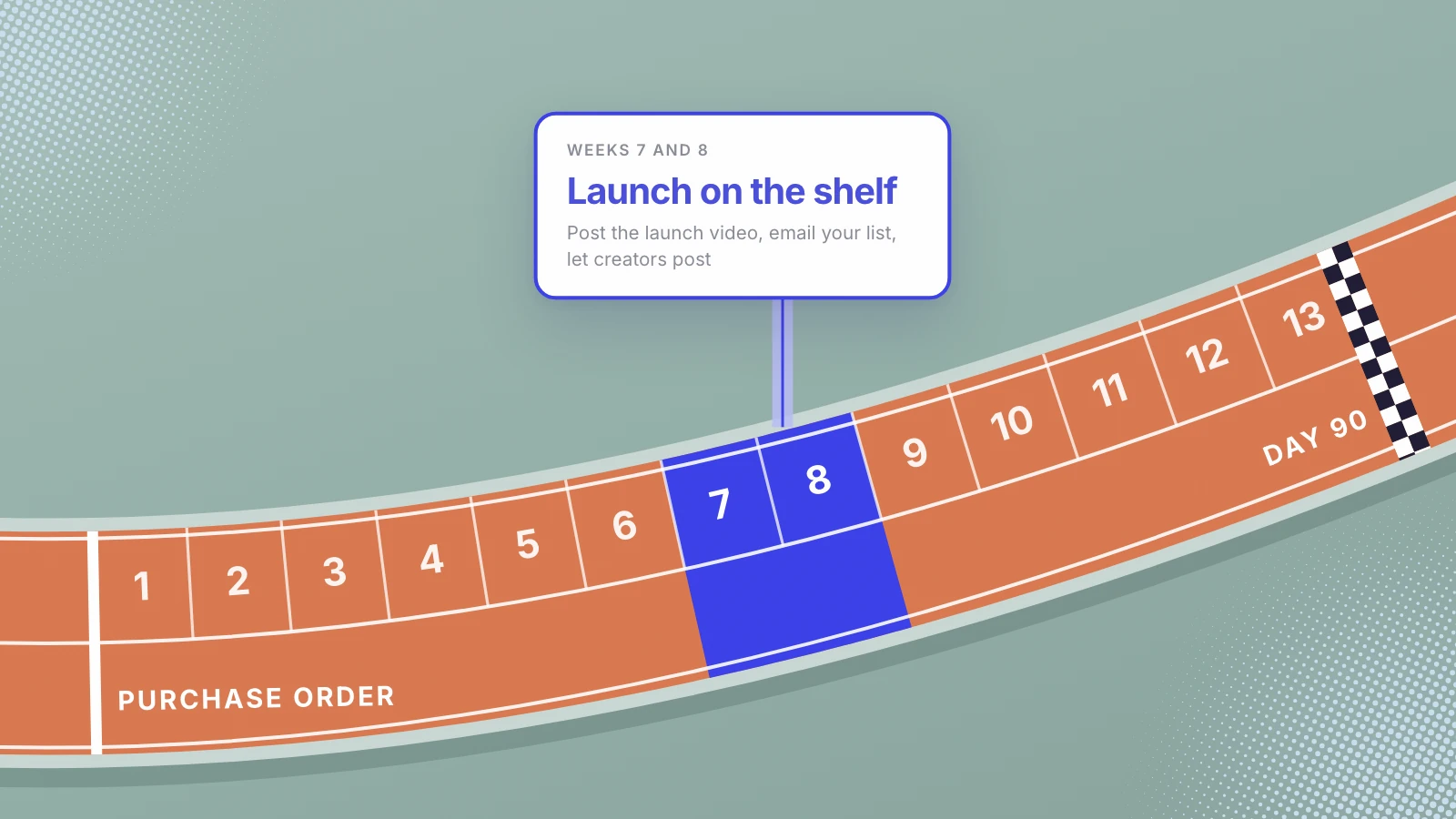
A retail launch marketing plan starts the day the purchase order lands, not the day the product reaches the shelf. The order is the buyer’s bet; the first 90 days are when you show it was a good one. Target Accelerators explains why: velocity, the units your product sells per store per week, is “the number retailers actually care about,” and it decides whether an item keeps its space at the next line review.
Most of that early velocity comes from people who already know you. Jamika Martin, whose skincare brand ROSEN launched into mass retail, wrote on Target Accelerators’ site that she thought retail needed a totally new marketing strategy, then found that “your online community is often the same group that’s going into stores to find you.” This plan points that community at specific stores and keeps doing it after launch week. For the stages before the order, see the founder’s guide to getting into retail stores.
The purchase order is the starting gun. Plan the 13 weeks after it before you ship.
What should a retail launch marketing plan include?
- The rules, in writing. What you may announce, when, and whether you can use the retailer’s name or logo.
- A store list. Which doors carry you, published where shoppers look.
- Local demand. Posts, creators and email aimed at the cities around your stores.
- In-store moments. Demos, sampling and shelf checks in your best doors.
- Retail media. A small test on the retailer’s own ad network.
- A weekly scorecard. Sales per store, stock, and what the marketing moved.
Time the spending to the retailer’s calendar. Target’s guide to retail readiness recommends “marketing investment aligned to key retail windows,” such as more digital spend ahead of a promotion or seasonal feature. It also says retailers typically expect 2 to 4 promotions a year, so your 90-day plan should already know when the first one falls.
What should you do in each week of the first 90 days?
Count week 1 from the day the purchase order lands, and slot the steps around the ship and on-shelf dates your buyer gives you.
- Weeks 1 and 2: get the launch facts in writing. Confirm the on-shelf date, the store list, the first promotion window, how demos are booked and paid for, and what you may say in public and when. Ask who handles retail media for your category.
- Weeks 3 and 4: film before you ship. Shoot product demos, how-to clips, packaging close-ups and the founder explaining who the product is for. This one shoot feeds the launch video and the posts for the rest of the quarter.
- Weeks 5 and 6: build the local plan. Publish a where-to-buy page from the store list. Rank the stores you can most easily reach, find creators in those cities, and brief them on the store, the shelf and the disclosure rules.
- Weeks 7 and 8: launch on the shelf. When you can photograph the product in a store (ask the manager first), post the launch video, email your list with the store finder and let creators post. Name the city and the store, not just the retailer.
- Weeks 9 and 10: put people in the aisle. Book demos or sampling in your best stores and film every one. Start a small retail media test if your buyer agrees.
- Weeks 11 and 12: back the stores that sell. Move creator and ad money toward the stores and cities selling best, and try a demo or a local creator where sales are weakest.
- Week 13: send the 90-day recap. Give your buyer sales per store per week, what marketing ran, what you learned and your plan for the next promotion window.
Creators near your stores need the same disclosure as anyone else. The FTC’s guidance says to disclose any financial, employment, personal or family relationship with a brand, including free products, and to put the disclosure in the video itself, not just in the description. This is general guidance, not legal advice.
Can you post “now available at Target”?
Ask your buyer before you post. Walmart publishes its own rules, and they make a good checklist for any retailer. Its brand guidelines on trademarks say:
- The Spark, the Walmart wordmark and other stylized marks “may only be used by others with our express written permission.”
- Others may be permitted to use the Walmart name “to truthfully convey information,” such as accurately referring to Walmart and its products.
- Don’t imply “an affiliation, partnership, connection, association, sponsorship, approval, certification, or endorsement” that doesn’t exist, and keep Walmart’s marks less prominent than your own.
- Never put Walmart’s name in your handle, account name, domain or product name.
If your retailer doesn’t publish rules like these, ask your buyer two questions and keep the answers in writing: may we name you, and may we show your logo? Announce on the day you can photograph your product on a real shelf, not the day the order arrives, and link to the retailer’s product page. If you are launching at Target, how to get your product into Target covers its supplier process.
How do you promote your product in stores?
In person, and more and more through the retailer’s own media. Walmart Connect’s store ads cover digital screens, in-store audio and experiential formats, which it lists as in-store demos, events, and pickup and delivery sampling. A Walmart Connect case study says a belVita demo campaign in May 2024 handed out more than 130,000 samples across 471 stores. Target’s retail media business, Roundel, said in its June 2026 fact sheet that it will launch “experiential activations like demos, sampling and digital screens” during 2026.
At any retailer, ask your buyer how demos are booked and who pays; the rules differ. Then, with the store’s permission, film every demo. One afternoon at a sampling table gives you a week of posts: first reactions, the question every shopper asks, the shelf behind you.
How do Roundel and Walmart Connect work for a new brand?
Both are the retailers’ own ad networks, open to brands that sell there. The basics, from their own pages:
| What to know | Roundel (Target) | Walmart Connect |
|---|---|---|
| Who can use it | Companies that sell products via Target, per its sign-up page | Brands, Marketplace sellers, vendors and agencies, per its 2020 guide |
| Self-serve start | Roundel Media Studio, which Target calls a self-service tool for “brands of all sizes” to access Target Product Ads | Sponsored Products, cost-per-click ads that lead to Walmart product pages |
| Scale and starting advice | More than 2,000 vendors; ads on Target.com, the app and 150+ partner publishers | A minimum of $100 a day recommended, and at least 30 days before you judge a first campaign |
Two cautions. Retail media is paid reach, and reviews affect it: Walmart Connect lists how many reviews an item has, and their scores, among the factors behind ad placement. And it doesn’t replace your own channels, so keep tracked links on your posts to see what your content does on its own. How to get your product into Walmart covers the supplier side.
What should you measure every week after launch?
The same numbers, on the same morning, every week. Target Accelerators’ example of a weekly retail scorecard covers units per store per week, fill rate, out-of-stock performance, retailer inventory, forecast accuracy, promotional results and consumer feedback. Add three marketing lines to it:
- Clicks from each post’s tracked link, by city.
- Creator posts that went live, and the stores they named.
- New reviews on the retailer’s product page.
Sell-through rate and velocity explains the formulas and how buyers compare you with the category. Every few weeks, send your buyer a short version; what buyers look for on your social media covers the proof worth adding.
Where Leo fits in a retail launch
We sell two things that fit this plan, so weigh this section accordingly. Leo’s launch video studio cuts a 30 to 45 second launch video from your footage, with on-screen text, captions and music cleared for social, in vertical and wide, for $500 in 5 working days, with two rounds of changes. A script and a licensed AI voice make it $700 in 7 working days; adding animated product mockups as well makes it $1,200 in 10. Nobody has to go on camera, and it starts with a free 30-minute call.
Then the demo and launch footage keeps working. Leo for consumer brands indexes it, finds the moments worth posting, cuts captioned vertical clips and schedules them; on the Pro plan, each post can carry a tracked link in its first comment. That covers the posting in weeks 7 to 13 without an editor. Leo doesn’t sell into stores or promise sell-through. It keeps the content side of the plan running.
If you have a purchase order in hand, this is the cheapest week to plan the launch. See how Leo works for consumer brands, then bring your store list to a call and we’ll show you what your footage could post through day 90.
The order puts you on the shelf. The next 90 days decide whether you stay there.
Sources
- Target Accelerators, The right shelf at the wrong time: why retail expansion isn’t a race
- Target Accelerators, Difficult decisions: what every founder should know before entering mass retail
- Target Accelerators, From scrappy to scalable: building a CPG brand ready for retail
- Federal Trade Commission, Disclosures 101 for social media influencers
- Walmart, Brand Center: trademarks
- Walmart Connect, Store ads
- Walmart Connect, belVita in-store demo case study
- Target, Learn more about Roundel, Target’s retail media business
- Roundel, Sign up for Roundel Media Studio onboarding
- Walmart Connect, Easy campaign set up
- Walmart Connect, A beginner’s guide to Walmart Sponsored Products
Written by Lera Leonteva. Leo AI makes social video, launch videos and creator campaigns for consumer brands, so we have a commercial interest in the marketing part of this plan. Retailer facts are from each retailer’s own pages, read November 2026.