
Restaurant brand building in grocery means turning a dish people already love into a product that sells to people who have never eaten at the restaurant. Carbone Fine Food did it by matching the restaurant recipe in a jar, starting in one regional chain, proving sales store by store and keeping a small team. It reported $101.3 million in revenue for 2025.
Restaurant brand building starts with an advantage most founders would envy: people already know the name. The catch is that a shopper in a town without the restaurant has never heard of it, and a jar has to win its place on the shelf on taste and price, without the room, the service or the reservation.
Carbone, the Major Food Group restaurant in New York, is the clearest recent example. Its packaged food company, Carbone Fine Food, put its first sauces on shelves in 2021 and “reached $100 million in five years,” according to Nosh, which has its CEO, Eric Skae, on the Nosh Live agenda on Thursday 3 December with a talk called Launch Code: From $0 to $100MM in 5 Years. I don’t know what he will cover beyond Nosh’s description, and this isn’t a summary of his talk. It is what Skae and Carbone have said in public, and what I’d ask.
A famous name gets you the first meeting. The jar has to earn every meeting after that.
Why is a famous restaurant name a head start, not a plan?
Because the name opens the first doors and then the product is on its own. Skae has said both halves in public. “The restaurants had a certain amount of awareness that we were able to leverage from a marketing standpoint,” he told Food Dive in March 2024. The same month, on the Startup CPG podcast, he said household awareness of Carbone “wasn’t as high as I thought it would be.”
There is a precedent for how far the head start can go, and Skae knows it well. Before Carbone he ran Rao’s Specialty Foods, the sauce company from another New York Italian restaurant; Carbone’s launch release says he led its reorganization, rebranding and sale in 2019. When Campbell completed its purchase of Rao’s owner, Sovos Brands, in March 2024, at an enterprise value of about $2.7 billion, it said Rao’s generated $775 million in annual revenue.
The lesson I’d take: use the name to get into the first stores, then plan as if nobody outside the restaurant’s cities has heard of you. Momofuku took a different route from a similar start; our post on emotional brand building follows it.
How do you turn a restaurant dish into a shelf-stable product?
You rebuild the recipe for a factory, then prove it still tastes like the restaurant. “We took their recipe and adapted it for commercial cooking,” Skae said in 2024. Food Dive reported that the founders left Manhattan at 3 a.m. to reach the production facility in central Pennsylvania three hours later while they worked on the formula, and Skae told Good Morning America that getting the marinara right “might’ve taken six or seven months.”
The promise on the jar was the restaurant’s process. Carbone’s 2021 launch release contrasted typical sauces, which mix tomato paste with dehydrated ingredients “in a process lasting only eight minutes,” with its own, which take “approximately one hour to produce.” The sauces launched at $8.99 a 24-ounce jar. Even the label came from the dining room: “That label is the menu at Carbone,” Skae said. Its website still sells the restaurant: “Now you can taste the hype, no reservation needed.”
A jar also brings rules a restaurant kitchen never faces. The FDA requires commercial processors of shelf-stable acidified and low-acid canned foods to register each establishment and file scheduled processes for each product. It defines an acidified food as a low-acid food with acids added, with a finished equilibrium pH of 4.6 or below and a water activity above 0.85. Ask your co-manufacturer which rules apply to your recipe before you set a launch date. This isn’t legal or food-safety advice.
How did Carbone get from first doors to national grocery?
One region at a time, using each region’s sales to win the next. Skae signed with Major Food Group on 29 October 2020, and by 1 March 2021 the sauce was on the shelves of its first customer, Stop & Shop, he said in 2024. At launch, Nosh reported a plan to focus on the tri-state area, then move up and down the East Coast, and only then into other regions. “I won’t go West until I can go to those retailers and say, ‘hey here’s what we’ve done out here and this is why you should have us,’” he told Good Morning America that April.
| When | Where Carbone Fine Food was | Source |
|---|---|---|
| March 2021 | First shelves: Stop & Shop in five Northeast states, plus online | Launch release |
| March 2024 | About 20,000 doors, and launching at Walmart | Startup CPG podcast |
| September 2025 | About 25,000 to 26,000 doors | Startup CPG podcast |
| August 2026 | More than 30,000 stores; $101.3 million in revenue for 2025 | Inc. |
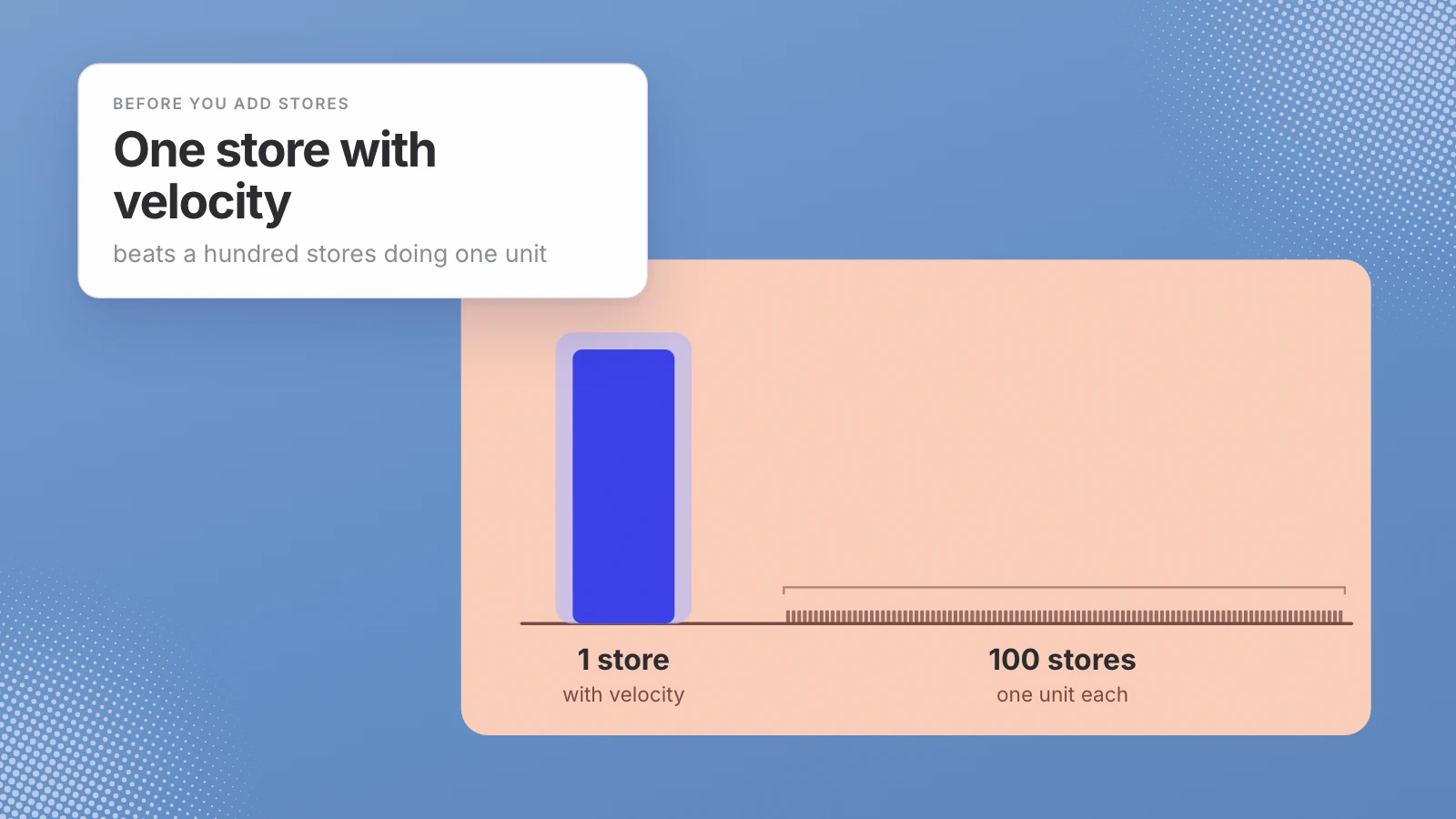
His rule for the early stage is the part I’d copy first. “Get me one store that’s got velocity,” he said on the podcast in September 2025. “Don’t go out and get a hundred stores that are doing one unit.” Velocity is sales per store per week; our guide to sell-through and velocity shows how buyers read it. Brokers and distributors usually open the next doors, and our guide to brokers and distributors covers who does what.
What does a run-lean playbook look like at $100 million?
Few people, little outside money, and marketing that follows distribution instead of leading it. Nosh says Carbone Fine Food grew to $100 million “while maintaining a lean organization,” and Skae has filled in the details himself:
- Team. “We’re at 35 people,” he said in 2025. “I like running small, lean teams.” Before launch it was him and one colleague: “We hired no one else.”
- Capital. “We funded the business ourselves to this point with a credit line,” with one outside investor from day one.
- Margin before volume. “Volume just doesn’t always get you margin,” he said in 2024, after freight from Italy “went through the roof” and tomatoes doubled in price following launch.
- Distribution before marketing. “I hate to market to empty shelves.”
- Borrowed attention. He told Inc. that an April Fools’ collaboration with Califia Farms generated $4.8 million in earned media value, by the company’s own count.
Pricing is where a lean company gets squeezed first. Our wholesale pricing guide works a shelf price back to what the brand keeps.
Questions to ask Carbone’s CEO at Nosh Live
Launch Code runs from 10:10 to 10:35 a.m. Pacific on Thursday 3 December in the California Ballroom at the Marriott Marina del Rey, according to the Nosh Live agenda, which notes that all times are subject to change. Nosh says Skae will cover the decisions “from launch to retail expansion” and what other brands “can borrow from his run-lean playbook.” These are the questions I’d want answered:
- What did the Carbone name open, and what did it not open?
- What did you decide not to build, hire or buy as you grew?
- How did you choose the next region, and which number had to be true first?
- Which part of the restaurant did you refuse to change for the jar?
- What would you do differently without a famous name?
Where Leo fits
I run Leo, so weigh this section accordingly. Nothing in Carbone’s story depends on software like ours, and Leo doesn’t open retail doors. What a restaurant brand has, more than most food startups, is footage: a kitchen, chefs, regulars and events, all of which can reach the shoppers who will never get a table.
Leo for consumer brands turns footage you already own into captioned vertical clips, finds the right moment by what is said in it, and keeps them posting on a schedule. For the launch itself, our studio’s launch cut is a 30 to 45 second video made from your footage, $500 in 5 working days, with captions and music cleared for social. Nobody has to go on camera.
If your restaurant already has the following and you are planning the jar, start with one store and one number. When you’re ready to show people the kitchen behind it, tell us who buys from you and we’ll show you how many posts are already sitting in your footage.
Sources
- Nosh, Nosh Live 2026 agenda: two days in LA
- Nosh, Nosh Live 2026 agenda
- Nosh, Nosh Live LA 2026: CEOs map the course from startup to challenger (Oct 2026)
- Carbone Fine Food, Iconic NYC restaurant Carbone launches line of pasta sauces (Mar 2021)
- Nosh, Secret sauce: Skae to head Carbone Fine Food (Feb 2021)
- Good Morning America, What the CEO says is next for Carbone after its pasta sauce launch (Apr 2021)
- Food Dive, Carbone Fine Food CEO leads another restaurant brand to pasta sauce success (Mar 2024)
- Campbell’s, Campbell completes acquisition of Sovos Brands (Mar 2024)
- Inc., How a beloved NYC restaurant became a $101 million brand (Aug 2026)
- The Startup CPG Podcast, #131 The rise of Carbone Fine Food with CEO Eric Skae, transcript (Mar 2024)
- The Startup CPG Podcast, #212 King of sauce: how Eric Skae has grown Carbone Fine Food, transcript (Sep 2025)
- U.S. Food and Drug Administration, Acidified and low-acid canned foods: guidance and regulatory information
- Carbone Fine Food, Dinner is the show
Written by Lera Leonteva. Leo AI makes social and launch video and runs creator campaigns for consumer brands, so we have a commercial interest in the marketing part of this guide. Company facts are from the company’s own releases, its CEO’s published interviews and named reporting, read November 2026.