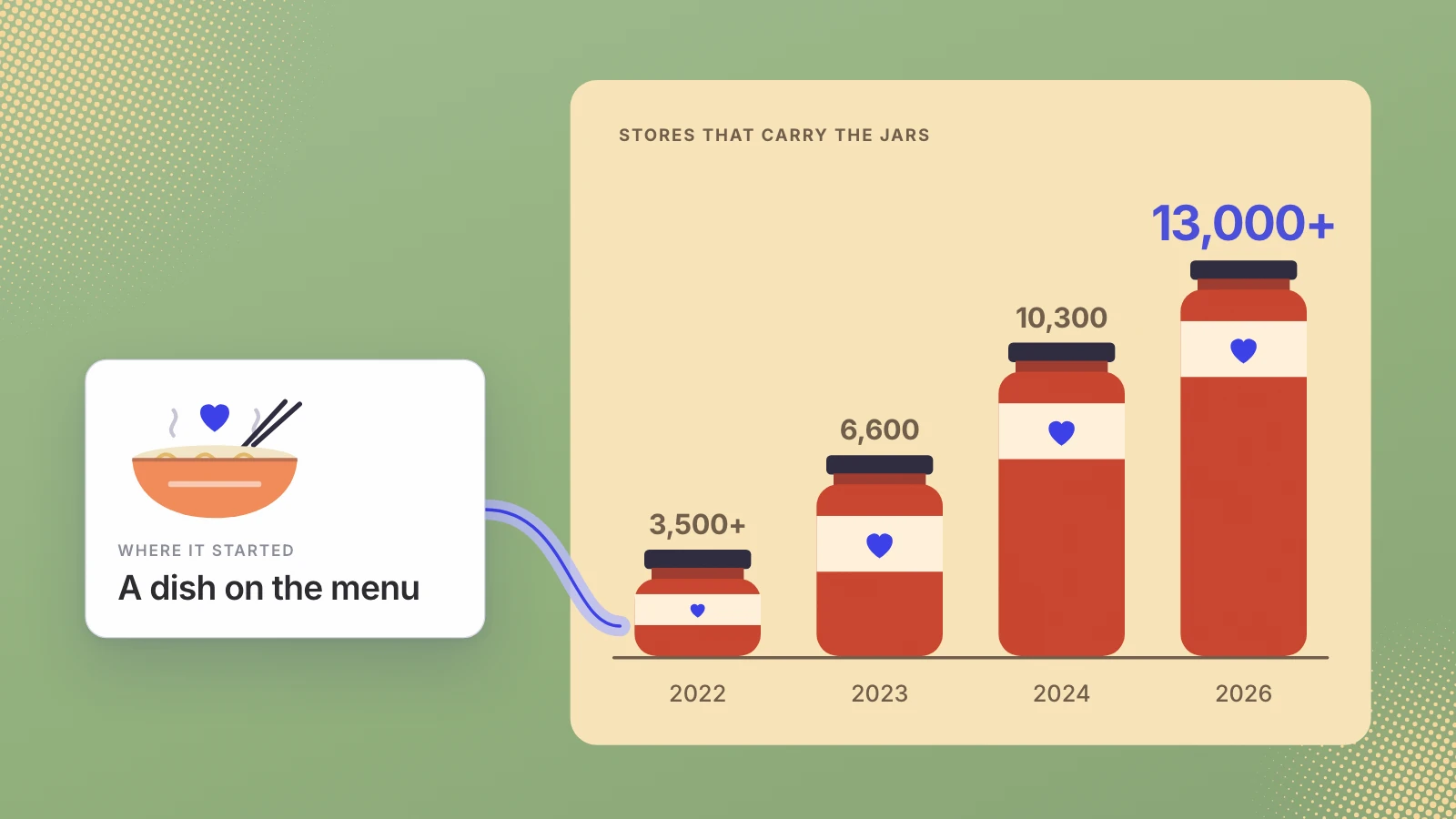
Emotional brand building means giving shoppers a reason to choose you that isn’t the price: a flavor, a ritual, a person or a place they recognize. Momofuku shows the pattern. Its grocery line began as dishes people had eaten at its restaurants and grew to more than 13,000 stores while keeping that origin on every jar.
Emotional brand building is the work of giving shoppers a reason to pick you that has nothing to do with the price tag. In grocery that reason is usually small and specific: a flavor they first tasted somewhere, a ritual, a person they trust. A discount can win the first purchase. A feeling is what brings people back when the store brand sits next to you for less.
Momofuku is a useful case because its feeling started in one place. Founded by Chef David Chang in 2004 with Noodle Bar in New York, Momofuku now has a packaged food company, Momofuku Goods, selling Chili Crunch, noodles and sauces in more than 13,000 stores. On Friday 4 December two chief executives, Marguerite Zabar Mariscal of Momofuku Holdings and Paddy Spence of Momofuku Goods, are on the Nosh Live agenda with a session called Momofuku on the Mind: Brand as Emotional Connection. I don’t know what they will say, and this isn’t a summary of their talk. It is what the public record shows, and the questions I’d want answered.
The feeling has to survive the trip from the dining room to the shelf.
What is building brand loyalty, beyond discounts and points?
Brand loyalty is a shopper choosing you again, at full price, when a cheaper option sits on the same shelf. Coupons and points can buy repeat visits, but they rent the habit rather than own it: stop paying and the reason to come back goes with them.
The cheaper option keeps getting stronger. Store brands reached a record $282.8 billion in U.S. sales in 2025, according to the Private Label Manufacturers Association, using Circana data. Their dollar sales grew 3.3% against 1.2% for national brands, and their share of dollar sales rose from 19.1% to 21.3% over five years. A brand whose only argument is a promotion is competing with a retailer that controls both the shelf and the price.
Feeling is the argument a store brand finds hardest to copy. Three researchers writing in Harvard Business Review reported that, across hundreds of brands, customers who are emotionally connected are “anywhere from 25% to 100% more valuable in terms of revenue and profitability” than those who are merely highly satisfied. The figure is from 2015, so I’d read it as a direction rather than a forecast.
Why do some food brands feel personal?
Because they come from somewhere you can picture: a real place, person or habit that every product keeps pointing back to. Momofuku’s own site opens with its origin, the noodle bar, and explains that the name means lucky peach; a peach is its logo.
Mariscal, who joined Momofuku as an intern in 2011 and became CEO in 2019, has described the restaurants as the advantage. Being a known restaurant “gives us a leg up because we already have a relationship with a lot of the customers that are coming through,” she told Modern Retail in 2023. The “restaurant grade” line on some products, she said, means “it has the stamp of approval of these restaurants.”
I think that is the core of it. Nobody feels loyal to chili oil as a category. People feel loyal to the specific jar that reminds them of a meal, or that they first saw in the hands of someone they follow.
What carries over from a restaurant following to a grocery shopper?
The dish carries over; the dining room doesn’t. A grocery shopper can’t taste the room, so the product has to bring the memory with it, and the brand has to reach people who never ate there. Momofuku’s sequence, as Inc. reported it in August 2025, shows how the following turned into distribution:
| When | What happened | Source |
|---|---|---|
| May 2020 | 5,000 jars of Chili Crunch listed online; they sold out almost instantly | Inc. |
| 2021 | Noodles launch to a 40,000-person waitlist; in March a Whole Foods buyer asks for Chili Crunch | Inc. |
| End of 2022 | More than 3,500 stores | Inc. |
| End of 2023 | 6,600 stores | Inc. |
| December 2024 | 10,300 stores; store sales pass online sales for the first time | Inc. |
| February 2025 | Paddy Spence, formerly CEO of Zevia and founder of SPINS, named CEO | Momofuku Goods |
| September 2026 | Five sauces launch; the brand is in more than 13,000 stores | Momofuku Goods |
Three things traveled with the product:
- The dish. Momofuku says it spent a decade tweaking the Chili Crunch formula in its restaurants, and each of its five new sauces names the dish it came from, from the chicken marinade at Bāng Bar to the galbi marinade at Majordomo in Los Angeles.
- The kitchen’s look. Inc. describes the packaging’s “signature peach logo and tape-style graphics that mimic restaurant back-of-house labeling.”
- The conversation. When the company rebuilt its noodles in 2025, Spence said the update followed “thousands of reviews, DMs, and emails offering praise and suggestions.”
The business model didn’t carry over. When Mariscal asked CPG (consumer packaged goods) veterans for advice, she told Inc., “We got pretty much a universal ‘Do not do this.’” Scaling meant going from orders of 5,000 units to 50,000, and by 2023 Modern Retail counted an 18-member team across sales, operations and finance for the packaged goods side alone.
Can emotional connection backfire?
Yes, because fans start to feel the brand partly belongs to them. In April 2024 Momofuku said it would not defend its trademark on “chile crunch” after cease-and-desist letters to other businesses using the term “sparked an outcry,” AP reported.
The lesson I take is about who else shares the feeling. A brand built on a cuisine sits inside a wider bond with the people who cook it, sell it and grew up with it. How you treat smaller makers, suppliers and fans becomes part of the product, in the same way the recipe is.
How can founders build the bond without a famous restaurant?
Start from the one real story you have and repeat it everywhere. Most founders don’t have a dining room full of fans, but nearly every food brand starts with a recipe, a kitchen, a person or a place. These are the five moves I’d make:
- Name the origin in one sentence. The dish, person or place it came from, said the same way on the pack, the site and every post. Momofuku’s is “from the team behind Momofuku restaurants”; yours might be a family recipe.
- Teach a ritual, not just a recipe. Show three or four ways the product fits a normal week, as Momofuku does with its community’s top-rated recipes.
- Keep the maker visible. Put the person who made it, and where, in the first seconds of your videos and on the side panel.
- Listen in public, then change something. When fans’ suggestions change a product, say so.
- Protect the name without fencing in the community. Check a name before you print it, and think about how enforcing it will look to people who share your cuisine.
If you are heading into retail, two of our guides cover how that demand shows up for a buyer: what retail buyers look for on your social media, and your first 90 days on shelf.
Questions to bring to the Momofuku session at Nosh Live
Momofuku on the Mind is a 25-minute session from 12:20 to 12:45 p.m. Pacific on Friday 4 December, according to Nosh’s Friday program, at the Marriott Marina del Rey. Nosh says the two CEOs will explore how the company built “an emotional connection with grocery shoppers” and how entrepreneurs “can identify and amplify that connection for their own brands.” If I were in the audience, these are the answers I’d want:
- What told you a restaurant fan would buy a jar in a supermarket?
- What did you change so a dish worked at home, and what did you refuse to change?
- How do you measure emotional connection, beyond repeat purchase?
- How do shoppers who have never eaten at a Momofuku restaurant find the brand?
- What can a founder without a restaurant borrow first?
Nosh says all agenda times are subject to change, so check the program the week before.
Where Leo fits
I run Leo, so weigh this section accordingly. Leo can’t create a feeling the product doesn’t earn, and it doesn’t get anyone onto a shelf. Where it helps is the part of emotional brand building that now happens on a phone: showing the kitchen, the maker and the ritual often enough that people remember them.
Leo for consumer brands turns footage you already own, such as cooking demos, founder talks and a day of tastings, into captioned vertical clips. It finds each moment by what is said rather than by file name, and schedules the posts. It also runs creator campaigns aimed at creators whose followers match your buyers. The FitCommit campaign: 124 creators found, 17 said yes. On the Pro plan, each post can carry a tracked link in its first comment, so you can see which clips send people to your site.
If you are building a food brand without a famous dining room, start with the one story you can tell in a sentence. Then tell us who buys from you and we’ll show you the creators they follow.
Sources
- Nosh, Nosh Live 2026 agenda: two days in LA
- Nosh, Nosh Live 2026 agenda, Friday 4 December (printable)
- Nosh, Nosh Live 2026 agenda
- Momofuku, About: our story
- Momofuku Goods, Momofuku Goods names Paddy Spence as CEO to lead next phase of growth (Feb 2025)
- Inc., How Momofuku Goods became a $67 million powerhouse (Aug 2025)
- Modern Retail, Restaurants like Momofuku are expanding to grocery stores (Mar 2023)
- Momofuku Goods, Momofuku Goods launches a new collection of sauces (Sep 2026)
- Momofuku Goods, Momofuku Goods reimagines its best-selling noodles (Oct 2025)
- Momofuku Goods, Chili Crunch
- Momofuku Goods, 4 ways to use our Chili Crunch
- Momofuku Goods, Chili Crunch sushi dip
- AP News, Momofuku backs down from ‘chile crunch’ trademark war (Apr 2024)
- Harvard Business Review, What separates the best customers from the merely satisfied (Dec 2015)
- PLMA, U.S. private label industry reached $282.8 billion in sales in 2025
Written by Lera Leonteva. Leo AI makes social video and runs creator campaigns for consumer brands, so we have a commercial interest in the marketing part of this guide. Event and company facts are from their own pages and named reporting, read November 2026.