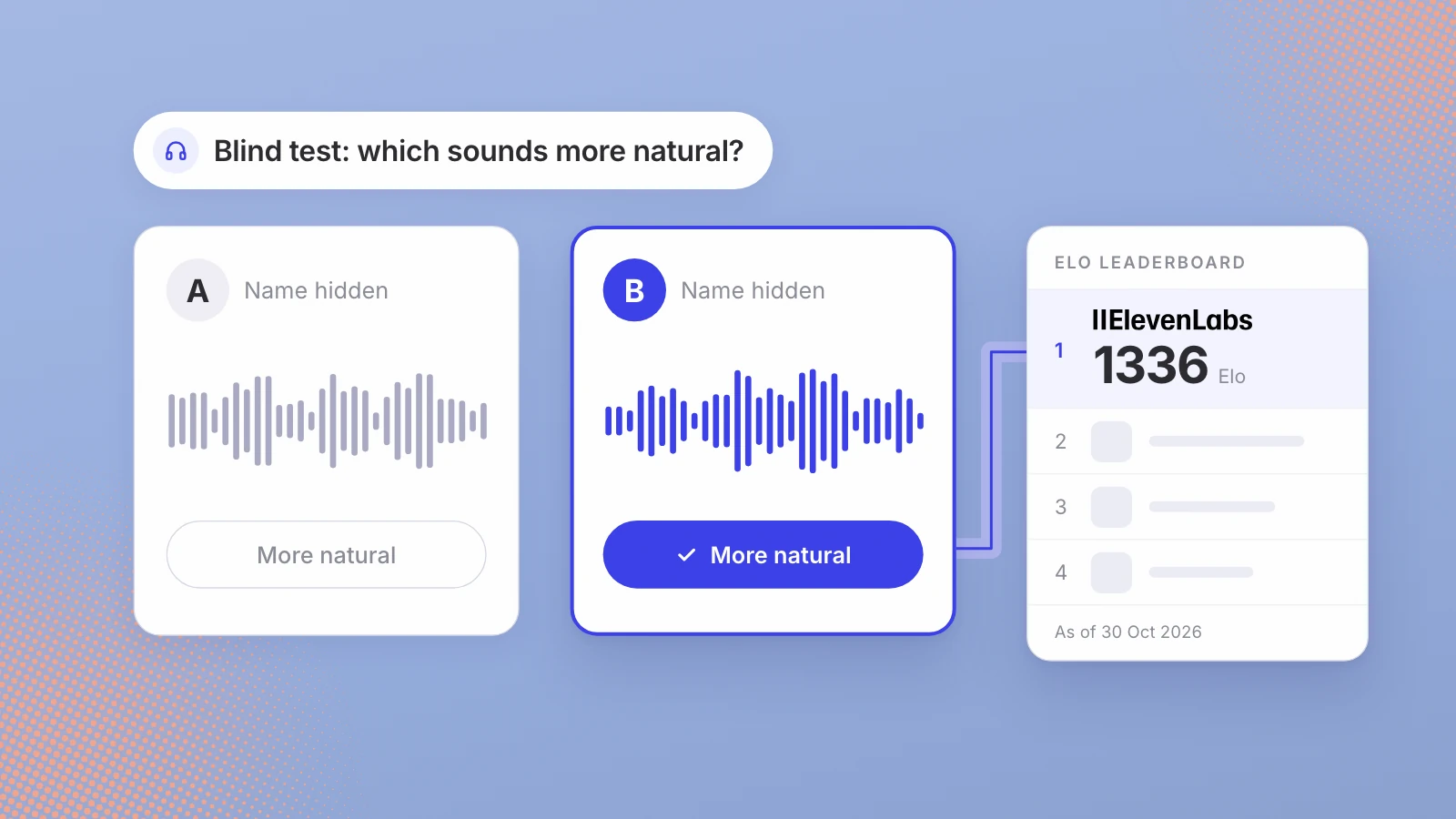
As of 30 October 2026, the most realistic AI voice by blind listener votes is ElevenLabs’ Eleven v4 Turbo, at an Elo of 1336 on the Artificial Analysis Speech Arena. Eleven v4 is two points behind, so the two are effectively tied, with Alibaba’s Qwen-Audio-3.1-TTS-Plus and Cartesia’s Sonic 3.6 next. For a real voiceover, test the leaders on your own script.
Search for the most realistic AI voice generator and much of what comes back is published by companies that sell a voice tool. A vendor’s list has every reason to put its own tool first. That doesn’t make every list wrong, but it does mean the order was never the neutral part.
There is a neutral way to ask the question. The Artificial Analysis Speech Arena plays listeners two clips of the same text from two hidden models and asks which they prefer. Thousands of those votes become a ranking. Below is its top 10, what the scores mean, and the parts of a real voiceover a blind vote can’t see.
If you want a realism ranking no vendor wrote, start with blind votes.
What is the most realistic AI voice generator in 2026?
As of 30 October 2026, ElevenLabs holds the top two places on the Speech Arena’s provider voice leaderboard: Eleven v4 Turbo at an Elo of 1336 and Eleven v4 at 1334. The arena’s own rank range puts both at 1 to 2, which means it can’t yet separate them. Alibaba, Cartesia and Google take the next three places.
| # | Model (provider) | Elo | Rank range | Price per 1M characters |
|---|---|---|---|---|
| 1 | Eleven v4 Turbo (ElevenLabs) | 1336 | 1 to 2 | $40.0 |
| 2 | Eleven v4 (ElevenLabs) | 1334 | 1 to 2 | $80.0 |
| 3 | Qwen-Audio-3.1-TTS-Plus (Alibaba) | 1305 | 3 to 4 | $19.3 |
| 4 | Sonic 3.6 (Cartesia) | 1296 | 3 to 5 | $49.0 |
| 5 | Gemini 3.8 Flash TTS (Google) | 1283 | 4 to 6 | $16.5 |
| 6 | Fish Audio Drama 3 (Fish Audio) | 1278 | 4 to 9 | $15.0 |
| 7 | Qwen-Audio-3.0-TTS-Plus (Alibaba) | 1269 | 6 to 10 | $19.3 |
| 8 | Realtime TTS-2 (Inworld) | 1267 | 6 to 10 | $20.8 |
| 9 | Lightning V3.1 Pro, Oct 2026 (Smallest.ai) | 1266 | 6 to 10 | $19.5 |
| 10 | Gemini 3.8 Flash-Lite TTS (Google) | 1259 | 7 to 11 | $11.0 |
Elo, rank range and price as published by Artificial Analysis on 30 October 2026. Price is what it calculates for generating 1M characters on the model creator’s API at default settings. The board lists 100 models and is recomputed several times a day, so check it before you quote it.
Three things stand out in that table:
- The top ten span 77 points, from 1336 down to 1259, and every one of them was released between August and October 2026.
- Price doesn’t follow rank. Eleven v4 lists at $80 per 1M characters and Eleven v4 Turbo at $40, two points apart. The tenth model is $11.
- Older, well-known models sit well down the board. OpenAI’s TTS-1 HD, which the leaderboard dates to November 2023, is 42nd at 1106, and TTS-1 is 49th at 1089.
How does the Speech Arena rank AI voices?
Artificial Analysis publishes its method in full. The parts that matter for reading the table:
- Each vote compares two clips generated from the same text prompt by two different models.
- A voter has to play part of each clip before voting; the arena page asks for at least 3 seconds of each. Then they pick the one that sounds more natural, in the leaderboard’s words. There is no tie button.
- Clips are loudness-normalised to a common target, so a louder clip can’t win on volume.
- On the provider voice board, each model speaks with up to 8 of its maker’s own voices (two each of US and UK, male and female), chosen by how prominent they are in the provider’s interface and documentation.
- Prompts come from four use cases (customer service, entertainment, knowledge sharing and assistants) and include awkward material such as alphanumeric strings and number sequences.
- Most published ratings come from a paid panel of native English speakers living in the US or UK. Votes pass automated screening before they count.
“Model names are hidden until after voting, presentation order is randomized”
Artificial Analysis, Text to Speech benchmarking methodology
The votes are fitted with a Bradley-Terry model and reported on the standard Elo scale, with one model fixed at 1000 as the anchor (on this board, Zonos-v0.1). Artificial Analysis also states that it takes no payment from providers for listings or results.
One caveat matters if you are choosing a voice rather than a model. Because the provider board uses each maker’s own voices, a vote rewards the model and the voice together. The separate controlled voice leaderboard clones the same 8 reference voices into every model to pull the two apart, and the order shifts: as of 30 October 2026, Eleven v4 and Eleven v4 Turbo are 4th and 5th there, and Qwen-Audio-3.1-TTS-Plus is 2nd. If you plan to use a vendor’s stock voices, the provider board is closer to what you will actually get.
What do Elo gaps between AI voices actually mean?
An Elo gap converts into how often listeners should prefer the higher model in a head-to-head vote. On the standard scale the arena uses:
| Gap | Example, as of 30 October 2026 | Expected share of votes for the higher model |
|---|---|---|
| 2 points | Eleven v4 Turbo (1336) vs Eleven v4 (1334) | About 50%, a coin toss |
| 77 points | 1st (1336) vs 10th, Gemini 3.8 Flash-Lite TTS (1259) | About 61% |
| 148 points | Gemini 2.5 Pro, Dec 2025 (1042) vs Neural2 (894) | About 70% |
| 230 points | 1st (1336) vs OpenAI TTS-1 HD (1106) | About 79% |
Read the top ten that way and the gaps are small. The leader would be expected to win about six votes in ten against the tenth model, not ten in ten. Each score also carries a margin: the published 95% intervals for the top ten run from ±13 to ±18 points. The ranking is good at telling you which models are in the leading group. It is much weaker at telling you which one in that group will win on your script.
Hear a generation gap
On 30 October 2026 we sent one 101-word launch script to four Google text-to-speech models. Two of them sit far apart on the arena: Neural2, which the leaderboard dates to June 2022, at 894 (95th of 100), and Gemini 2.5 Pro, listed as the December 2025 version, at 1042 (72nd). We can’t confirm Google served our clip from the exact build the arena tested. They are also different voices, the same mix the provider board votes on. Press play on both.
On everything we measured, the two clips are close: 37.6 and 37.8 seconds, 161 and 160 words a minute, 13 pauses each, -19.1 and -19.0 LUFS. A Whisper transcript of the Neural2 clip heard the URL as “leo-i.io”, while the Gemini 2.5 Pro transcript matched every word of the script. Pro took 28.3 seconds to answer; Neural2 took 2.0. Whatever difference you hear between them is what the arena votes on, and none of our numbers capture it.
Neither model is anywhere near today’s top ten. The full test has all six clips, the method, and the newer models we couldn’t include.
What a blind vote can’t tell you about a voiceover
The arena measures one thing well: which of two clips a careful listener prefers, heard side by side at matched loudness. A launch voiceover has to do more than that, and the ranking is silent on all of it:
- Forty seconds, start to finish. A vote can be cast after 3 seconds of each clip. Your script has to hold its pace and energy to the last line.
- Your product name, price and URL. These are where reads go wrong. Artificial Analysis scores pronunciation in a separate benchmark, and our script guide covers the fixes you can make in the text.
- The mix. Arena clips play alone. Yours plays under music, over cuts, often from a phone speaker.
- Whether you can run it in an ad. A vote says nothing about licence terms or AI labels. This guide to commercial use does.
- Fit and familiarity. Whether the voice suits your buyer, and whether your audience has heard it on a hundred other videos. Matching a voice to your buyer and why AI voiceovers sound the same take those on.
It is also why, in our launch video studio, the voice is chosen by ear on the customer’s own script rather than taken from a ranking.
Is there a free realistic AI voice generator?
Yes, within limits. Three providers in the arena’s top ten publish a free plan on their own pricing page, as read on 30 October 2026:
- ElevenLabs: Free, $0 a month, with 10k credits a month (pricing).
- Cartesia: Free, $0 a month, with 20K credits a month (pricing).
- Fish Audio: Free Tier, $0 a month, with 8,000 credits a month and up to 7 minutes of generation (plans).
Credits aren’t characters, and each vendor counts them differently, so the fair comparison is your own script run through each. The other free route is open weights, models you can download and run yourself. The highest-ranked open-weights model on the board is Fish Audio Drama 3, sixth at 1278. Running one yourself still means reading its licence; the leaderboard has an “Open Weights Commercial” filter for exactly that.
Whether a free plan lets you use the audio commercially is a separate question with a different answer per vendor. Can you use an AI voice in ads? goes through it.
What about the Reddit answers?
People add “reddit” to this search because they want an answer from someone who isn’t selling. That instinct is right. But a thread is a handful of people who usually know which tool they are hearing, and you can’t always tell who works for whom. The arena asks the same question blind, with names hidden and votes screened.
I’d use threads for what the arena doesn’t cover: how a tool copes with long scripts, billing surprises, export formats. I’d use the arena for the realism question.
How to choose a realistic AI voice for a launch video
Use the leaderboard to build a shortlist, then decide by ear on the real script. Take three to five models from the leading group, render your full script with each, and listen on a phone, under your music. The leaderboard picks a winner on a prompt; your video needs one that holds up for 40 seconds on your own words.
That last step is the one we do for customers. In the voice tier of our launch video studio, we write the script with you, send three realistic AI voices reading it, and you pick by ear or ask for another read. A launch cut with a realistic voice is $700, delivered in 7 working days, cleared for posts and paid ads, and never a clone of a real person’s voice.
Let the blind vote build the shortlist. Let your own script make the choice.
Sources
- Artificial Analysis, Text to Speech leaderboard (Provider Voice Arena)
- Artificial Analysis, Controlled Voice Arena leaderboard
- Artificial Analysis, Text to Speech benchmarking methodology
- Artificial Analysis, Speech Arena
- ElevenLabs, Pricing
- Cartesia, Pricing
- Fish Audio, Plans
Written by Lera Leonteva. Prices and rules change; each one is linked to its own page, read October 2026.