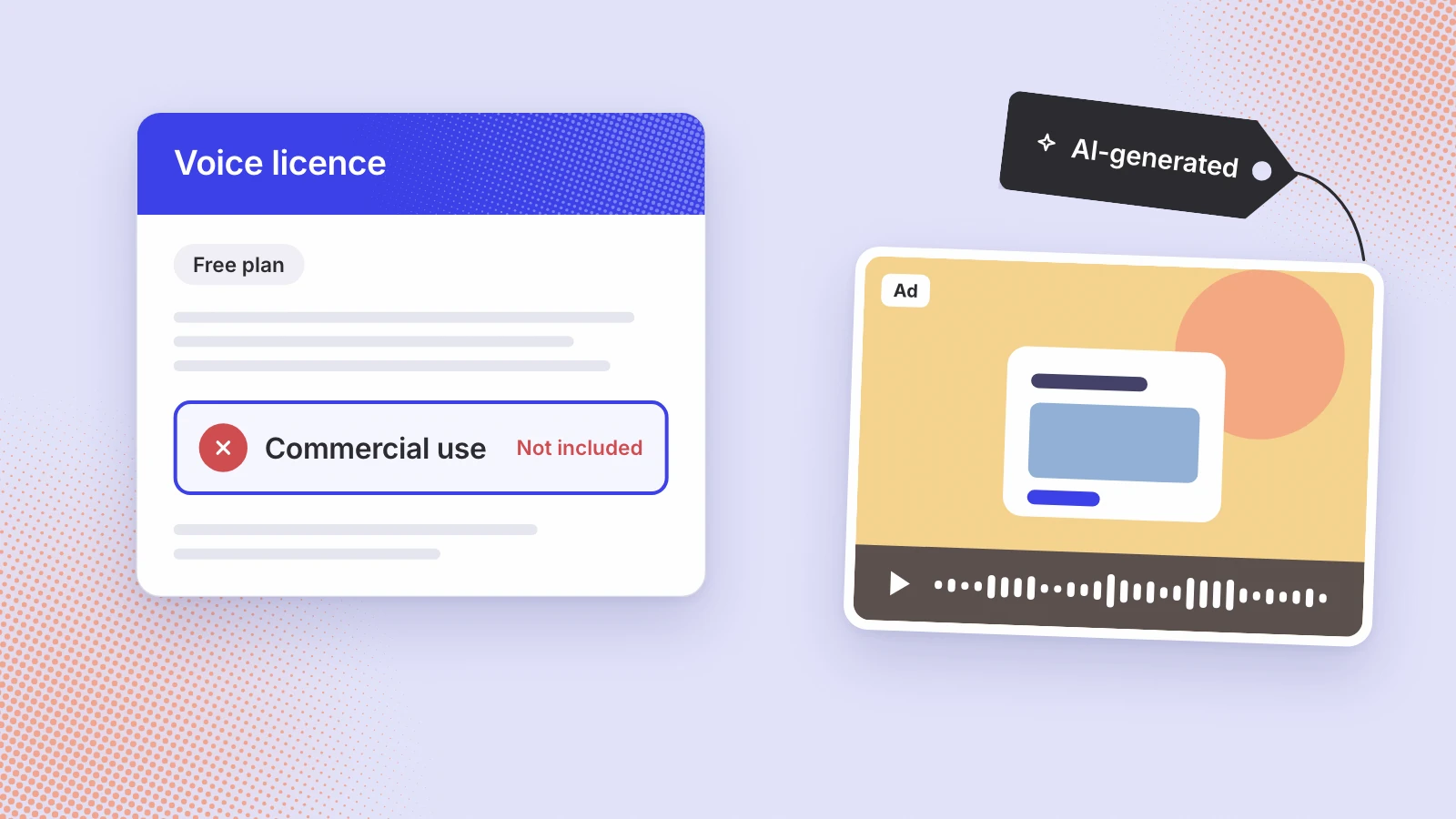
Yes, on a paid plan. ElevenLabs, Cartesia and Speechify Studio all keep commercial use off their free plans. Then label it where the platform asks: TikTok requires an AI label or disclaimer on ads with fully AI-generated audio, and YouTube and Meta ask for one on realistic AI content. Never clone a real person’s voice without consent.
Most answers to this question are second-hand summaries, and they disagree with each other. So on 30 October 2026 I read the vendors’ and the platforms’ own pages instead. An AI voice in an ad has to clear four separate rulebooks, and each one is written by someone different.
The licence, the vendor’s own rules, the platform’s label and whose voice it is. An ad needs all four.
One note first: this is a summary of published terms and policies, not legal advice. If your ad runs on broadcast TV, or sells something regulated, ask a lawyer who knows the markets it runs in.
Can you use a free AI voice generator for commercial use?
Not with the hosted tools I checked. An ad is the plainest commercial use there is, and each of these keeps commercial use off the free plan:
| Tool | Free plan | What a paid plan adds |
|---|---|---|
| ElevenLabs | “Does not include a commercial license and cannot be used for any commercial purpose” (help centre) | “All paid plans include a commercial license”, except for output from its Beta Services |
| Cartesia | “Personal, non-commercial use only” unless your tier allows more (terms, 4.1) | Pro, the first paid plan, lists a “Commercial use license” (pricing) |
| Speechify Studio | “No commercial usage rights” on the free card (pricing) | Studio Starter lists “Commercial usage rights” |
Two details matter more than the table. First, ElevenLabs says content created outside a paid subscription, “before or after”, cannot be used commercially. Upgrading on launch day doesn’t license the clip you made on the free plan last week, so generate the final read again once you are paying. Its terms of use put it plainly: a free user “may only use the Services for non-commercial purposes”.
Second, Cartesia’s terms name advertising outright. Unless your tier allows it, you may not use the service for “communicating or facilitating any commercial advertisement or solicitation”. Free ElevenLabs output has a further catch: if you publish it, you must credit ElevenLabs with “elevenlabs.io” or “11.ai” in the title. Nobody wants that on a launch ad.
What those paid plans cost, and how that compares with hiring a person, is in AI voice vs a voice actor.
Do AI voice tools make you say the voice is AI?
Some do, in their own terms, whatever the platform asks. OpenAI’s text-to-speech guide puts it in one sentence:
“Our usage policies require you to provide a clear disclosure to end users that the TTS voice they are hearing is AI-generated and not a human voice.”
OpenAI, Text to speech guide
If you build on OpenAI’s speech API, that duty follows the voice into every channel, organic or paid. Before an ad goes out, read the use policy of whichever tool made the voice, because a vendor can ask for a disclosure that no platform does.
Do you have to label an AI voiceover on TikTok, YouTube and Instagram?
Each platform writes its own rule, and third-party summaries of them disagree. This is what each platform’s own help and policy pages said on 30 October 2026.
TikTok
TikTok is the clearest. Its ad policy on edited media and AI-generated content counts “images, video, or audio that are completely AI-generated” as AI content, and allows it in ads if you apply the AIGC label or add “a clear disclaimer, caption, watermark, or sticker” of your own. If TikTok finds undisclosed AI content, “your ad will be rejected or restricted.” Ads Manager lists AI-generated media among its mandatory disclaimers, shown at the bottom of the in-feed video for the length of the ad.
For organic posts, TikTok’s help page says it requires a label “for realistic images, audio, and video”, and that the label won’t affect your video’s distribution. You can’t remove it after posting, so switch it on before you post.
YouTube
YouTube requires creators to disclose AI content that “seems realistic”, and names four cases: making a real person appear to say or do something they didn’t, altering footage of a real event or place, generating a realistic scene that didn’t happen, and AI music that is the main focus. On its list of things you don’t need to disclose is “Cloning one’s own voice to create voice overs or dubs”.
A synthetic narrator reading your own script is on neither list, so this one is unclear. YouTube does say that labels for “non-music AI-generated audio” may appear in the expanded description, and that disclosing “alone won’t limit a video’s audience or impact its eligibility to earn money.” With so little downside, I’d select Yes under AI use in YouTube Studio. If the same video runs as a Google ad, the synthetic-content disclosure in Google’s ad policies is written for election ads.
Instagram and Facebook
Meta says it requires people to use its AI disclosure tool “when they post organic content with a photorealistic video or realistic-sounding audio that was digitally created or altered”, and may apply penalties if they don’t. A realistic AI narrator is realistic-sounding audio, so label your organic Reels and posts.
Paid ads are less clear. Meta’s ads help page describes an “AI info” label for ad images made or edited with AI, shown under About this ad, and since 1 June 2026 Meta says it adds information to ads it detects were made with third-party AI tools. Self-disclosure is required for ads about social issues, elections or politics. I found no rule written for an AI voice in an ordinary product ad.
Where a rule is unclear, label it. TikTok and YouTube both say the label itself doesn’t cost you reach.
That is also how our launch video studio works: every video carries an AI label wherever a platform asks for one, so nobody has to rerun this research before each post.
Can an AI voiceover be monetised on YouTube?
YouTube’s channel monetization policies don’t mention synthetic voices or text-to-speech at all. They judge what the video is. Since 15 July 2025 the old “repetitious content” policy has been called “inauthentic content”, and among the things it won’t monetise is this:
“AI-generated content made with generic or unoriginal templates giving the impression of mass production without adding the creator’s original, authentic insights or perspective”
YouTube Help, YouTube channel monetization policies
The reused content policy also refuses “Content that exclusively features readings of other materials you did not originally create, like text from websites or news feeds”. On the allowed side, YouTube lists “using AI to edit your video scripts” as a creative tool.
So the voice is not the test. A channel of AI voices reading scraped articles is the case these rules describe. A launch video in which a licensed voice reads your own script over your own product is the opposite case.
Can you clone someone’s voice for an ad?
Not without their consent, and at least one US state has written that into law. Tennessee’s ELVIS Act, the Ensuring Likeness, Voice, and Image Security Act, took effect on 1 July 2024. It added voice to the state’s personal rights law and defines it widely:
“‘Voice’ means a sound in a medium that is readily identifiable and attributable to a particular individual, regardless of whether the sound contains the actual voice or a simulation of the voice of the individual”
State of Tennessee, Public Chapter No. 588 (House Bill 2091)
Knowingly using someone’s voice “for purposes of advertising products, merchandise, goods, or services” without their prior consent makes you liable to a civil action. So does publishing a voice you know wasn’t authorised, and offering a tool whose primary purpose is producing a particular, identifiable person’s voice without their permission. Because the definition covers a simulation, a sound-alike counts if listeners can tell whose voice it is.
Tennessee is one state, and its statute is the only law I read for this post. The platforms set their own rules too. TikTok’s ad policy bars using a public figure’s likeness, “audio or visual”, without permission, and its safety policy bars the likeness of private adults used without their permission. OpenAI only creates a custom voice from “a speaker’s consent recording”.
Cloning your own voice is the easy case; YouTube doesn’t even ask you to disclose it. For anyone else, a colleague included, I’d get consent in writing that says where the voice will run and for how long.
A checklist before an AI voice goes into your ad
- Generate the final read on a paid plan, and note the plan and the date.
- Read the voice tool’s own use policy for a disclosure duty, as OpenAI’s has.
- Turn on the AI label: on every TikTok ad with an AI voice, and on YouTube and Meta posts where the voice sounds real.
- Use a stock voice, a designed voice or your own. Never a real person’s voice, or an imitation of it, without their consent.
- Check the music licence separately. Clearing the voice doesn’t clear the track under it.
If you’d rather not keep four rulebooks in your head for every launch, our studio handles them. Every launch video ships with voice and music cleared for posts and paid ads, an AI label wherever a platform asks for one, and never a cloned voice. See what each tier includes on the launch video pricing page, or how the most realistic voices rank in blind tests if you’re still choosing a tool yourself.
Pay for the licence, label the voice, and never borrow someone else’s.
Sources
- ElevenLabs Help Center, Can I publish the content I generate on the platform?
- ElevenLabs, Terms of Service
- Cartesia, Terms of Service
- Cartesia, Pricing
- Speechify, Studio pricing
- OpenAI, Text to speech guide
- TikTok Advertising Policies, Misleading and false content
- TikTok Ads Manager, About ad disclaimers
- TikTok, AI-generated content
- TikTok, Supporting responsible, transparent AI-generated content
- YouTube Help, Disclosing use of GenAI content
- YouTube Help, YouTube channel monetization policies
- Google Ads Help, Political content policy
- Meta, How Meta is preparing for the 2026 US midterm elections
- Meta Help Center, How AI-generated images in ads are identified and labeled
- State of Tennessee, Public Chapter No. 588, the ELVIS Act
Written by Lera Leonteva. Prices and rules change; each one is linked to its own page, read October 2026.