
Published prices in November 2026: Fame sells 15 podcast clips a month for $700, 25 for $1,000 and 60 for $2,350. We Edit Podcasts edits video episodes from $230 each. Upwork says its video editors typically cost $6 to $25 an hour, and the BLS median for a staff editor is $75,420 a year. A network’s bill depends on shows, episodes and archive hours.
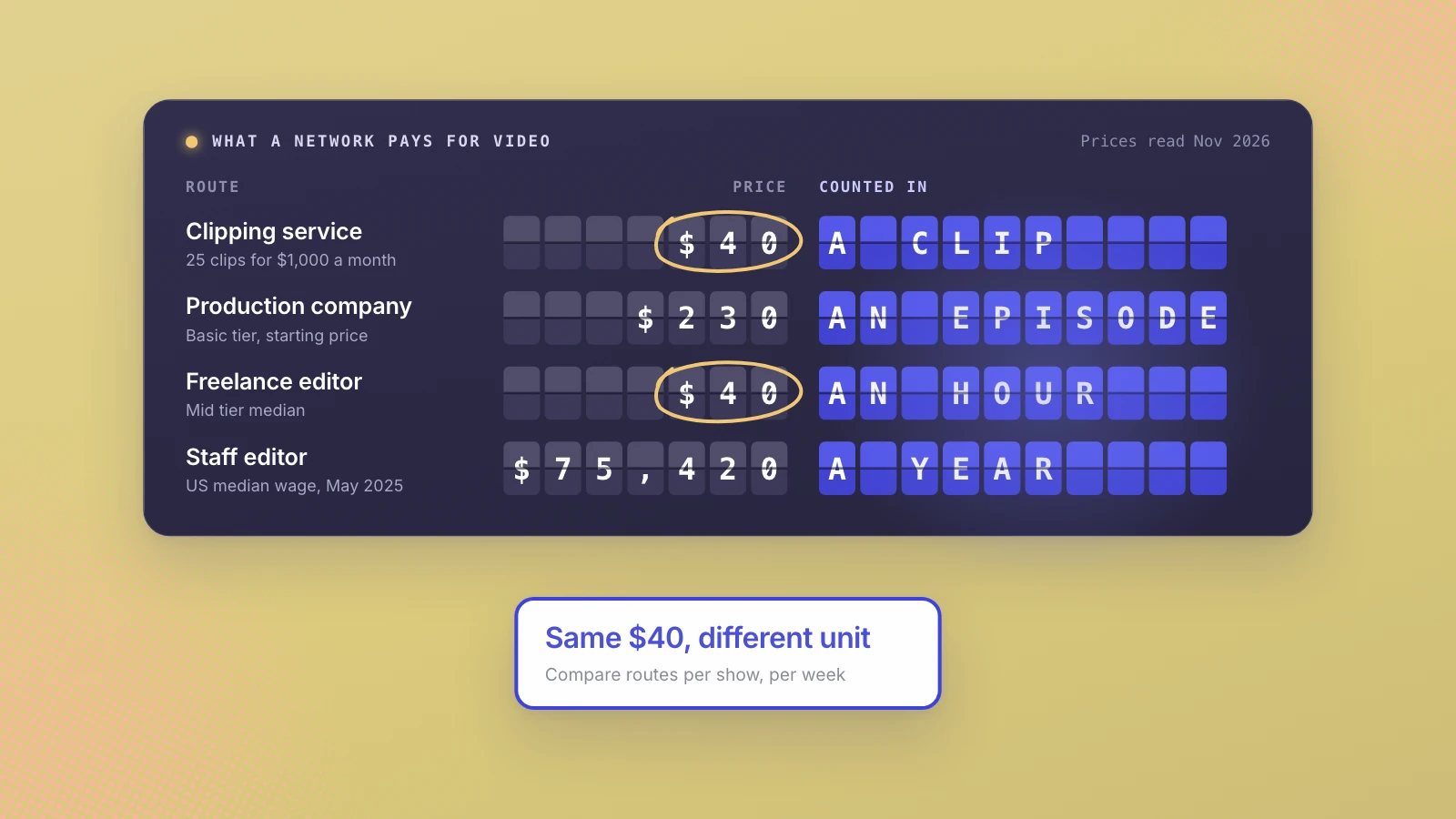
A network has four ways to pay for video: a clipping service priced per clip, a production company priced per episode, editors paid by the hour or on salary, and software that someone on staff runs. Most networks end up mixing them. What makes the bill hard to predict is that each route is priced in a different unit, so a quote of $40 a clip and a quote of $230 an episode can’t be compared until you know how many clips and episodes you need.
Below are the published numbers for each route, then the cost drivers that matter once you multiply by dozens of shows.
For a network, the unit price matters less than what the price is counted in.
What podcast clipping services charge
Clipping services sell a number of finished clips a month. Fame’s clip subscriptions, from the B2B agency Fame, are a clear example of the model:
| Fame plan | Price a month | Clips a month | Per clip |
|---|---|---|---|
| Business | $700 | 15 | $46 |
| Professional | $1,000 | 25 | $40 |
| Ultimate | $2,350 | 60 | $39 |
Each plan has a 72-hour turnaround. Fame describes the Business plan as suitable for one episode a week, and notes that subscriptions are month to month and “credits don’t rollover”. That last line matters for a network, where some shows publish weekly and others go quiet for a season.
What podcast production companies charge per episode
Production companies price the full episode and add clips on top or in a bundle. We Edit Podcasts lists video editing from $230 an episode on its Basic tier (72 hours) and from $550 on Premium (96 hours). Its monthly retainers show how clips get bundled:
| We Edit Podcasts retainer | Price a month | Episodes | Short clips |
|---|---|---|---|
| Essentials | $1,990 | Up to 4 | None listed |
| Growth | $3,800 | Up to 6 | 5 per episode, with multi-cam video |
| Revenue Partner | $7,500 | Unlimited | Not given as a number |
This route makes sense when the long-form episode needs editing anyway. If your shows already edit their own episodes, you are paying for work you don’t need.
What freelance and staff editors cost
Upwork publishes its own rate data for video editors. Its cost page says editors on the platform “typically cost $6 - $25 per hour”, and breaks the market into three tiers: entry level below $30 an hour (median $10), mid tier $31 to $60 (median $40) and senior $61 to $150 (median $100). Upwork notes that the data comes from historical contracts worldwide, so treat it as a range, not a quote.
For a staff editor in the US, the Bureau of Labor Statistics reports that “the median annual wage for film and video editors was $75,420 in May 2025.” That is about $6,285 a month before anything else (my arithmetic). Upwork’s page lists what comes on top for an employee: “salary, benefits, equipment, software, and other employment expenses.”
The hidden variable with people is throughput. An hourly rate tells you nothing until you know how many finished clips an editor turns out in an hour on your footage, and that depends on how long your episodes are and how many cameras they use. Ask any candidate to cut one real episode before you agree a rate.
What clip software costs
Self-serve tools are the cheapest line on the bill. Their entry paid plans run from $15 to $29 a month, and I compared three of them for multi-host shows, with their own prices and limits, in clip tools for multi-host podcasts.
The catch is that a subscription buys suggestions, not finished posts. Someone still reviews every clip, fixes the framing, keeps each show’s template current and posts. For one show that fits around other work. For a network, it is a job, which puts you back in the staff row.
Doing the maths for a network
Per-clip and per-episode prices are built for one show. Multiply them by a network and the numbers change character. If each of 60 shows bought Fame’s 15-clip plan at list price, the total would be $42,000 a month (my arithmetic, before any volume terms you might negotiate). That is not a criticism of the price; it is what happens when a single-show unit meets a network.
The archive is the other gap. Podtopia Network operates 67 podcasts and more than 18,000 episodes, as Newsweek reported. A per-clip plan covers new episodes; it has no line for searching a decade of old ones, which is often where a network’s best material sits (more on that in podcast clipping for a network).
The cost drivers that decide a network’s video bill
- Shows and channels. Each show adds accounts to post to, a look to maintain and an approver to chase.
- Episodes a week. Volume across the network, which is what per-clip and per-episode prices actually multiply.
- Hours in the back catalogue. A one-time cost to make old episodes searchable, then a small cost for each new one.
- Camera setup. Multi-camera recordings take more work to cut. We Edit Podcasts, for example, names multi-cam video as part of its higher Growth retainer.
- Review and posting time. The cost no price list shows: the hours your producers spend approving clips and uploading them to each show’s accounts.
How Leo prices video for a network
Leo prices on the drivers above rather than per clip. There is no public rate card; a quote follows channels connected, posts published, hours of video indexed and workspaces. The Enterprise plan covers multiple connected channels, higher indexing and publishing volume, a security review and onboarding support, which is where most networks fit. Leo for podcast networks explains the setup.
What that price covers: every episode indexed into short segments that are transcribed and embedded, so moments are found by meaning; clips trimmed, reframed to vertical, captioned with speaker tags and given a cover frame; and posts scheduled to connected accounts, with nothing posted when nothing fits. Instagram Reels is live, and YouTube Shorts is in beta for invited accounts.
The cheapest way to test any of these routes is one episode. Podtopia’s first was a two-camera, 22-minute interview that came back as six cuts in one batch (the case study). If you are pricing video across many shows, send one episode to Leo for podcast networks and put the result next to the per-clip quotes you already have.
Compare routes in the same unit: what each one costs for every show, every week, including the archive.
Sources
- Fame, Clips pricing and subscriptions
- We Edit Podcasts, Video podcast production
- Upwork, How much does hiring a video editor cost?
- U.S. Bureau of Labor Statistics, Film and video editors and camera operators
- Newsweek, AI agents are reshaping the business of marketing
Written by Lera Leonteva. Leo AI sells video clipping to podcast networks, so we have a commercial interest in this subject. Every outside price is from the seller’s own page or from a government source, read 8 November 2026.