
For a network, clipping stops being an editing job and becomes an operations job. Give each show its own look, make the back catalogue searchable by what was said, name one approver per show and approve in weekly batches, post to each show’s own channels, and price on shows, hours indexed and posts published rather than per clip.
One show with one editor is a solved problem. The editor watches the episode, marks the good minutes, cuts four or five clips, captions them and posts them. Double the shows and the editor gets busier. Go to sixty shows and that model stops working, not because editing gets harder, but because everything around the edit multiplies: finding the moments, keeping each show looking like itself, getting a yes from the right person, and posting to the right account.
At network scale, the bottleneck moves from cutting clips to running the system that decides which clips exist.
What changes when a network clips sixty shows instead of one?
Here is the same job at both sizes. Every row is something a single-show team handles in its head and a network has to write down.
| The job | One show | A network |
|---|---|---|
| Finding moments | The editor remembers the episode | Nobody has watched most of the hours |
| The look | One template | One template per show, kept apart |
| Old episodes | A few seasons, rarely touched | Thousands of episodes nobody searches |
| Approval | The host glances at it | A named approver per show, or the queue stalls |
| Posting | One account | Each show’s own accounts, on a schedule |
| What drives cost | Editor hours | Shows, hours indexed and posts published |
The rest of this guide takes those rows one at a time, in the order I’d fix them.
Give every show its own look
A network’s shows share a back office, not an audience. A true crime show and a business interview show should not arrive in the feed wearing the same caption font, colors and end card. When they do, viewers can’t tell them apart, and each show loses the recognition it’s trying to build.
There is a platform reason too. YouTube’s channel monetization policies were updated on 15 July 2025 to say plainly that the old “repetitious content” rule covers “content that is repetitive or mass-produced”, and the rule was renamed “inauthentic content”. YouTube says “channels where content feels interchangeable from video to video are not allowed to monetize.” The same page lists “same intro and outro for your videos, but the bulk of your content is different” as allowed. So a shared template is fine. What has to change from clip to clip is the substance: a different moment, a different idea, a different guest.
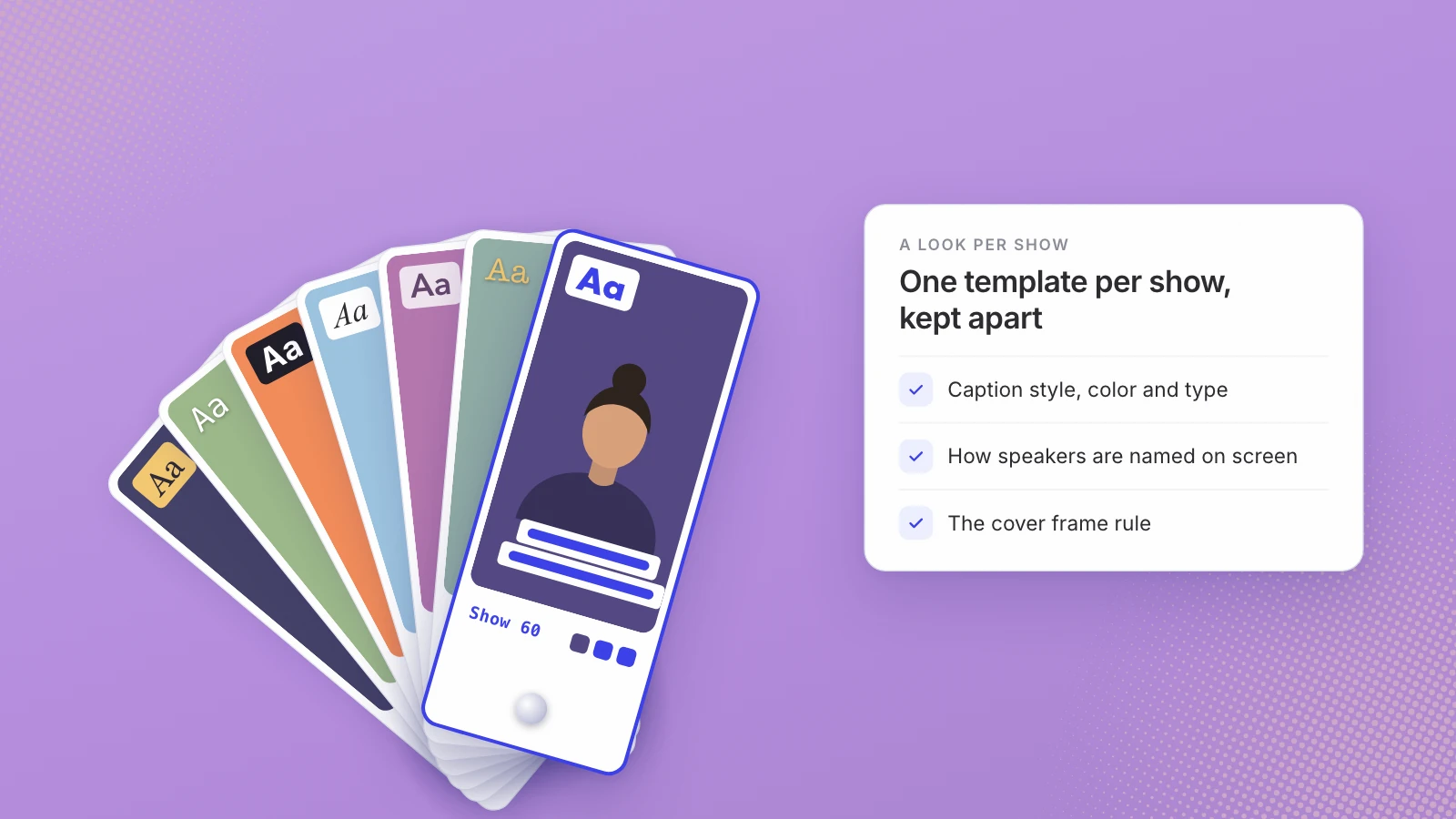
In practice, a look per show means three decisions written down for each one: caption style, color and type; how speakers are named on screen; and the cover frame rule. On Leo, the look comes from the reels you pin: pin a few clips a show already likes and Leo matches them. Leo runs many workspaces from one console, which is how its agency plan works, so each show can keep its own settings. That is the model Leo for podcast networks is built around.
Search the back catalogue by meaning, not by date
A single show’s archive is a few seasons. A network’s archive is the real asset. Podtopia Network, for example, operates 67 podcasts and more than 18,000 episodes, as Newsweek reported on 5 November 2026. No team re-watches that, so most of it is never clipped.
The fix is to make the archive searchable by what was said. Leo indexes footage by splitting it into short segments, then transcribing and embedding each one, so the right 60 to 90 second moment is found by meaning rather than by file name. A question in this week’s news can be answered by a guest from four years ago. On the Pro plan, Leo checks trends every hour and matches them against what is in the library.
Why bother with old episodes on video at all? Because the audience is there. YouTube announced in February 2025 that it has “more than 1 billion monthly active viewers of podcast content”, as of January 2025, and called itself “the most frequently used service for listening to podcasts in the U.S.”
Approvals that don’t stall sixty shows
Approvals are where network clipping quietly dies. A clip waits for a host who is traveling, the queue backs up, and the moment it was cut for passes. Three rules keep it moving:
- One named approver per show. Not a shared inbox. A producer or the host, written next to the show’s name, with a deputy for the weeks they are away.
- Approve in batches, not clip by clip. Send each show its week of clips at once, on the same day each week. Podtopia’s first interview came back as six cuts in one batch on 1 October, which is far easier to review than six separate messages.
- Agree what the approver is checking. Names spelled right, nothing a guest asked to keep off the record, nothing a sponsor would object to. Taste is settled once, in the show’s look, not argued clip by clip.
The other half of approval is what never reaches the approver. Leo has a hard rule that no match means no post: if nothing in a show’s library fits, nothing goes out, rather than a filler clip that someone then has to reject.
Where the clips go: each show’s channel or one network channel
I’d post each show’s clips to that show’s own accounts. A network-wide clip channel sounds efficient, but it mixes audiences that followed different hosts for different reasons, and it teaches nobody which show to subscribe to. YouTube’s reused content policy, on the same page, lists “content that primarily features the uploading creator in the video” among its allowed examples, which describes a show posting its own episodes’ moments to its own channel.
Length is less of a constraint than it was. YouTube says Shorts can be “up to 3 minutes long”, and Instagram’s head, Adam Mosseri, announced in January 2025 that Instagram now supports reels “up to three minutes long”. That doesn’t make three minutes the target. It means a story that needs 70 seconds no longer has to be chopped to fit.
On channels, be precise about what any vendor actually posts to. Leo publishes to Instagram Reels today, and YouTube Shorts is in beta for invited accounts. Accounts connect through each platform’s official sign-in, and posts go out on a schedule.
What drives the cost of clipping a network
Per-clip pricing makes sense for one show. For a network, it rewards the wrong thing: you pay the same whether a clip came from last night’s episode or from a search across ten years of archive. The cost drivers that actually move with a network’s size are:
- Shows and channels connected. Each show adds accounts to post to and a look to keep.
- Hours of video indexed. A decade of episodes is a bigger first job than a single season, then each new episode adds a little.
- Posts published. How many clips go out each week across all shows.
- Workspaces. How many separate teams, looks and approvers you run.
That is how Leo prices it. There is no public rate card; the quote follows channels connected, posts published, hours of video indexed and workspaces. The Enterprise plan adds multiple connected channels, higher indexing and publishing volume, a security review and onboarding support, which is usually where a network lands.
Start with one episode, then one show
Don’t start with sixty shows. Pick one episode from a show with a clear voice, and judge the cuts against what that show’s audience already likes. Podtopia started with a single two-camera, 22-minute interview. It became six cuts, delivered in one batch: four Shorts and Reels, one for LinkedIn and one long-form (the full case study). Every Leo clip is trimmed to the moment, reframed from sideways footage to vertical, and given burned-in captions, speaker tags and a cover frame.
“We got this great AI video clipping tool that just is better than what I want to build.”
Joe Massa, CEO, Podtopia Network
If the first episode works, add the rest of that show’s archive, then a second show with a different look, and only then the network. Each step tests one new thing. If your network runs more shows than it has editors, send one episode through Leo for podcast networks and judge the cuts before you think about the other fifty-nine.
One show needs an editor. Sixty shows need a system, and the system is mostly decisions you only have to make once.
Sources
- YouTube Official Blog, Celebrating 1 billion monthly podcast users on YouTube
- YouTube Help, YouTube channel monetization policies
- YouTube Help, Get started creating YouTube Shorts
- Adam Mosseri on Threads, Reels up to three minutes long
- Newsweek, AI agents are reshaping the business of marketing
Written by Lera Leonteva. Leo AI sells podcast clipping to networks, so we have a commercial interest in this subject. Platform rules are linked to their own pages, read 8 November 2026.