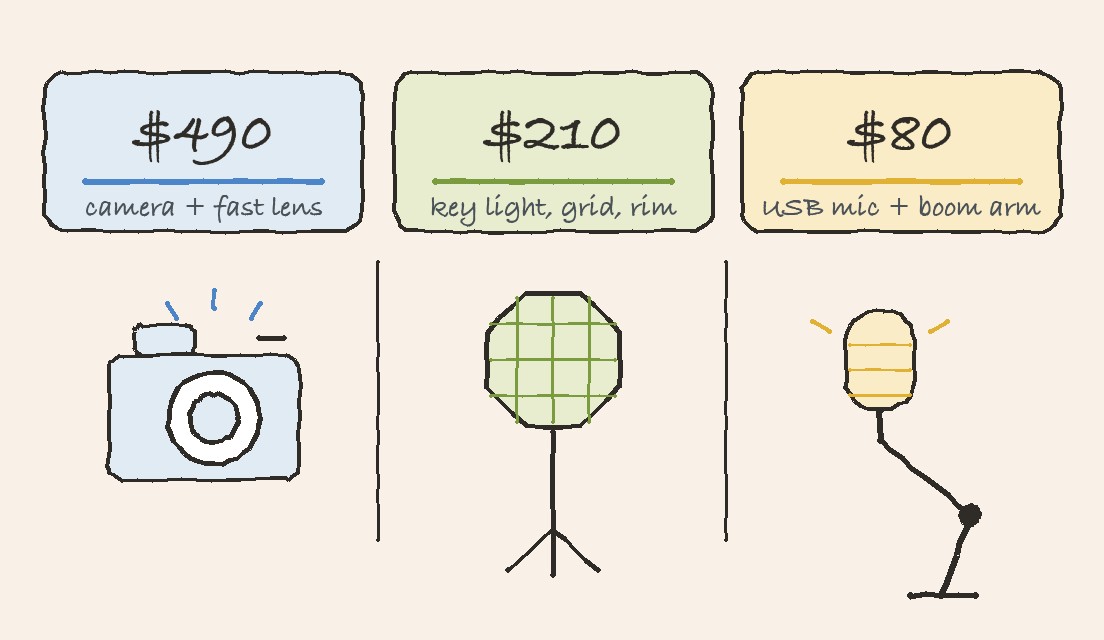
The studio podcast look comes from light, lens and mic placement, not an expensive camera. A used camera with a fast lens, a gridded key light and a dynamic mic close to the mouth get you there for well under $1,000 per person. No studio? Coworking operators rent meeting rooms by the hour with no membership, from about $30 an hour in New York.
Hi, I'm Lera. Every issue of Video Scaling Strategies uses what the market is actually doing to explain why some video earns attention and some doesn't.
It's the Light, Not the Camera
When a video podcast looks expensive, the first guess is the camera. It's usually the light. Take this episode of Founder Mode (a German-language podcast for founders) with Andre Retterath, a partner at the European venture capital firm Earlybird: a warm, dim set with a wood-slat wall and a lamp, a face lit softly from one side, the background melting into blur, a broadcast mic (the large microphone radio hosts talk into) close to the mouth.
None of that needs a cinema camera (the kind used to shoot films). It needs three things: light that stays on the speaker and off the wall, a fast prime lens (a lens with one fixed zoom and a wide opening that lets in lots of light), and dynamic mics (sturdy microphones that mostly pick up what is right in front of them) close to the mouth.
An expensive camera in bad light looks cheap. A used $400 camera in good light looks like a studio.
The Camera: Two Ways to Buy It
Prices are per camera angle. Any large-sensor mirrorless body (a camera with swappable lenses and a much bigger image sensor than a phone, sold without a lens) will do. The lens, not the body, gives you the blurred background. Look for a low f-number like f/1.4 (how wide the lens opens: lower means more light and more blur) and a focal length (how zoomed in the lens is, in mm) of around 30 to 35mm.
Cheapest: buy used · about $490 per camera
Body: Sony a6000, used ($415 to $520). Lens: TTArtisan 35mm f/1.4 or 7Artisans 35mm f/1.4, new ($69 to $73). Manual focus (you turn the focus ring by hand), so set it once and sit still. It stops every 29 minutes and warms up on long takes: restart at natural breaks and power it from the wall with a dummy battery (a battery-shaped adapter that plugs into a socket). A used Panasonic G7 ($300 to $340) is cheaper still; pair it with a 25mm lens for the same framing.
Easiest: buy new · $940 to $1,170 per camera
Body: Sony ZV-E10 ($748). Lens: Viltrox 33mm f/1.4 or Sigma 30mm f/1.4 ($191 to $419). Eye-tracking autofocus (the camera finds your eyes and keeps them sharp by itself) means no one has to stand behind it. Record in HD (standard 1080p video) with the overheat setting (Sony calls it Auto Power OFF Temp) on High for takes of up to about an hour. Canon’s EOS R50 is the alternative, at up to 59:59 per clip (one continuous recording).
Lighting: Where the Money Shows
This is the part that reads as expensive. The job is to light the face and keep the back wall dark, with a key light (the main light on your face), a softbox (a fabric cover that makes that light soft and even), a rim light (a small light behind you) and accent lights (small lights on the back wall for mood).
| What | Pick | Price |
|---|---|---|
| Key light | Godox SL60IID, Amaran 60x S or Neewer CB60B | $120 to $160 |
| Softbox | 35 in (90 cm) octabox (an eight-sided softbox) with a honeycomb grid (a fabric mesh that stops light spilling sideways) | $60 to $100 |
| Rim light | Small RGB LED (a light that can change color), like the Ulanzi VL49 | about $30 |
| Accents | LED light bar, or a warm lamp you already own | $0 to $50 |
The grid is the piece people skip. It stops the soft light spilling onto the wall, which is what lets the background fall into shadow. A rim light behind you draws a thin edge on your hair and shoulders so you don't melt into it.
Audio: Dynamic Mics, Close to the Mouth
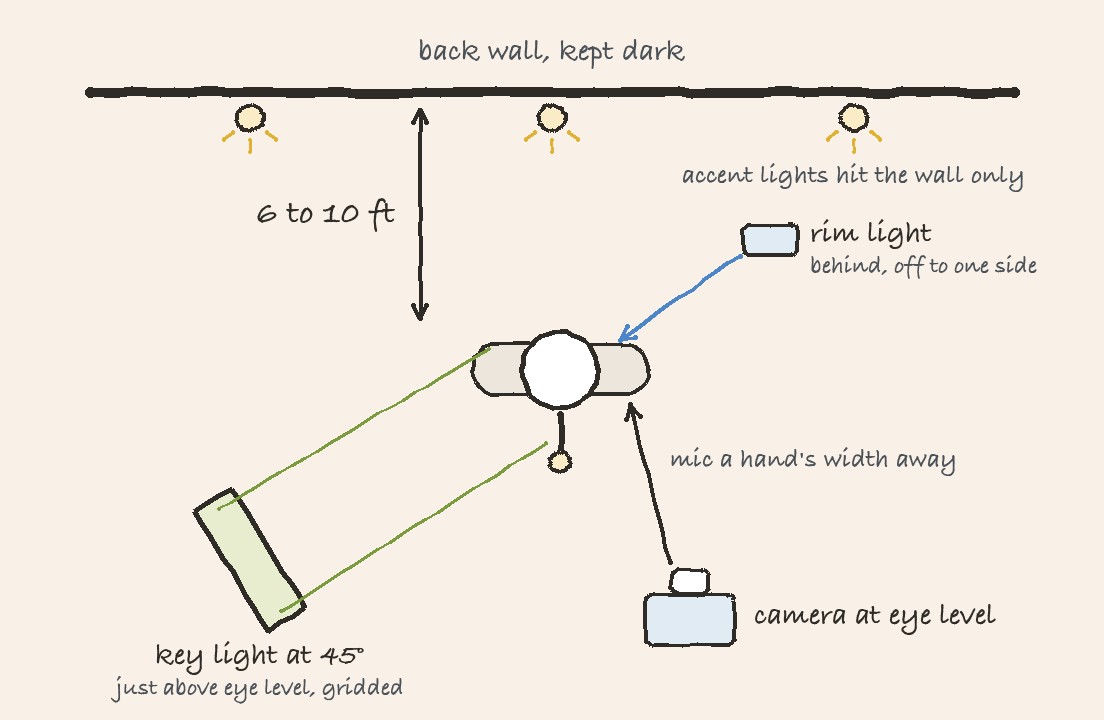
Studio podcasts sound warm and close because the mic is close. A dynamic mic a hand's width from the mouth hears the voice and very little of the room, which matters most when the room isn't yours.
Mics connect one of two ways: USB (straight into a laptop) or XLR (the three-pin cable professional audio gear uses). XLR needs an interface (a small box that turns the mic's signal into something your computer can record).
| What | Pick | Price |
|---|---|---|
| Microphone | Fifine K688 or Samson Q2U (USB and XLR), or Rode PodMic (XLR) | $55 to $100 |
| Interface | Focusrite Scarlett Solo for one XLR mic, Vocaster Two for two | $140 to $250 |
| Mounting | Desk boom arm (a jointed arm that clamps to the desk and holds the mic) | from $25 |
The K688 and Q2U plug straight into a laptop over USB, so a solo host can skip the interface. Add one, and move to XLR, when a guest joins.
Four Placement Rules
Sit 6 to 10 feet from the back wall
Distance is what blurs it. Against the wall, even a great lens can’t.
Put the key light 45° to one side
A little above eye level.
Keep every camera at eye level
Looking up or down at a speaker reads as amateur.
Shoot a neutral, flat picture profile
(the camera’s built-in color and contrast setting). Flat keeps detail in a dark set. Use log (an extra-flat profile that looks washed out until edited) only if you will color grade (adjust the colors in editing).
No Studio? Rent a Meeting Room by the Hour
You don't need a lease or a coworking membership to record somewhere that looks professional. Most operators rent meeting rooms by the hour to anyone:
| Where | How it works without a membership | New York price |
|---|---|---|
| WeWork On Demand | Book a room by the hour in the app and pay as you go | from $8 a seat per hour |
| Regus | Book meeting rooms online across 69 Manhattan locations | from $35 an hour |
| Deskpass | No membership, and it now lists the rooms of Breather (a meeting-room app it merged with in 2024) | from about $30 an hour |
| LiquidSpace | One free account for hourly rooms across coworking brands, podcast rooms included | from about $50 an hour |
| Peerspace | Rooms and fully kitted podcast studios from local hosts (people and businesses renting out their own space), usually a 2-hour minimum | $35 to $100 an hour |
Then Make the Episode Earn Its Keep
A well-shot 40-minute conversation holds far more than one post. Most teams publish the episode, cut one clip, and move on.
In Issue 4, a podcast editor explained why shows stall around episode 10. The ones that keep going treat every recording as a library of clips, not a single upload. See how Leo AI edits your video into scheduled social posts.
Written by Lera Leonteva. Prices are US street prices checked in September 2026 at B&H, MPB, Sweetwater, Focusrite, Sigma, Amaran, Neewer and Ulanzi; camera prices have moved with tariffs this year and used prices vary by condition. Recording limits from Sony’s help guides and recordinglimits.com. Room prices are New York rates from WeWork, Regus, Deskpass, LiquidSpace and Peerspace.