CPG branding is the name, look, story and packaging system that make shoppers pick your product over a cheaper one. Treated as an asset, it should keep paying back: in sales per store, in the price you can hold and in what a buyer would pay for the business. Measure it with velocity and shopper testing, not compliments.
I think CPG branding often gets bought like a logo: once, at launch, from whatever budget is left after the formula and the first production run. Then the brand adds a third flavor and a second retailer, and the packaging starts to look improvised. Treating branding as an asset changes the question from “what does a redesign cost?” to “what should it keep paying back?”
That is roughly the idea behind a session at Nosh Live on Thursday 3 December. Design as an Asset: Turning Branding Into Business Value is on the agenda from 11:25 to 11:50 a.m. Pacific with three people from Interact, which describes itself as “a branding and design agency that builds brands at the intersection of culture and creativity”: Dan Gladden, executive creative director; Avery Henderson, executive director of growth; and Blake Mitchell, principal. Nosh hasn’t published a description, so I don’t know what they will show. This is how I’d think about the question, and what I’d ask them.
What is branding in business, beyond a logo?
Branding is everything that tells a shopper the product is yours and why it is worth choosing; the logo is one part of it. The American Marketing Association defines a brand as “a name, term, design, symbol, or any other feature that identifies one seller’s goods or service as distinct from those of other sellers,” and notes that ISO brand standards call a brand “an intangible asset.”
There is a legal layer too. The U.S. Patent and Trademark Office says a trademark “can be any word, phrase, symbol, design, or a combination of these things that identifies your goods or services.” Using a mark gives you limited rights, it says, and registering it gives you stronger nationwide ones. For a food brand, the brand lives in four places:
- The name and the mark, checked and protected before you print 10,000 boxes.
- The front of the pack, which does most of the selling.
- The voice: how the brand writes on the side panel, the website and in posts.
- The system: the rules that make a new flavor look like family on day one.
How does packaging design sell on a crowded shelf?
By being found, understood and chosen in a few seconds, among more items than any shopper can read. FMI, the food industry trade association, puts the average supermarket at 33,248 items in 2025. A pack has to say what the product is and why it’s different before the shopper moves on.
Federal rules set part of the layout. The FDA’s labeling guide says the front panel, which it calls the principal display panel, must carry the statement of identity (the name of the food) and the net quantity, with the net quantity in the bottom 30 percent of that panel. It also says brand names should not be “unduly prominent” next to the statement of identity. The guide dates from 2013 and the rules sit in 21 CFR 101; this isn’t legal advice.
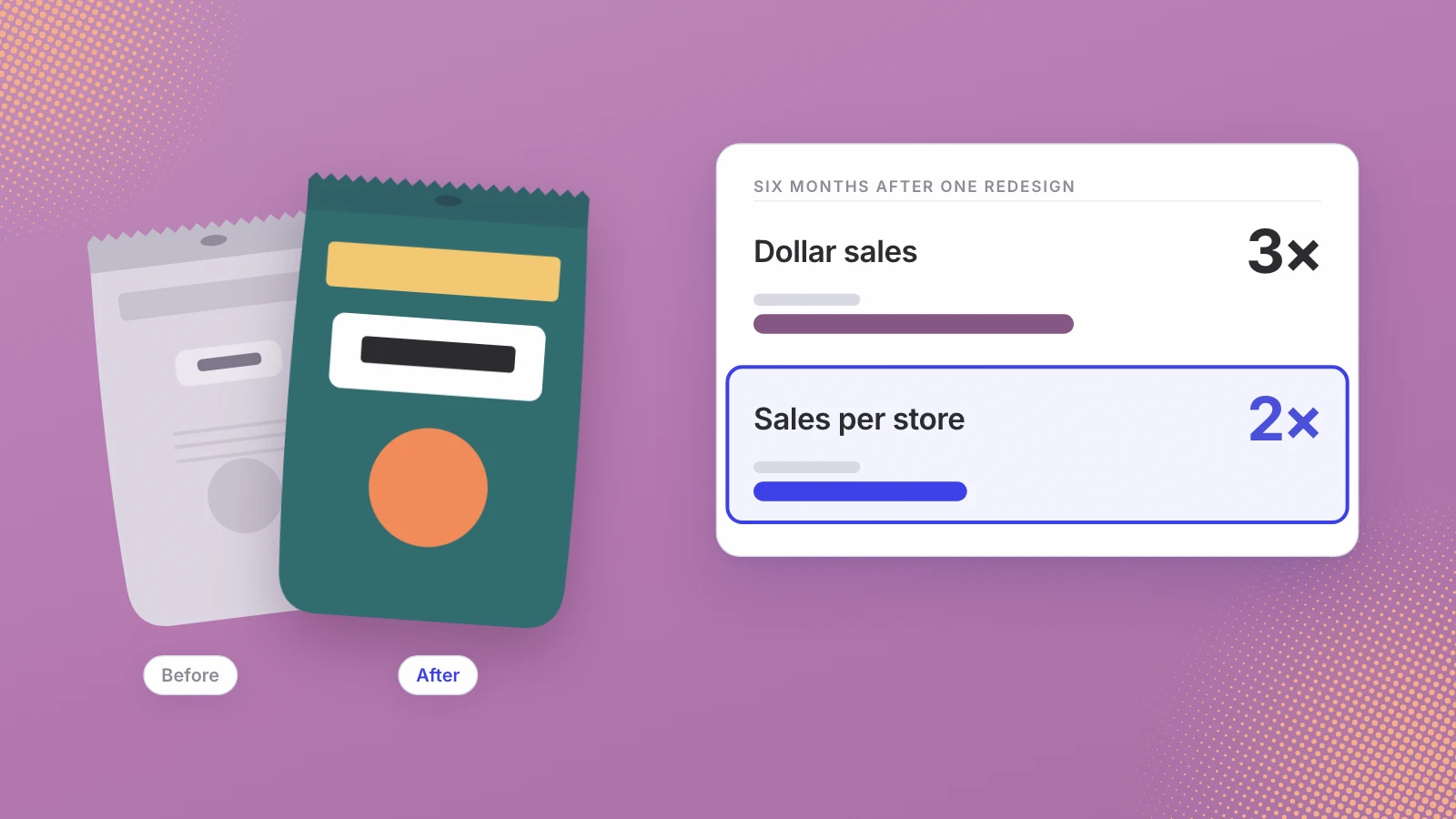
The best public evidence that design moves sales comes from Designalytics, which judges its awards on market sales and consumer testing. Its 2025 grand prize went to BUILT, the protein snack brand, and its agency, Interact. The redesign brought “a bolder logo, a modified hierarchy of communication, and enhanced flavor imagery,” and moved nutrition claims from the center to the top. Nearly two-thirds of shoppers in testing preferred it. In the six months after the redesign, dollar sales tripled and sales per point of distribution doubled against the same months a year before.
One winner isn’t proof that every redesign pays. Designalytics chose it from hundreds of redesigns it evaluated, and BUILT added Target, Kroger and other retailers after the redesign. But sales per point of distribution, which is sales per store that carries it, rose too, and that is the number that separates a better pack from more doors.
How do you build a brand system that survives new flavors, formats and retailers?
Decide what never changes and what each product may change, before the second product exists. BUILT is a good illustration: Interact says the work included “improved portfolio architecture” to tell the Puff and Bar lines apart, the design system was carried across the portfolio, and a side-panel line, “It’s not a bar, it’s a puff,” reset expectations. The steps I’d follow:
- Write the fixed rules. Logo position, layout grid, type and the one brand color that never moves.
- Choose what flexes. Flavor color, food photography or illustration, and claims.
- Test the third product early. Mock up flavors you haven’t made yet, a multipack and a club-size box before you sign off the first.
- Leave room for the front-of-pack rule. The FDA has proposed a Nutrition Info box on the front of most foods that carry a Nutrition Facts label, rating saturated fat, sodium and added sugars as Low, Med or High. It isn’t final: the FDA lists December 2026 as its goal for a final rule, and the proposal gives businesses under $10 million in annual food sales four years after it takes effect.
- Plan the barcode and the case. New sizes and multipacks bring barcode and case-pack decisions; our guide to UPC, EDI and chargebacks covers them.
How does strong branding show up in pricing power and valuation?
In the premium you can hold over a cheaper alternative, and in what a buyer would pay for the business. The cheaper alternative is strong. Store brands reached a record 21.3% of U.S. dollar sales in 2025, according to PLMA, using Circana data, and their sales grew almost three times as fast as national brands’. A brand that can’t explain its price on the shelf loses to the retailer’s own label. Our wholesale pricing guide works a shelf price back to what the brand keeps.
At the other end is the sale. When Unilever agreed to buy the men’s personal care brand Dr. Squatch in June 2025, its announcement credited “culturally-relevant collaborations with limited-edition packs” among the things that “helped to drive sales and grow a loyal consumer following.” Unilever didn’t disclose the price; the Financial Times put it at $1.5 billion, Reuters reported. Interact’s own 2025 review puts it this way: “We saw our redesign for Dr. Squatch exit to Unilever for over a billion dollars.” A redesign doesn’t make a valuation, but I think the pack is part of what a buyer pays for.
Across industries, McKinsey’s 2018 study of 300 listed companies found that the top quarter of design performers had 32 percentage points higher revenue growth than their industry peers over five years. It’s a correlation, from a consultancy, and eight years old. Its more useful finding is the other one: just over half of the companies had “no objective way to assess or set targets for the output of their design teams.”
How do you measure the return on design?
Pick the numbers before the new pack ships, and compare the same stores before and after. The five I’d track:
- Sales per point of distribution, so new doors don’t flatter the result. Our guide to sell-through and velocity has the formulas.
- Shopper preference and findability, old pack against new, tested before you print.
- Price realization: the average price you actually get after promotions.
- Repeat rate, wherever a retailer or a data service reports it.
- Cost per pack, including the plates and old stock you write off.
Give it six months, which is the window Designalytics used for BUILT.
Questions to bring to the Interact session at Nosh Live
Design as an Asset is a 25-minute main-stage session at the Marriott Marina del Rey, part of a program that Nosh says covers “everything from design and storytelling to category growth.” If I were in the audience, I’d want answers to these:
- Which numbers do you agree with a client, before launch, to judge a redesign?
- When is a refresh enough, and when does a brand need a rebrand?
- How should a brand under $10 million in sales budget for design?
- What breaks first when a range grows past three flavors?
- How are you designing front panels for the FDA’s proposed Nutrition Info box?
The agenda says all times are subject to change; check it the week before.
Where Leo fits
I run Leo, so weigh this section accordingly. We don’t design packaging, and Leo can’t make a weak pack sell. But I think a pack now has to work in a phone as well as on a shelf, because more shoppers meet it first in a video, and that part is ours.
Leo for consumer brands turns footage you already own, such as product demos, founder talks and in-store tastings, into captioned vertical clips, and it matches the look of the reels you pin, so a new design system carries through to your feed. In creator campaigns, its portal checks each submitted video for a call to action and the brand named, among other things, before you review it.
If you’re about to spend on a redesign, write down the three numbers you’ll judge it by first. Then tell us who buys from you and we’ll show you the creators they follow, the people who will hold your new pack up to a camera. If a famous founder is part of the plan, our post on celebrity brand building covers what fame does and doesn’t buy.
Sources
- Nosh, Nosh Live 2026 agenda
- Nosh, Nosh Live 2026 agenda: two days in LA
- Interact, Interact Brands
- Interact, Built: case study
- Interact, 2025 year end reflection
- Designalytics, Designalytics Effectiveness Awards 2025: BUILT claims grand prize (May 2025)
- Designalytics, “Purse candy” powerhouse: BUILT’s redesign (Dec 2025)
- Designalytics, Special report: seven brands that prove the business value of design (Dec 2025)
- American Marketing Association, Definitions of marketing and brand
- U.S. Patent and Trademark Office, What is a trademark?
- FMI, Food industry facts
- U.S. Food and Drug Administration, A food labeling guide (January 2013)
- Federal Register, Food labeling: front-of-package nutrition information, proposed rule (Jan 2025)
- U.S. Food and Drug Administration, Foods program regulations under development
- PLMA, Store brand facts
- McKinsey & Company, The business value of design (Oct 2018)
- Unilever, Unilever to acquire men’s personal care brand Dr. Squatch (Jun 2025)
- Reuters, Unilever to pay $1.5 billion for men’s grooming brand Dr Squatch, FT reports (Jun 2025)
Written by Lera Leonteva. Leo AI makes social video and runs creator campaigns for consumer brands, so we have a commercial interest in the marketing part of this guide. Event, company and regulatory facts are from their own pages and named reporting, read November 2026.