
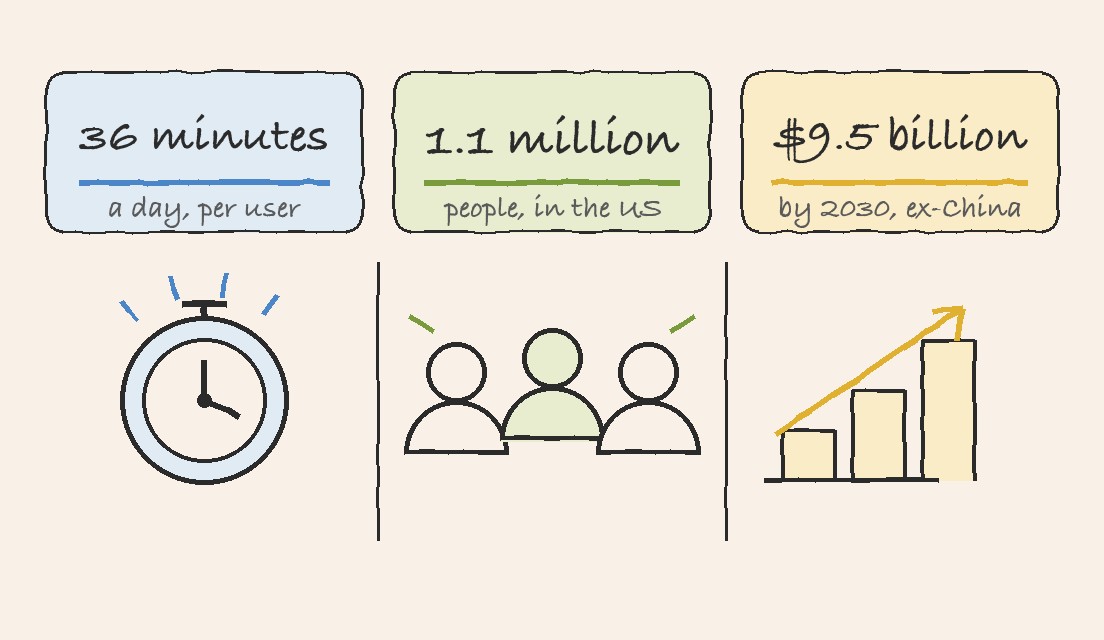
Vertical soap operas sold by the unlock: about $3 billion outside China last year, forecast at $9.5 billion by 2030. US viewers spend longer per day in ReelShort than in Netflix on mobile — but there are 1.1 million of them against Netflix's 12 million. Deep, not wide. For most brands the opportunity is the format, not the app.
Hi, I'm Lera. Every issue of Video Scaling Strategies uses what the market is actually doing to explain why some video earns attention and some doesn't.
Where the Consumer Actually Is
A micro drama is a scripted vertical series. Episodes run 60 to 120 seconds, a season runs 70 or more, and the stories are blunt on purpose: secret billionaires, revenge arcs, werewolf husbands. The first few are free. Then the app wants coins, an ad, or about $20 a week.
The engagement number is what stops people. Omdia put US ReelShort users at 35.7 minutes a day — ahead of Netflix, Prime Video and Disney+ on mobile.
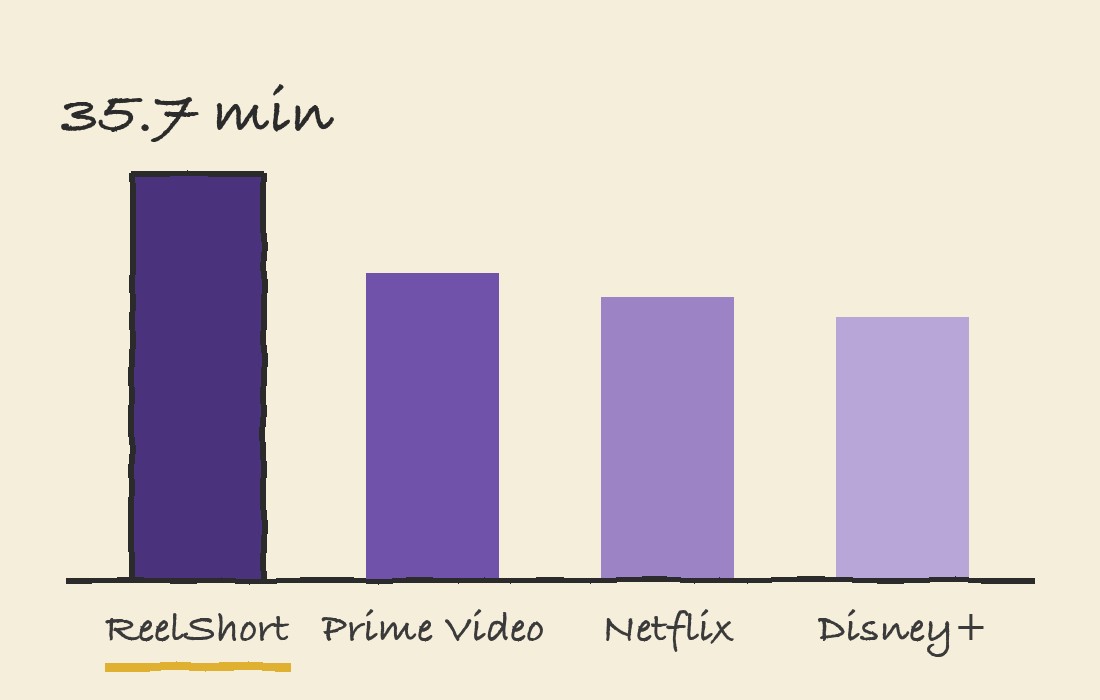
Then the number nobody quotes beside it. Netflix has about 12 million monthly active mobile users in the US. ReelShort has 1.1 million. Eleven times fewer people, each watching 40% longer — which is why the same market gets called a gold rush and a bubble in the same week.
Who they are is contested. Media Partners Asia says affluent urban women, 30 to 60. Ampere says 46% are 18 to 34. Both are probably right: the people paying inside the apps aren't the people meeting the format in a feed.
Depth is not reach
Time per user is the strongest signal here. Total audience is the weakest.
Two different audiences
Payers inside the apps and viewers in a feed are not the same group.
How Big the Opportunity Really Is
The headline figures move depending on who is counting.
| Market | 2024 | 2025 | 2030 |
|---|---|---|---|
| Global | — | $11B | $20B+ |
| China | $7B | $9.4B | $16.2B |
| Outside China | $1.4B | ~$3B | $9.5B |
| United States | $819M | ~$1.5B | $3.8B |
China is 83% of it, and its micro-drama revenue passed the country's own box office in 2025. The column that matters here is the third: $1.4 billion to $9.5 billion by 2030.
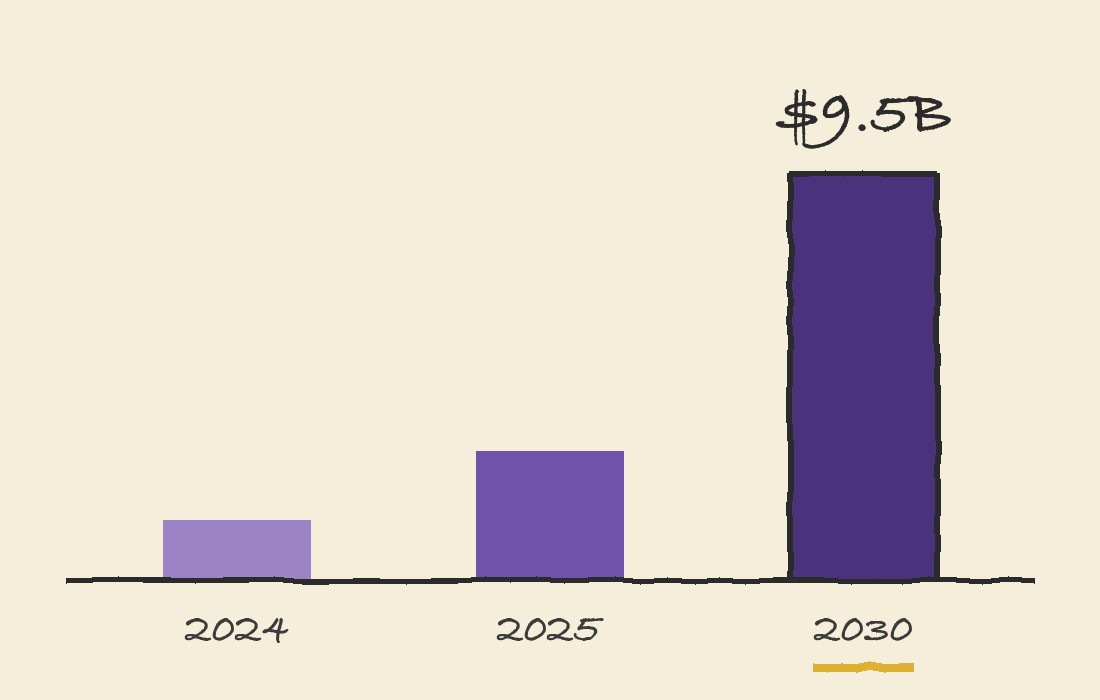
Sensor Tower measured $2.98 billion in short-drama in-app purchases across 2025, up 115%. North American revenue per download runs about $4.70 against a global $2.00.
The line that matters most for a marketing budget: by 2030, advertising is forecast at 25% of non-China revenue, up from almost nothing.
Why It Worked Where Quibi Didn't
Quibi raised $1.75 billion, hired Spielberg and del Toro, and closed six months later. The comparison gets made constantly, usually as a warning, and usually wrong.
Quibi made television and cut it into pieces. Micro dramas are built like mobile games: adapted from web novels that already proved they convert, shot in eight to ten days for $100,000 to $300,000 a season, then re-cut on performance data. ReelShort is making 400 originals this year. At that budget, a miss costs what one commercial costs.
The other difference is the checkout. The first 7 to 12 episodes are free, then it's 20 to 50 cents each. The paywall lands on a cliffhanger instead of a homepage.
The Brands Already Inside the Format
What has actually shipped:
| Brand | What they made | Result |
|---|---|---|
| Crocs | “Charmed to Meet You” on ReelShort, built around Jibbitz charms | Close to 10M views, and a sequel |
| Crocs | “Déjà Shoe”, seven shoppable episodes on TikTok Shop | Made in under four weeks |
| JCPenney | Five-part micronovela with TelevisaUnivision | 16M impressions, 5.6M video views |
| P&G | “The Golden Pear Affair” for Native, 50 parts | Plus a second series on Albertsons' platforms |
| Issa Rae | “Screen Time” with TikTok and PineDrama, 57 episodes | 150M+ views, sponsored by General Mills |
Maybelline, Marc Jacobs, Dr Pepper and Nuuly have commissioned series too, and TikTok now sells brands a tool for building their own.
The pattern in the ones that work: the product sits inside the story rather than getting demonstrated at the audience. Maybelline's concealer never gets a beauty shot, it's just there in a meet-cute. The failure mode is a normal ad, stretched to eight parts.
The Case Against
Downloads grew 95.5% to 1.45 billion and the user base is near 800 million monthly actives — but the growth is coming from Tier-2 and Tier-3 markets while the US stays small and flat. More users, each worth less. Naavik calls it the volume versus value paradox.
Retention is poor, so the apps buy their audience back every quarter: 68% of US micro-drama ad spend went to social in the first nine months of 2025. On the brand side, the critique is sharper.
If I look at what brands are doing in microdramas right now, it really feels like they're renting the format. Doesn't feel like there's any real plan there.
Matt O'Rourke · Chief Creative Officer, Via
The word people keep using is bubble. Both can be true: a format can matter and still be over-invested in for two years.
What to Take From It
Almost nobody reading this should launch one. It's a user acquisition business with a content department attached, and the category is consolidating around a handful of winners. The transferable part is how the things get made.
The unit is the episode
A season is 70 separate attempts at holding someone, not one asset with a media plan.
The catalogue is a database
They index what they own by topic, so the clip that matches this week is already findable.
The third habit is the one teams skip: publishing is the start of the edit, not the end. Studios hold budget back to re-cut on where people drop off.
None of that needs a vertical soap opera. It needs knowing what your audience already watches, and being able to cut against it fast enough to matter. See how Leo AI edits your video into scheduled social posts.
Written by Lera Leonteva. Sources: Omdia (Feb 2026, using Sensor Tower data); Media Partners Asia, “The Micro-Drama Economy”; Sensor Tower, State of Mobile 2026; Naavik; Digiday; Marketing Dive; Appfigures; Ampere Analysis. Figures vary by methodology.