In a decision dated 4 June 2026 the Oversight Board upheld Meta's decision to permanently disable a widely followed Instagram account over credible threats of violence, while finding serious due process problems. It said accessible, consistent and comprehensive information about Meta's approach must be ensured, that delays undermined due process, and that there are no intermediate options between permanent disablement and the strikes system.
Hi, I’m Lera. Every issue of Video Scaling Strategies uses what the market is actually doing to explain why some video earns attention and some doesn’t.
For the first time, Meta’s Oversight Board took a case about permanently disabling an account. It agreed with the decision, and then said the process around it does not meet the standard.
The case itself is not ambiguous and it is not a story about false positives. A widely followed Instagram account was permanently disabled after a pattern of violations including credible threats of violence against a journalist. The Board upheld that. Meta was right.
What makes the Oversight Board’s decision of 4 June 2026 worth your time is everything the Board said next, because it applies to every account rather than to that one.
The findings that apply to you
“Accessible, consistent and comprehensive information about Meta’s approaches must be ensured.”
On how Meta explains account disabling. the Oversight Board’s decision of 4 June 2026, 4 June 2026
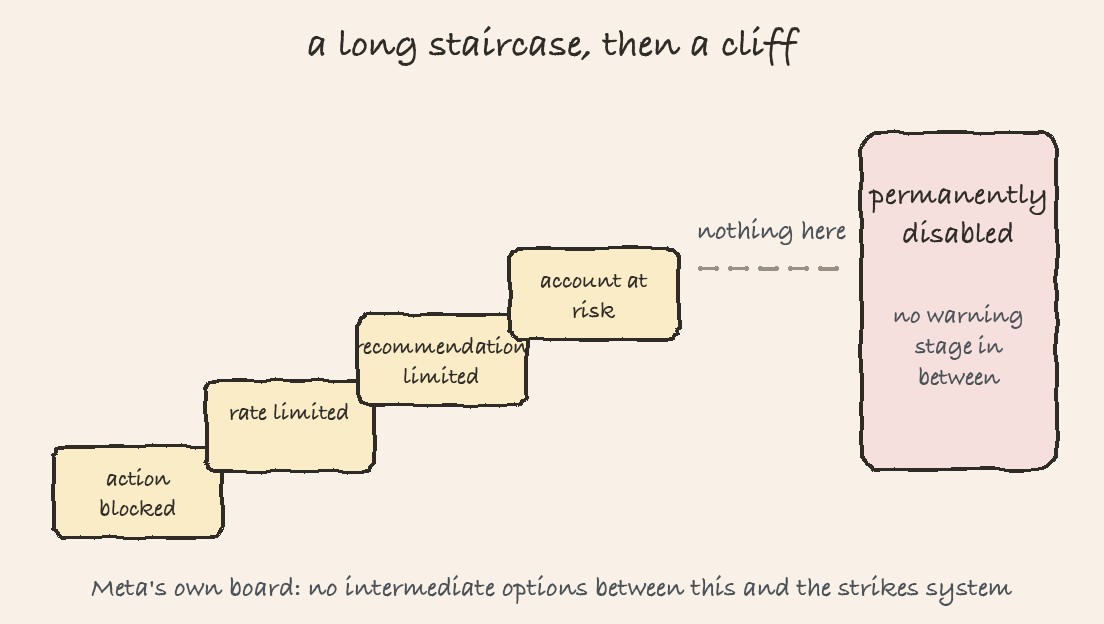
“No intermediate options between permanent disablement and leaving the strikes system.”
On the absence of anything short of permanent. the Oversight Board’s decision of 4 June 2026, 4 June 2026
Set that second one against how enforcement actually escalates. There is a long list of temporary limits, and then there is a cliff. Meta’s own review body noticed that there is very little in between, and said so.
The Board also found that delays in resolving the case undermined due process for the account holder, and that the two clear and credible threats were not reviewed swiftly when posted. Both sides of the system were slow, in other words, and the Board was willing to say it in a decision that went Meta’s way.
The five principles it set out
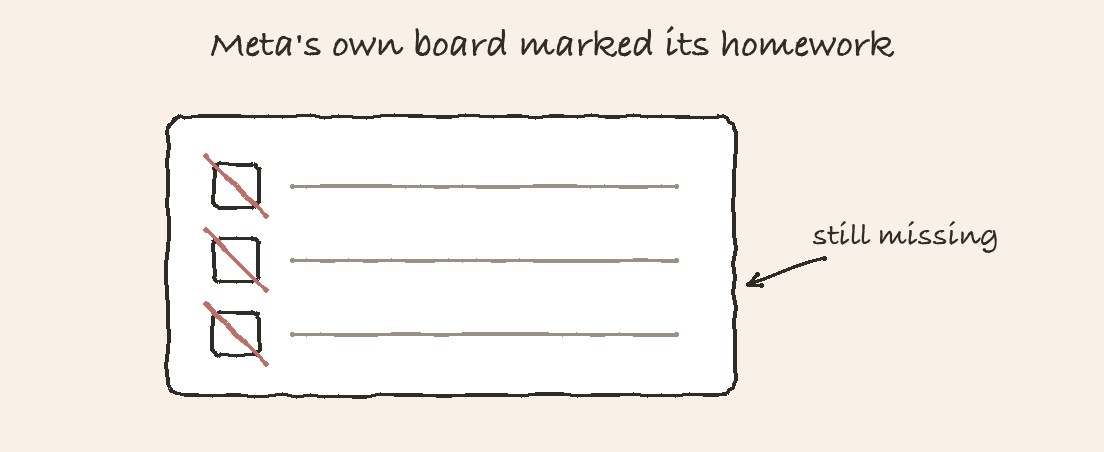
- People should have clear guidance on the rules for permanent account disablement.
- They should get detailed reasons, appeal options, and disclosure of government requests.
- Companies should coordinate on accounts threatening serious violence.
- Appeals should be effective and fair, with written responses and human review in edge cases.
- There should be detailed transparency reporting on account disablement enforcement.
Look at the second and fourth. “Detailed reasons” and “human review in edge cases” are being recommended, which means they are not reliably happening now. That is the single most useful fact a business can have about this system, and it comes from the body Meta itself created.
What to take into next year
Not cynicism. A planning assumption, which is different. The assumption is that enforcement is largely automated, that the explanation you get may be thin, that review may be slow, and that there is not much between a warning and the end.
Everything in this run follows from that assumption. Remove the risks you control, because they are free to remove. Then make the remaining risk survivable, because it is not going away.
Next week: the thirty day window that quietly decides whether your account is recommended to anyone new.
Frequently asked questions
What did the Oversight Board decide about account bans?
It upheld the permanent disablement in the case before it, and separately found due process concerns in how Meta disables accounts generally.
Does Meta have to follow the Oversight Board?
Its decisions on individual cases are binding. Its broader policy recommendations are not.
What did the Board recommend Meta change?
Clear guidance on permanent disablement, detailed reasons and appeal options, coordination on serious threats, effective appeals with human review in edge cases, and transparency reporting on enforcement.